

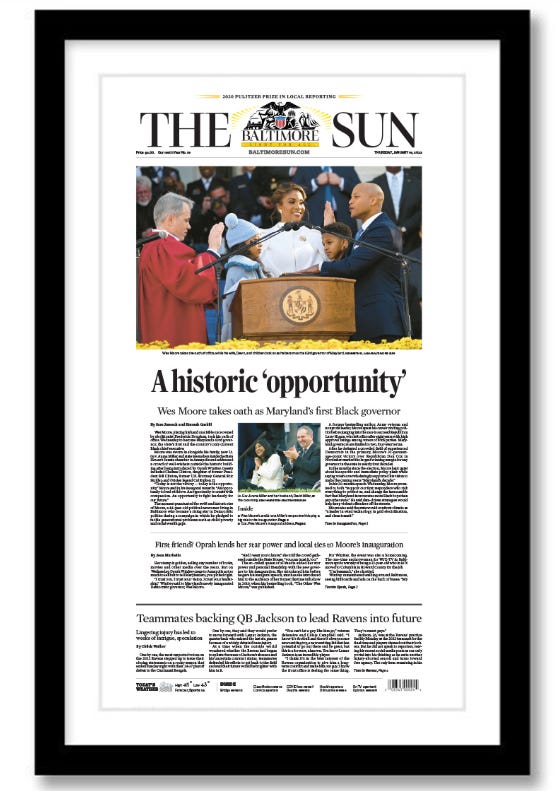
The Baltimore Sun’s Hybrid Era
Journalism, Propaganda, and the Smith Problem
A Maryland Wire Deep‑Dive
For most of my life, The Baltimore Sun has been the institutional backbone of Maryland journalism. Even today, the bulk of its work still looks like the legacy paper we grew up with: sourced, edited, fact‑checked, and recognizably professional. Eighty to ninety percent of the Sun’s output still fits the mold of a traditional metro newsroom doing its job.
But the remaining slice — that 10 to 20 percent — has become impossible to ignore.
Because in that slice, the Sun stops behaving like a newspaper and starts behaving like something else entirely: a political instrument, a messaging vehicle, and at times a propaganda outlet for its owner, David Smith. This isn’t about sloppy reporting or ideological drift. It’s a structural shift. The Sun has entered a hybrid era, where legitimate journalism and owner‑driven political content coexist under the same masthead.
And readers can feel the difference.
The Dual Identity: Legacy Newspaper Meets Political Machine
The Sun’s newsroom still contains talented reporters who do serious work. But the paper no longer exists in isolation. It now sits inside a larger media apparatus built by Smith — one that blends traditional reporting with a coordinated political messaging system.
That system includes:
- WBFF Fox45, Sinclair’s flagship station, long known for crime‑heavy coverage and relentless criticism of Baltimore’s Democratic leadership.
- The Baltimore Sun, purchased personally by Smith, giving him direct influence over the region’s largest newspaper.
- Spotlight on Maryland, a joint investigative unit staffed largely by Sinclair‑aligned reporters, functioning as a bridge between Fox45’s editorial framing and the Sun’s print infrastructure.
This is not a normal media ecosystem. It is a vertically integrated messaging machine capable of pushing narratives across broadcast, digital, and print simultaneously. And Smith has openly stated his intention to use his media holdings for political purposes.
That matters. It shapes coverage. It shapes tone. It shapes what gets elevated and what gets ignored.
When Journalism and Propaganda Share a Newsroom
Most Sun stories still look like the paper’s traditional work. But then you hit the outliers — the pieces that read like Fox45 segments rewritten for print, the stories that feel engineered rather than discovered, the investigations that seem less like watchdog journalism and more like political targeting.
This is where the hybrid model reveals itself.
It’s not that the facts are fabricated. It’s that the facts are arranged, framed, and weaponized. Media scholars call this structural bias created by ownership influence. It’s subtle, but once you see it, you can’t unsee it.
And once you can’t unsee it, you stop trusting the paper.
What Media Scholarship Says About Owner Influence
The academic literature is clear.
Columbia Journalism Review has documented Sinclair’s use of must‑run segments, centralized editorial directives, and top‑down political messaging. These practices shape framing even when the underlying facts are accurate.
Pew Research Center shows that strong owner control correlates with partisan framing — and readers detect the shift immediately.
Nieman Lab has written extensively about ideological owners taking over legacy newspapers. The pattern is consistent: straight news and propaganda begin to coexist, readers struggle to distinguish the two, and subscription decline accelerates.
The Sun fits the model perfectly.
Spotlight on Maryland: The Hybrid System in Action
Spotlight on Maryland is the clearest example of the hybrid era.
On paper, it’s an investigative unit focused on accountability journalism. In practice, it is:
- Staffed by reporters aligned with Sinclair’s editorial culture
- Branded as a partnership between Fox45 and the Sun
- A mechanism for injecting Sinclair‑style framing into the Sun’s pages
Some Spotlight stories are legitimate investigations. Others read like Fox45’s political targeting dressed up as newspaper reporting. The issue isn’t the existence of investigations — it’s the selective asymmetry. Who gets targeted. How often. And why.
Readers notice patterns.
Patterns create distrust.
Distrust creates churn.
The Moore Coverage: Where the Hybrid Model Breaks
My own breaking point — the moment I canceled my subscription — was the Sun’s coverage of Governor Moore.
The stories didn’t read like journalism. They read like assignments. They read like narratives built first and sourced second. They read like political messaging wearing the clothes of newspaper reporting.
This isn’t about defending Moore. It’s about defending fairness.
When a newspaper becomes a vehicle for an owner’s political grievances, fairness becomes impossible. And once fairness collapses, trust collapses with it.
The Decline: What the Numbers Show
The Sun has been bleeding readers for more than a decade. That decline predates Smith and mirrors national trends. But the question is whether Smith’s ownership stabilized or reversed the slide.
Industry reporting says no.
There is:
- No evidence of a subscription increase after Smith’s acquisition
- No evidence that Spotlight on Maryland brought new readers
- Some evidence of continued decline consistent with hybrid‑model erosion of trust
Readers who want traditional journalism do not trust Sinclair.
Readers who trust Sinclair do not subscribe to the Sun.
The hybrid model satisfies neither audience.
The Central Question: Can Fairness Survive Owner‑Driven News?
This is the core issue.
Can a newspaper remain credible when:
- 80–90% of its content is legitimate journalism
- 10–20% is owner‑driven propaganda disguised as news
The research says no.
Hybrid systems create:
- Structural bias
- Reader confusion
- Erosion of trust
- Subscription decline
A newspaper cannot be both a watchdog and a weapon. Not without losing its audience.
The Maryland Wire Thesis
Here is the argument, plainly:
The Baltimore Sun still produces real journalism. But under David Smith’s ownership, it has become a hybrid media system — part newspaper, part political instrument — where owner‑driven messaging is sometimes disguised as news. That hybrid model erodes trust, alienates readers, and raises serious questions about whether fairness can survive when the owner is effectively writing part of the news agenda.
This is the story.
And it’s one Maryland Wire is uniquely positioned to tell.
Spot on Barry...the Sun is better used to wrap fish.
I love the Maryland Wire.