

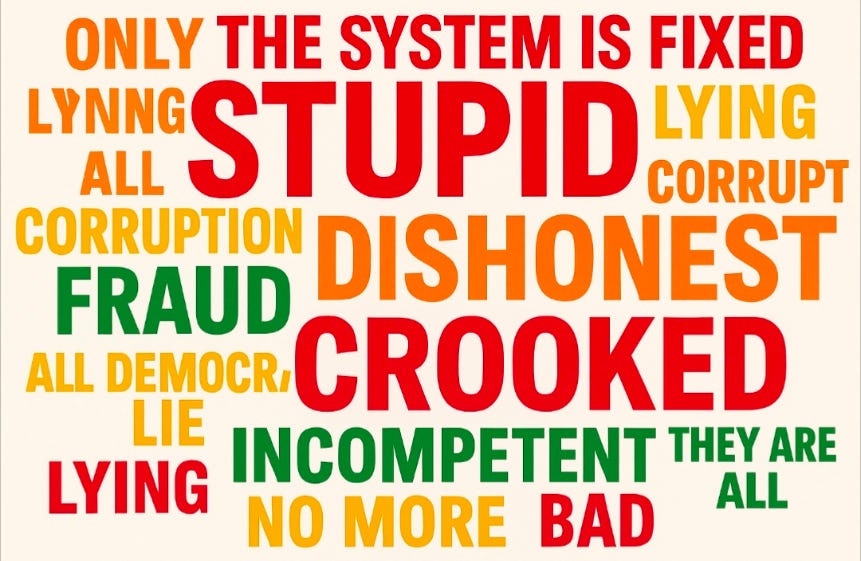
THE ANGER WITHOUT A NAME
Why Some Marylanders Lash Out at Wes Moore — And Why They Don’t Realize What’s Driving Them
By Barry O’Connell
Maryland Wire Magazine Edition
There’s a strange kind of fury that shows up in political comment sections these days — a fury without a subject, a rage without a reason. You’ve seen it. You post a story about Governor Wes Moore, and within minutes the thread fills with accusations that feel pre‑loaded: stupid, corrupt, dishonest, incompetent. Ask for specifics and the room goes quiet. Ask for evidence and the conversation collapses into memes.
It’s not debate. It’s not even disagreement.
It’s something more primal — and more revealing.
Across Maryland, especially in online spaces where people feel unobserved and unaccountable, a certain kind of commenter is reacting not to policy, but to a feeling. A feeling that their world is slipping out of their hands. A feeling that the rules changed without their consent. A feeling that the future is being written by people who don’t look like them, don’t sound like them, and don’t ask their permission.
They’re not arguing with Wes Moore.
They’re arguing with their own loss of control.
The Politics of Powerlessness
For many of these commenters — often white, often older, often politically displaced — the last decade has been a slow erosion of certainty. Jobs changed. Neighborhoods changed. Culture changed. The political map changed. And the institutions they once trusted no longer feel like they’re on their side.
Status Threat
Political scientists call this status threat — the sense that one’s group is losing ground in society. It’s not always conscious. It’s not always malicious. But it is powerful.
When people feel powerless, they look for someone to blame.
And they look for someone they feel safe blaming.
Why Black Leaders Become Lightning Rods
In American political life, Black executives — governors, mayors, prosecutors, school superintendents — often become the symbolic targets of this displaced frustration. Not because of anything they’ve done, but because of what they represent.
A Black governor in a majority‑white state disrupts old expectations about who holds authority. For some people, that disruption feels like a personal loss, even if they can’t articulate why.
So the mind reaches for the oldest, easiest scripts:
- He’s not qualified.
- He’s corrupt.
- He only won because of something shady.
- He’s not one of us.
These aren’t policy critiques.
They’re identity reactions.
And they’re often delivered by people who would never describe themselves as prejudiced. In their minds, they’re simply “telling it like it is.” They don’t realize they’re repeating narratives older than they are.
The Nationalization of Local Anger
Another piece of the puzzle: the attacks on Moore rarely mention Maryland at all. They don’t cite budgets, contracts, or legislation. Instead, they echo national talking points — the same language used against any Democrat, any Black leader, any figure who symbolizes “the other side.”
Local politics has been swallowed by national grievance.
To these commenters, Moore isn’t a governor.
Wes is a stand‑in for every cultural frustration they’ve absorbed from cable news, talk radio, and meme pages.
That’s why the accusations are so vague.
They’re not responding to Maryland.
They’re responding to America.
The Emotional Economy of Online Spaces
Online, anger spreads faster than facts. Outrage is contagious. And when people feel unheard in their real lives, they often seek validation in digital spaces where the loudest voice wins.
In that environment:
- Certainty replaces curiosity
- Insults replace arguments
- Identity replaces evidence
And the comment section becomes a pressure valve for people who feel they’ve lost control of their own story.
Why They Don’t Know Why They’re Angry
Here’s the part my readers will find most surprising:
Most of these commenters genuinely don’t understand the roots of their own reactions.
They’re not sitting at home thinking, I’m going to attack a Black governor today.
They’re thinking, Something is wrong and I don’t know how to fix it.
The human mind hates uncertainty.
So it grabs the nearest explanation.
And in a country with a long history of racialized narratives about competence, trustworthiness, and leadership, Black public figures become the easiest — and safest — targets for displaced anger.
It’s not right.
It’s not fair.
But it is real.
---
Maryland’s Challenge — And Opportunity
Maryland is a state of extraordinary diversity, but also extraordinary divides. The comment threads you see aren’t just noise; they’re signals. They tell us where people are hurting, where they feel left behind, and where the political conversation has broken down.
Understanding the anger doesn’t excuse it.
But it does help us navigate it.
Because the truth is this:
People who feel powerless will always lash out at the symbols of the world they think is leaving them behind.
And in this moment, Wes Moore — young, Black, confident, successful — represents a future some people fear they won’t have a place in.
The Work Ahead
For Maryland to move forward, we have to do two things at once:
- Hold people accountable for harmful rhetoric
- And understand the emotional landscape that produces it
Not to excuse it.
But to defuse it.
Because anger without a name is dangerous.
But anger understood is anger that can be redirected.
And maybe — just maybe — that’s the work of this moment.
I question the willingness of the rage-a-holic class to absorb this rhetoric or recognize themselves in it.
It’s far too easy to stay firmly rooted in confirmation bias and maintain a position, no matter how irrational. People are inherently intellectually lazy and are not willing to examine themselves, conduct research, or do the work required that might lead to change if necessary.
Unfortunately, they become what they blame or contribute to the position they say they are unhappy with and can’t even recognize the circular logic.
There is I’m afraid no help for them. They are best ignored. Time marches on and they will be left out and left behind - but not because of outside factors.