

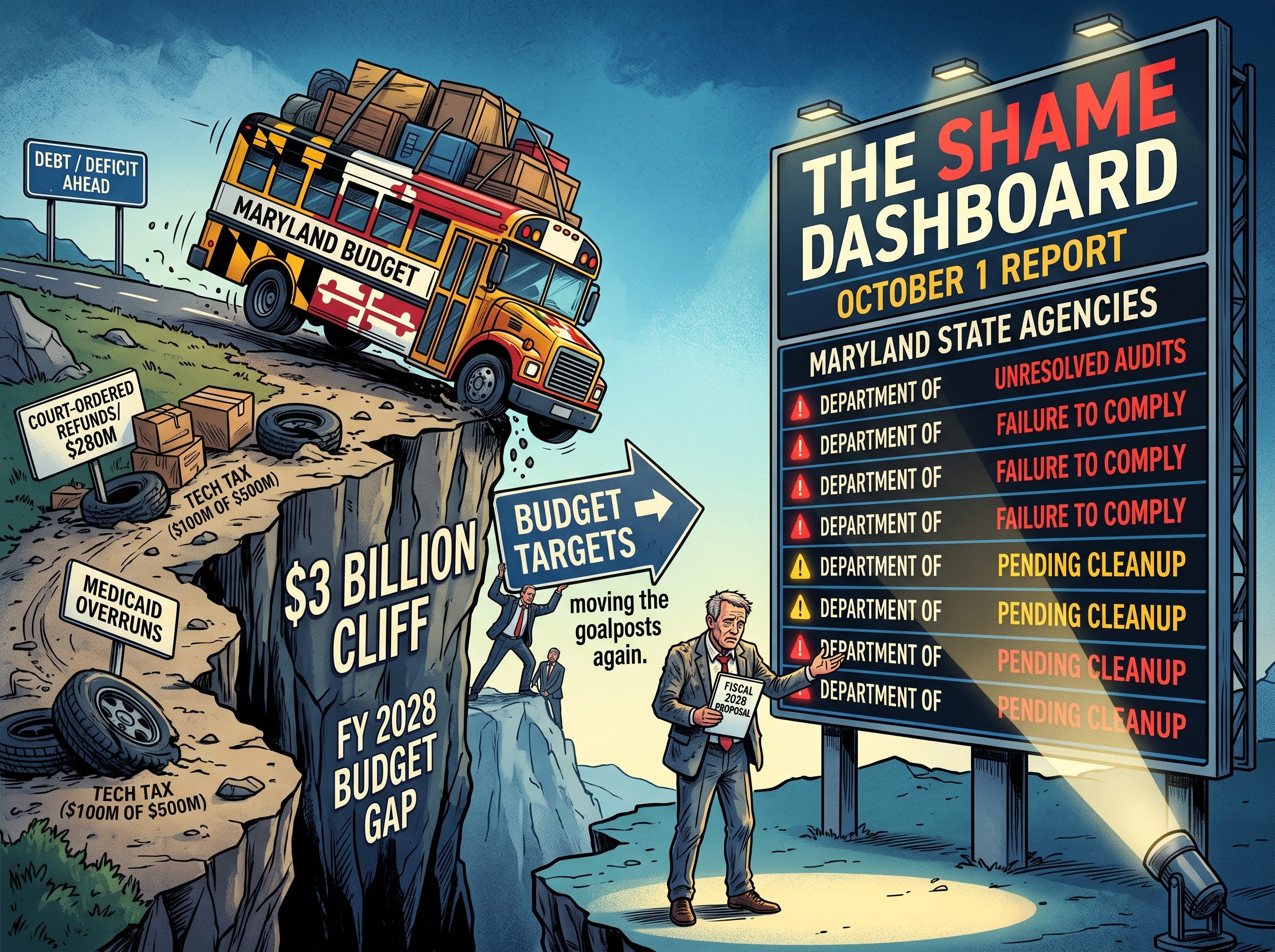
The $3 Billion Cliff and the Shame Dashboard
Maryland’s budget gap keeps growing, the fixes keep flopping — and a new law just built a public machine for naming the agencies that never clean up their audits. Its first report was due October 1.
Maryland’s budget people just moved the goalposts again, and not in the direction anyone wanted.
The numbers keep getting worse
The Board of Revenue Estimates’ latest forecast puts the structural gap at roughly $3 billion for fiscal 2028. Revenues came in $320 million above the last estimate — Comptroller Brooke Lierman called it a “mixed picture,” which is Lierman-speak for enjoy the good news, because here comes the rest. Growth is running 3.3 percent, below the state’s 4 percent trend. Paycheck withholdings are slowing. The one-time windfalls — big estate and capital-gains collections — aren’t coming back.
And then there’s the tech tax. Remember the 3 percent sales tax on IT and data services, sold as a $500 million answer to the deficit? It has collected about $100 million. Add a $280 million court-ordered refund to Potomac Edison, and you start to see why Budget Secretary Jake Weissmann isn’t celebrating. Agencies have been told to find roughly 3 percent in cuts. Their fiscal 2028 budget proposals are due in January, and the math doesn’t work.
Lierman, in a September release, called this “the most tumultuous decade for revenues in a generation.” She’s not wrong. The December briefing that put the fiscal 2027 shortfall at $1.5 billion — five times the spring prediction — blamed a familiar cocktail: Medicaid cost overruns (including $190 million in provider reimbursements), the One Big Beautiful Bill Act’s $371 million negative swing in state revenues, and $718 million in revenues that simply never showed up.
The Blueprint problem
Behind all of it sits the Blueprint. Education reform costs are on track to approach $3.8 billion a year, and the dedicated revenues run dry around fiscal 2028–29 — at which point the whole thing lands on the general fund. Wes Moore told the Spending Affordability Committee the Blueprint “cannot continue in its current form.” House Appropriations Chair Ben Barnes doesn’t want to roll back education reforms. That’s a genuine fault line inside the Democratic supermajority, and it’s where the 2027 session will be fought.
So: a $3 billion hole, a flopped tech tax, and the biggest spending mandate in state history about to eat the general fund.
Here’s what nobody’s watching: while the money burns, Maryland just built a machine to publicly name the agencies that waste it. Its first report was due October 1.
[ PAYWALL BREAK ]
