

A President in the Front Row
There are moments in American civic life that make you stop and ask, “Has this ever happened before?”
Donald Trump attending Supreme Court oral arguments this week was one of those moments — because the answer is no. In more than two centuries of constitutional history, no sitting president has ever walked into the courtroom to watch the justices hear a case involving his own administration.
Presidents go to investitures.
They go to funerals.
They do not go to oral arguments.
And they especially do not go to oral arguments about their own executive orders.
Why? Because it looks like pressure.
Because it looks like influence.
Because the Court is supposed to be insulated from exactly that kind of presidential presence.
Whether Trump intended to influence the Court or not, the simple fact of showing up created that perception. That’s why every president before him — conservative, liberal, and everything in between — stayed away.
But Trump went anyway.
He sat in the front row, hands folded, watching as the justices pressed his solicitor general on the administration’s attempt to end birthright citizenship. And for a while, he stayed. Long enough to hear the Court’s conservative bloc — including justices appointed by him — ask pointed, skeptical questions about the legal theory behind the order.
Then, shortly after the opposing counsel began, he stood up and left.
Some observers described it as “storming out.” Others simply noted that he exited at the moment the argument turned sharply against the administration’s position. I’ll leave the interpretation to the reader, but the timing was hard to miss.
What was unmistakable was the Court’s posture.
This was not a bench cowed by the presence of a president.
This was not a bench signaling deference to the executive.
This was a bench doing its job.
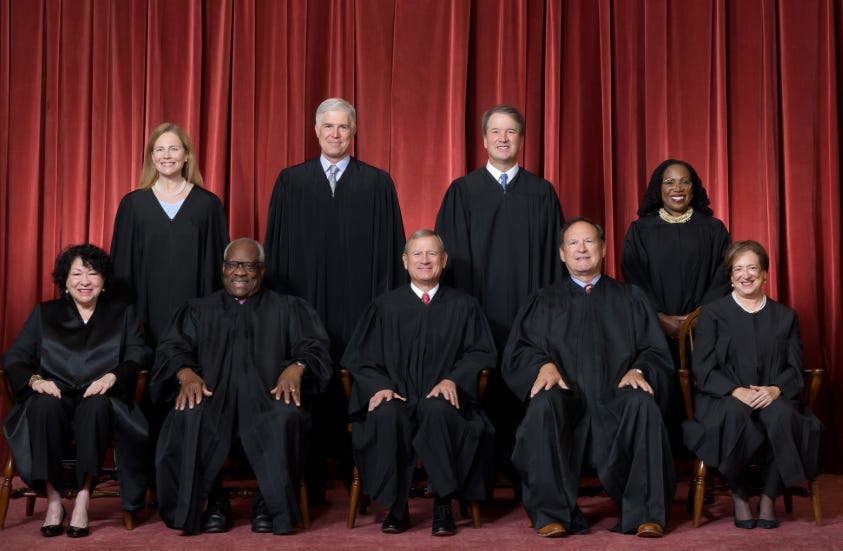
Justice Gorsuch, in particular, surprised people who had long assumed he would reflexively side with Trump on any question touching immigration or executive power. Instead, he pressed the administration’s lawyer with the same rigor he applied to the challengers. He wasn’t alone. The conservative justices — all six of them — showed no sign of adjusting their tone, their questions, or their independence because the president was sitting ten feet away.
Now, let’s be clear: this is still a far more conservative Court than the one we had 10 or 15 years ago. Their jurisprudence reflects that. Their outcomes reflect that. But what this hearing showed is that they are charting their own course, not following the president’s preferred reading of the Constitution.
They may rule in his favor. They may not. But they are not taking instructions from the front row.
And that, in this moment, is worth noting.
Because the Court has taken plenty of criticism in recent years — some of it deserved, some of it partisan, some of it structural. But on this day, in this case, the justices demonstrated something that has been in short supply in American institutions: independence.
They asked hard questions.
They challenged assumptions.
They treated the president’s presence as irrelevant to their work.
That’s how it’s supposed to be.
And if the president left the room looking — shall we say — less than thrilled, that’s his business. The Court’s business is the Constitution. And for at least one morning, they acted like it.