

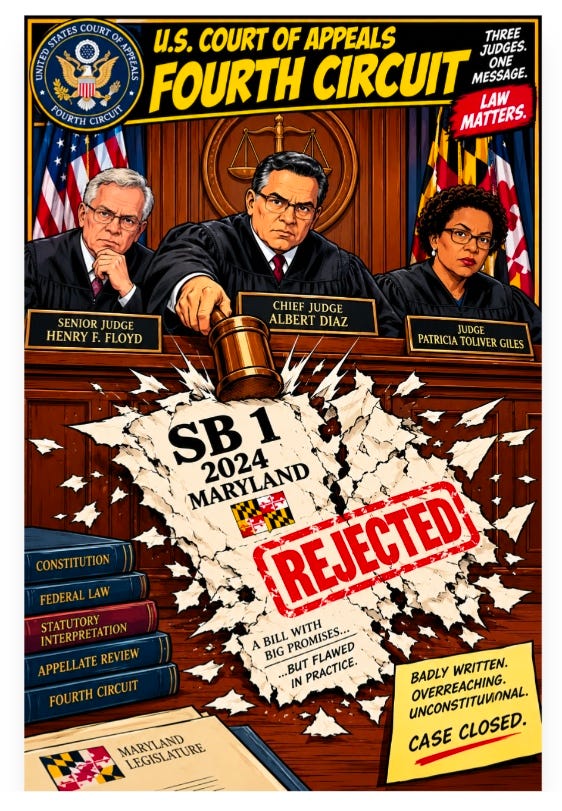
Statutory Wishful Thinking: Why Maryland’s “Greenwashing” Law Collided with the First Amendment
By Barry O’Connell
There is an old, fundamental rule of drafting legislation that statehouse leaders continuously try to bypass: if you want a law to mandate a specific outcome, you have to actually write the law to mandate that outcome.
You cannot simply write a regulation you wish you had, attach a gag order to force companies into compliance, and expect federal judges to play along.
That basic disconnect is precisely why the U.S. Court of Appeals for the Fourth Circuit handed down a major published opinion in Retail Energy Advancement League v. Brown (Docket No. 25-1012), granting a preliminary injunction that struck down the marketing speech restrictions in Maryland’s Senate Bill 1.
To a non-lawyer looking at the mechanics of the power grid and statutory drafting, what happened here is glaringly obvious. Unfortunately, it seems to have completely escaped the state officials and legislative architects who pushed SB 1 through the General Assembly.
The Reality of Carbon vs. The Illusion of Local Electrons
The core issue underlying SB 1 is the state’s fight against perceived “greenwashing.” State lawmakers argued that when a retail electricity supplier sells a “100% renewable” or “green” power plan, residential consumers assume that solar panels down the street are directly powering their microwave.
That is not how the electric grid works. Electrons cannot be routed to individual houses based on a contract. Power accounting relies on Renewable Energy Credits (RECs)—financial certificates representing one megawatt-hour of clean energy generated and fed into the overall grid.
