

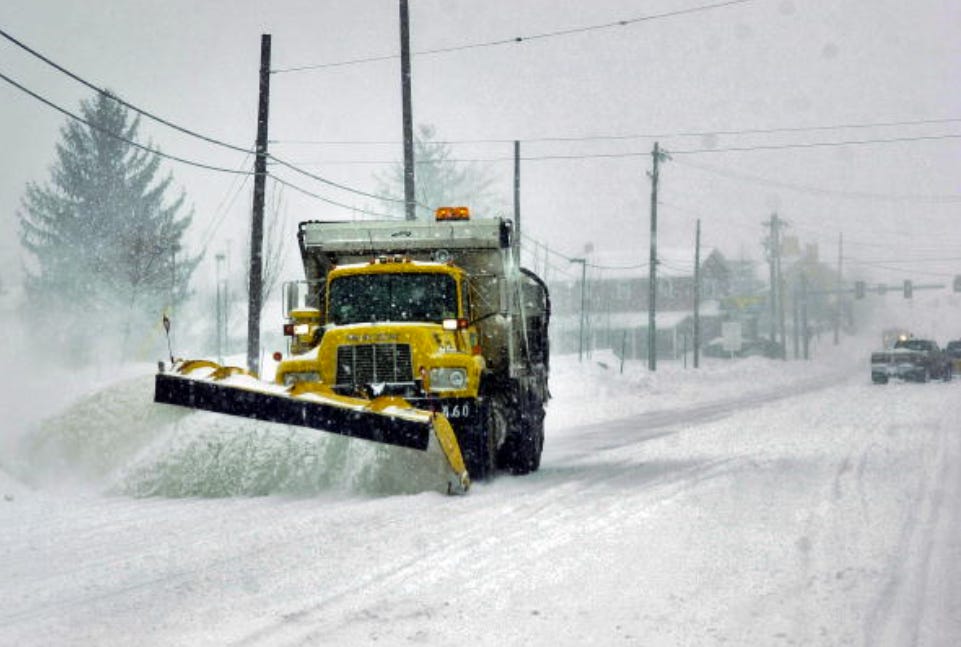
THE WINTER THAT EXPOSED A COUNTY’S MEMORY LOSS
Inside Prince George’s quiet collapse of institutional knowledge — and why a predictable storm still caught the county flat‑footed
Prince George’s County didn’t fail because of corruption. It failed because the system forgot how to do its job.
That’s the through‑line emerging from two very different sources: a tip about last‑minute truck procurement through “friends of Aisha and Michael Arrington,” and a long, reflective conversation with a retired operations manager who spent decades running winter response for both the State Highway Administration and the county. Put together, they tell a story not of scandal, but of institutional amnesia — a county that once knew how to manage winter weather but no longer remembers the basics.
And in the vacuum left behind, improvisation filled the space where planning used to be.
I. The Trucks That Arrived Two Days Before the Storm
The first tip is almost mundane on its face: the county used “friends of Aisha and Michael Arrington” to secure trucks, and those trucks didn’t show up until 48 hours before the storm.
Not illegal. Not even unusual in a county where personal networks often substitute for procurement pipelines.
But it’s revealing.
Winter operations aren’t supposed to be a scramble. Contracts for dump trucks, 4x4s, and one‑tons are typically secured months in advance. Equipment is staged before the first flake falls. Routes are assigned. Operators are trained. Salt is stockpiled. Pre‑treating begins days ahead.
If you’re calling friends for trucks two days before the storm, it means something deeper:
- You don’t have standing contracts.
- You don’t have reliable vendors.
- You don’t have a plan.
It’s not corruption.
It’s hollowed‑out governance.
And that’s exactly what the retired operations manager describes next.
II. “We Didn’t Harvest Knowledge. We Didn’t Document.”
The retired manager — 30 years with the State Highway Administration, then years with Prince George’s — doesn’t sound angry. He sounds sad.
He describes a system that once worked because it was staffed by people who had lived through blizzards, ice storms, and the 2010 “Snowmageddon.” People who knew the roads, the equipment, the timing, the choreography.
Then they retired.
> “We didn’t harvest knowledge. We didn’t document… it was too late.”
That’s the quiet catastrophe:
the county lost its institutional memory and never replaced it.
The people now in charge, he says, “don’t understand what it takes to plan for emergency operations.” Not because they’re bad people — but because no one trained them, no one mentored them, and no one wrote anything down.
The knowledge walked out the door in July 2022, and the county never recovered.
III. The Basics They Forgot
The retired manager lays out the fundamentals of winter operations — the kind of things that used to be second nature:
- Pre‑treat early. Salt goes down at ¼–1 inch of accumulation.
- Stage equipment before the storm.
- Use 6‑ and 10‑wheel dump trucks on major roads.
- Use 4x4s and one‑tons in neighborhoods.
- Clear turn lanes or traffic collapses.
- Monitor roadway temperature sensors.
- Tailor the plan to each storm.
- Coordinate with regional partners through Mayday/Maytop.
- Invest in technology that predicts equipment needs.
None of this is exotic.
None of it is new.
All of it is standard practice across the region.
But Prince George’s didn’t do it.
And the retired manager knows why:
> “If you’re not a data‑driven manager… you’re going to fail.”
IV. The County Used to Have 200+ Dump Trucks. Now? No One Seems to Know.
When he ran operations, the county had:
- 200+ contract dump trucks
- An abundance of 4x4s
- Monthly coordination meetings
- Shared plans with DC, Montgomery, VDOT, and SHA
- A culture of preparation
Now, he says, he has no idea what equipment the county has.
That uncertainty alone is telling.
If the county had the trucks, they wouldn’t have been calling friends two days before the storm.
V. The Failure to Learn From Last Year
The retired manager brings up last January — unprompted.
> “After last January… you would have thought they would have learned.”
The county didn’t.
The same neighborhoods were stranded.
The same roads went untreated.
The same scramble unfolded.
This is the part that stings:
the county had a near‑identical failure last year and still didn’t invest in winter operations.
Not in equipment.
Not in training.
Not in pre‑treating capacity.
Not in technology.
And certainly not in institutional knowledge.
VI. The Real Story: A System That Forgot How to Function
This isn’t a corruption story.
It’s a competence story — and those are often more damning.
What you have is a portrait of a county that:
- Lost its experienced operators
- Failed to capture their knowledge
- Didn’t train replacements
- Didn’t invest in technology
- Didn’t secure equipment early
- Didn’t pre‑treat
- Didn’t plan
- Didn’t learn from last year
- And didn’t have leaders who understood the job well enough to fix it
The result was predictable:
a storm that should have been manageable became a crisis.
Not because of malice.
Because of memory loss.
VII. The Quiet Consequence
Residents don’t care about procurement pipelines or roadway sensors. They care about getting to work, getting to school, getting to the store, getting to their medicine.
And as the retired manager puts it:
> “It’s all about getting people out of the neighborhoods onto the primary roads.”
That didn’t happen.
Not because the county is corrupt.
Because the county is unprepared.
And unpreparedness, repeated year after year, becomes its own kind of negligence.
https://themarylandwire.substack.com/publish/post/168407836
County has not lost all of its institutional knowledge there's employees that's been there for 30 to 40 years that leadership don't listen to that's a failure .
https://www.princegeorgescountymd.gov/sites/default/files/media-document/FINAL%20Snow%20Summit%20Presentation%202025%20-%20DPWT%20%282%29.pdf