


A Maryland Wire Essay by Barry O’Connell
The Georgetown Girl and the 14th-Century Warlord
Subtitle: What a RNC aide in 1986 understood about power, political sheep, and Ibn Khaldun.
Every so often, Washington hands you a casual conversation that ends up haunting you for forty years.
Mine came in the fall of 1983. I was a kid knocking around national political circles, ending up in a candidate development session run by the Republican Congressional Campaign Committee. I was a GOP operative but not a career striver; I was just curious. I wanted to take the back off the clock and watch how the gears turned.
In our cohort was a young woman from Georgia. She was polished, sharp as a tack, and living in a Georgetown townhouse whose rent was clearly being subsidized by family money. She had been raised inside the trade, not outside it. She carried herself with the quiet, casual confidence of someone who had known the rules of power since childhood.
One evening, over drinks, she dropped a line that sounded like a cross between plantation arrogance and insider political shorthand:
“Ninety percent of people are sheep. Five percent are shepherds. And five percent could be shepherds, but they opt out.”
She didn’t say it aggressively. She didn’t say it like philosophy. She said it like she was telling me the sky was blue. It was just the operational reality of the political world in 1986.
At the time, I brushed it off as D.C. cynicism. But decades later, after watching how parties coalesce, fracture, and fall apart, I realized she wasn’t just spouting 1980s campaign rhetoric. She was echoing a theory written six centuries earlier by a wandering North African scholar who understood political power better than any modern pollster: Ibn Khaldun.
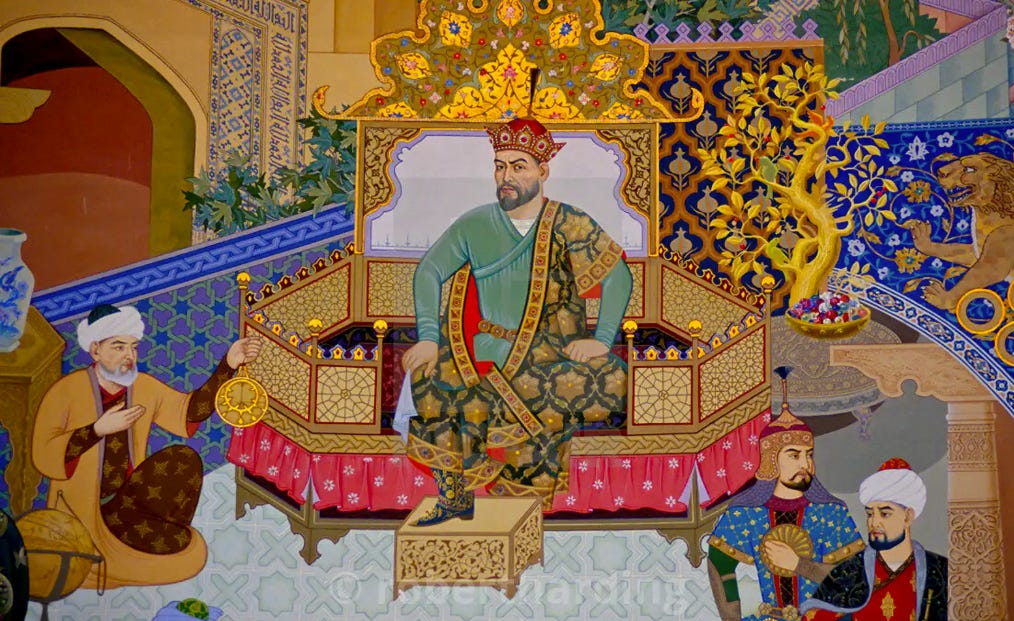
II. Ibn Khaldun and the Mathematics of Human Cohesion
If you’ve never read Ibn Khaldun, you’re in good company—most modern political consultants haven’t either.
Born in Tunis in 1332, Khaldun lived a life that makes Machiavelli look like a suburban city councilman. He was a statesman, judge, vizier, and political operative who bounced across North Africa and the Middle East, serving sultans, surviving prison, and navigating the brutal rise and fall of medieval empires. By 1401, he was sitting in a tent outside Damascus, debating history and statecraft with Tamerlane while the warlord’s armies besieged the city.
Out of those experiences, Khaldun wrote the Muqaddimah—quite possibly the most important book on political science that no one reads today. But sadly it is a book so obscure that if Len Foxwell hasn’t read it I can’t imagine who else might have.
Khaldun’s core insight was built around a concept he called asabiyyah—a word translated as group cohesion, social solidarity, or tribal willpower.
He observed that human groups don’t organize around policy papers or abstract ideals; they organize around asabiyyah. Put a hundred people in a room, and a natural sorting mechanism takes over:
Most people naturally seek cohesion, direction, and safety within the group.
A tiny fraction will naturally contend for authority to lead it.
When crisis hits, the group inevitably fractures, and leadership consolidates toward the strongest figure capable of enforcing order.
When the Georgetown girl broke down her 90/5/5 math over white wine in D.C., she was giving me Khaldun in a blazer and pearls.
PAYWALL BEGINS HERE
