


From Golden Girl to Workhorse: The Reinvention of Sarah Elfreth
By Barry O’Connell
Maryland Wire Magazine Feature
For years, I used to call her “Selfish Sarah.” It wasn’t meant as a joke. It was a shorthand for the way many people in Annapolis talked about Sarah Elfreth when she first arrived on the scene — polished, privileged, and unmistakably aware of both. She was young, ambitious, and wired directly into the power grid of the Maryland General Assembly. And in those days, that grid ran straight through the office of Speaker Mike Busch.
To understand Sarah’s early political identity, you have to understand the culture she walked into. Busch was never indicted, never charged, never formally accused of wrongdoing. But the era he presided over was one in which the Democratic caucus saw a steady drumbeat of corruption cases. At least eleven members were convicted or sent to prison during his speakership — roughly one every couple of years. It wasn’t that Busch was taking envelopes of cash. It was that he presided over a system where others did, and where the guardrails were loose enough that the machine kept humming along anyway.
Residency rules were treated as suggestions. Senior members lived out of state for most of the year. Enforcement was selective. Loyalty mattered more than legality. And everyone in Annapolis knew it.
The most vivid example came in 2018, when the U.S. Department of Justice released its case against Senator Nathaniel Oaks. The FBI had recorded him taking thousands of dollars in bribes in exchange for official acts — letters on state letterhead, bond bill requests, political favors dressed up as constituent service. In the wire recordings, Oaks even used a kind of playground slang for the bribe money. A thousand dollars was a “lollipop.” Five thousand dollars? “Five lollipops.” It was casual, almost cheerful — the language of a man who believed the system would protect him because it always had.
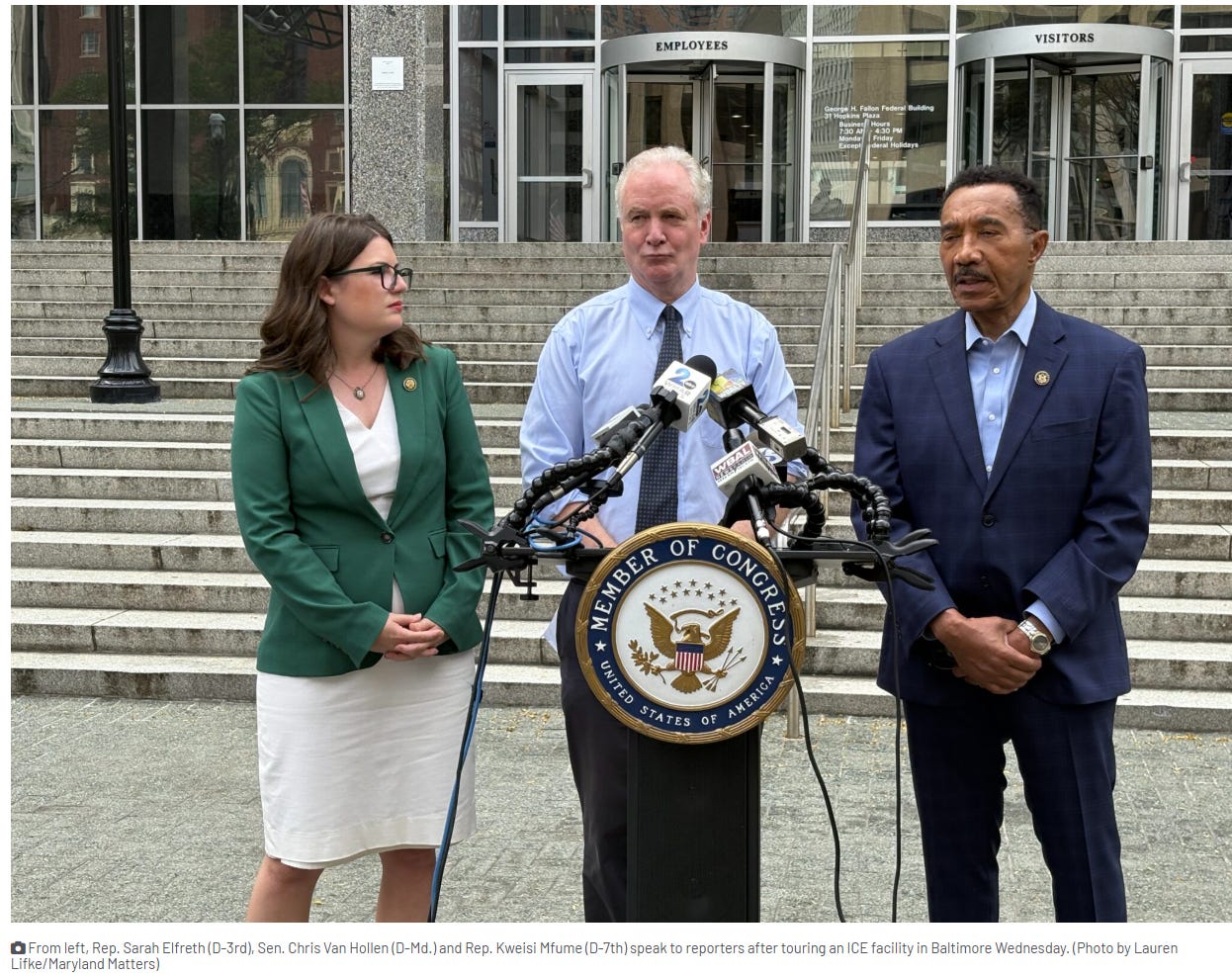
That was the Annapolis Sarah Elfreth entered as a young protégé of the speaker’s circle. She didn’t break the law. She didn’t take bribes. But she rose inside a machine where others did, and where proximity to power mattered more than anything else. According to colleagues who served with her, she was treated as a rising star from the moment she arrived — fast‑tracked into plum committee assignments, given responsibilities that usually took years to earn, and regarded as the “golden girl” of the leadership class.
I wasn’t the only one who saw her that way. When I criticized her as entitled or self‑impressed, I rarely found anyone in Annapolis who disagreed. Many told me privately that I had her pegged exactly right. She was talented, yes — but she was also insulated, elevated, and unmistakably aware of her own trajectory as astar in the Mike & Mike ,achine.
Then she went to Congress. And everything changed.
In Washington, Sarah Elfreth was no longer the center of gravity. She wasn’t the most important freshman from Maryland — that distinction went to John Olszewski Jr., who landed one of the coveted leadership posts. She wasn’t even the most prominent Sarah in the Democratic caucus. She was one of dozens of new members, each trying to find oxygen in a chamber that rarely gives any to newcomers.
For someone who had spent her entire career as the favored one, it was a shock. And, according to people who watched her closely, it forced a kind of reckoning.
Ambition didn’t disappear. It transformed.
Instead of entitlement, she leaned into work. Instead of assuming she mattered, she tried to prove it. Instead of floating above constituents, she began showing up for them — especially the ones who had the least power and the most to lose.
The turning point came in the case of Pastor Daniel Fuentes Español, a longtime Easton resident who had lived in Talbot County for nearly twenty years. When ICE suddenly detained him and prepared to deport him, panic spread through the Hispanic community. Families were terrified. A man who had ministered to them, worked beside them, and raised his children among them was about to be taken away.
According to my sources, Sarah Elfreth stepped in with a level of urgency and compassion that surprised even her critics. She worked closely with strategist Len Foxwell, pressing federal agencies, coordinating with advocates, and refusing to let the case disappear into bureaucratic darkness. She didn’t do it for headlines. She didn’t do it because anyone powerful asked her to. She did it because a family was in crisis and she felt responsible for them.
People noticed. Especially people of color who had once viewed her with skepticism. As colleagues told me, this wasn’t the Sarah they remembered from Annapolis. This was someone humbler, more grounded, more willing to fight for people who had nothing to offer her in return.

Len Foxwell on Sarah Elfreth
“I will never forget what Congresswoman Elfreth did for me, for my family and Pastor Fuentes Espinal this past year.
Her empathy and kindness were a godsend to a family that has been devastated by grief. By reading Darren’s name into the congressional record on the floor of the House of Representatives. Sarah shared with the nation the story of this beloved young man who was taken from us far too soon.
“It didn’t stop there. I contacted Sarah on the very evening that Pastor Fuentes Espinal had been kidnapped by ICE. Within minutes, she was working on his case, contacting the right agencies to confirm his whereabouts and expressing serious concern about the conditions in which he and others were being detained. She stayed in touch with me every day and worked with Rep. Ivey to call attention to the inhumanity of this situation.
“Sarah Elfreth is my friend, she is a supremely effective lawmaker and she is the embodiment of a good person who is in politics for the best reasons.”
Text from Professor Len Foxwell
Pastor Fuentes Español eventually returned home. And in Easton, that mattered. It changed how people talked about her. It changed how I talked about her.
Now, in Congress, she sits on the Armed Services Committee at a moment when U.S. military operations in the Caribbean are under scrutiny for civilian casualties — fishing boats shot up, survivors killed, families shattered. A decade ago, she might have treated that assignment as a résumé line. Today, she seems to treat it as a responsibility.
Whether she rises further is an open question. Whether she reverts to old habits is another. But one thing is clear: the Sarah Elfreth who arrived in Washington is not the same Sarah who once glided through Annapolis on rails laid by other people’s power.
Some politicians grow harder as they rise. She grew softer — in the best sense of the word. More human. More aware. More willing to carry the weight of other people’s fear.
Ambition didn’t leave her. It simply found a better use.
And in a political era defined by cynicism, that alone is worth noticing.
Very interesting. Heartwarming too. Thank you for sharing this new perspective.