

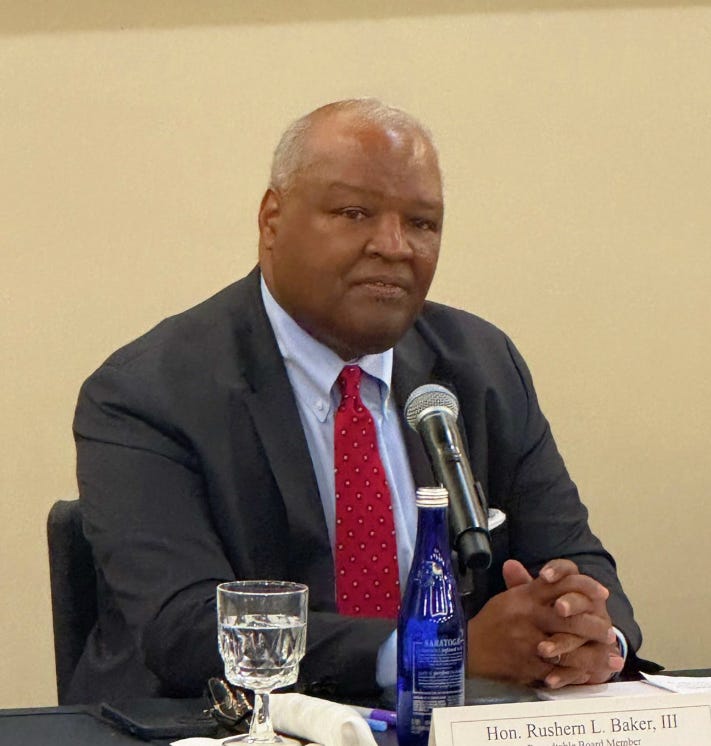
Rushern Baker’s Path to Victory
A plausible scenario in a fragmented MD‑05 primary
Every campaign in Maryland’s 5th Congressional District has a theory of the case. Some are aspirational. Some are financial. Some are built on the hope that a crowded field will magically consolidate at the right moment. And then there is the Baker campaign’s theory — which is not flashy, not complicated, and not dependent on a miracle. It is, instead, a structural argument rooted in name recognition, geography, and the math of a 20‑plus‑candidate primary.
After meeting with Barry Hudson and Madeline “Maddie” Russak, and after reviewing the internal memos circulating in the race, it’s clear that the Baker team believes they have the most straightforward path to the 27,000 votes likely needed to win. Whether that path holds is a separate question. But the path itself is real.
This is what it looks like.
The Polling: A Lead That Comes From Somewhere
The Greenberg Quinlan Rosner poll (Feb. 26–Mar. 1) puts Rushern Baker at 22%, ahead of Harry Dunn at 15%, with Adrian Boafo at 3% and a large undecided bloc.
What makes this number meaningful is not the margin — it’s the foundation. According to the memo, Baker enters the race with 69% total name recognition, the highest in the field by a wide margin. His favorability is also stable: 42% favorable / 14% unfavorable.
In a race where most candidates are still introducing themselves, Baker is not. Voters already know who he is, what he did as County Executive, and what they think of him. That’s not a guarantee of victory, but it is a guarantee of efficiency. Every dollar he spends goes further because it is not spent on introduction.
Prince George’s County: The Center of Gravity
Prince George’s County is roughly 48% of the district’s population, but nearly two‑thirds of Democratic primary voters.
That is the entire ballgame.
Baker’s eight years as County Executive give him a built‑in base that no other candidate can replicate. The memo describes this as a “durable, district‑based coalition,” and that’s accurate. PG County voters know him, have voted for him before, and have a formed opinion.
In a race where the winning number is only 22–28%, a strong PG County base is not just helpful — it is decisive.
Southern Maryland: Baker’s Overlooked Advantage
One of the more interesting points raised in your meeting is that Baker’s strength is not confined to PG County. His two statewide campaigns gave him visibility in Charles, Calvert, St. Mary’s, and Southern Anne Arundel.
In fact, he won Calvert County outright in a previous gubernatorial primary — a detail the Baker team is quick to remind people of.
This matters because the rest of the field is not anchored in Southern Maryland. If Baker can simply remain competitive there — not dominate, just compete — he adds incremental votes that push him closer to the 27,000‑vote target.
The Money Argument: Spending Less Because You Can
On paper, Baker’s fundraising looks modest:
- $202,645 raised
- $169,689 cash on hand
Compare that to:
- Harry Dunn: $2 million+
- Quincy Bareebe: ~$3.5 million
But the Baker campaign’s argument is that money is not the primary variable in this race. The memos explicitly state that the DC media market is one of the most expensive in the country, and that candidates who need to buy name recognition are at a structural disadvantage.
Baker doesn’t need to buy name recognition. He already has it.
Their pitch is simple:
“We don’t need as much money because we don’t need to introduce him.”
Whether that holds depends on how aggressively the better‑funded campaigns spend in the final stretch. But the logic is internally consistent.
The Fragmented Field: Winning With a Quarter of the Vote
With more than twenty candidates in the race, the winning coalition is estimated at 25,000–27,000 votes, or roughly 22–28% of the electorate.
Baker is already at 22%.
He doesn’t need a surge.
He needs a hold.
In a field this fractured, the candidate who starts with the largest durable base has the simplest path. The memos emphasize Baker’s 19% second‑choice support, which positions him to benefit from late consolidation if undecided voters break toward familiar names.
This is not a persuasion‑heavy race. It is a consolidation race. And Baker begins closer to the finish line than anyone else.
A Plausible Path — Not a Prediction
The Baker campaign’s path to victory is coherent, data‑driven, and grounded in structural advantages that are difficult to replicate. That does not make it inevitable. It makes it plausible.
There are vulnerabilities:
- Dunn has the resources to change the race if he localizes his message.
- Bareebe has the money to buy name ID if she finds a message that converts.
- PG County could splinter if multiple local candidates catch fire.
- Baker’s support is broad — but broad support is not always enthusiastic support.
This is a race where late movement is possible, and where money, message, and momentum can still reshape the field.
But as of now, the Baker campaign’s theory of the case is one of the clearest in the race.
A Note on My Own Position
I want to be transparent with readers. I have friends in this race.
Foxwell, who is working with the Boafo campaign, is an old friend.
Mark McLaurin, who is helping lead Quincy Bareebe’s effort, is another longtime friend — we don’t always see eye to eye, but I know his ability and I don’t take his candidate lightly.
Of the more than twenty candidates running, I know many personally. I like some of them. Others I don’t know well. But I am not tied to any campaign, and nothing I write should be read as a prediction or a preference.
My goal is to describe the race as it exists — not the race I want, and not the race anyone is paying me to see. Right now, the reality is that money isn’t everything. In a district this large and this expensive, name recognition and favorability are the currency that matters most, because the better liked your candidate is, the less you have to spend convincing voters to learn who they are.
That’s the landscape. What happens next is up to the campaigns — and the voters.
I hope voters do their research and not vote for someone because of name recognition.
Rushern’s candidacy really is just an exercise in leveraging high but weak name ID in a time when voters care about who is actually going to deliver for them and fight back against this administration. I respect the guy, but I don’t think one should be rewarded with a seat in Congress after losing two statewide races in addition to his old PG County Exec seat. He’s got a lousy fundraising operation, and frankly voters like myself are tired of candidates that carry an aura of inevitability just because people know their name.