

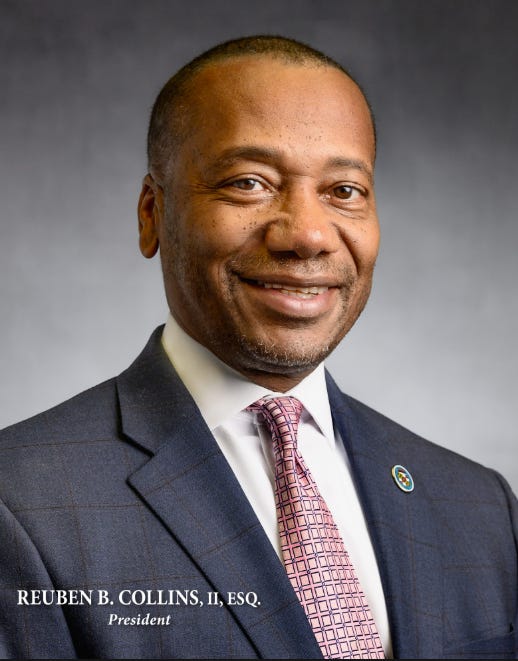
THE MAN FROM BRYANS ROAD
Reuben B. Collins II Steps Out of Charles County and Into the MD‑05 Arena
By Barry O’Connell
Maryland Wire Magazine Feature
I. The Quiet Architect of Southern Maryland
Every election cycle produces a few surprise entrants — the kind of candidates who don’t need to introduce themselves to the people who actually run things. Reuben B. Collins II is one of those. If you’ve spent any time in Charles County government, or anywhere in the Metropolitan Washington regional planning orbit, you’ve already bumped into him, usually chairing the meeting you didn’t realize he was chairing.
Collins has been the President of the Charles County Board of Commissioners since 2018, after earlier service from 2006 to 2014, including a stint as vice president.
He’s also the first African American ever elected to that role — and the first in twenty years to win reelection to it.
But titles don’t quite capture the way Collins operates. He’s not a bomb-thrower. He’s not a headline-chaser. He’s a systems guy — the sort who reads the regional transportation plan for fun and then rewrites half of it.
And now he wants a seat in Congress.
II. A Résumé Built for the Long Game
Collins’s public service career spans more than three decades, and it reads like someone preparing for federal office without ever saying so out loud.
He has served on:
- The National Capital Region Transportation Planning Board, including as chair (2022–23)
- The Metropolitan Washington Council of Governments (COG) Board, where he will serve as Chair in 2026, the first Charles Countian ever to do so
- The Critical Area Commission
- The Patuxent River Commission
- The Maryland Association of Counties (MACo) Board of Directors
This is not the résumé of a local politician.
This is the résumé of a regional strategist.
And unlike many county executives who come up through business or activism, Collins is a lawyer — admitted to the New Jersey, D.C., and Maryland bars — with a long-running practice focused on corporate and small‑business transactions.
He’s also the author of a 2013 book, Evolutionary Actuality, which is exactly the sort of title you’d expect from a man who thinks in long arcs.
III. The Charles County Transformation
If you want to understand Collins, you have to understand Charles County — a jurisdiction that has spent the last twenty years transforming from a bedroom community into a regional force.
Under Collins’s leadership, Charles County has pushed:
- Affordable housing initiatives (2020–21)
- A “Smart City Vision” for modernization
- Youth employment programs
- Redevelopment corridors in Waldorf and Pomonkey
- Diversity, equity, and inclusion frameworks, including Resolution 2021‑24
He also helped launch the first Resilience Authority in Maryland, a structural innovation that other counties have since studied.
These are not small-bore projects. They’re the kind of institutional rewiring that only happens when someone is willing to sit through the meetings, read the footnotes, and push the bureaucracy uphill.
Collins is that someone.
IV. The Man Behind the Professional Calm
Born in Bryans Road, educated in Charles County public schools, and a graduate of Fisk University and the D.C. School of Law, Collins is a local son with national instincts.
He’s also a family man — married, with three children — and a fixture in civic organizations from Kiwanis to the Black Leadership Council for Excellence.
People who know him describe him as steady.
Measured.
Unflappable.
In a political era dominated by theatrics, Collins is the opposite: a man who believes that the work matters more than the noise.
V. Why MD‑05 Makes Sense for Him
Maryland’s 5th Congressional District — long shaped by Steny Hoyer — is a sprawling, complex district that touches Prince George’s County, Charles County, and Southern Maryland’s shifting political terrain.
Collins enters the race with:
- Executive experience
- Regional planning credentials
- Environmental and transportation expertise
- Deep roots in Charles County
- A long record of coalition-building
These are factual observations, not predictions.
But it’s clear that Collins is not running as a protest candidate or a placeholder. He’s running as someone who has been preparing for this level of governance for a long time.
VI. The Question Ahead
The MD‑05 field is still taking shape. Voters will decide what kind of leadership they want next. But Collins brings something unusual to the table: a blend of local grounding and regional sophistication that is increasingly rare in congressional politics.
He’s not flashy.
He’s not loud.
He’s not trying to go viral.
He’s trying to govern.
And in an era of performative politics, that alone makes him a fascinating figure to watch.