

The 8–0 Mirage: Why Lines Don’t Vote and Candidate Quality Still Rules Annapolis
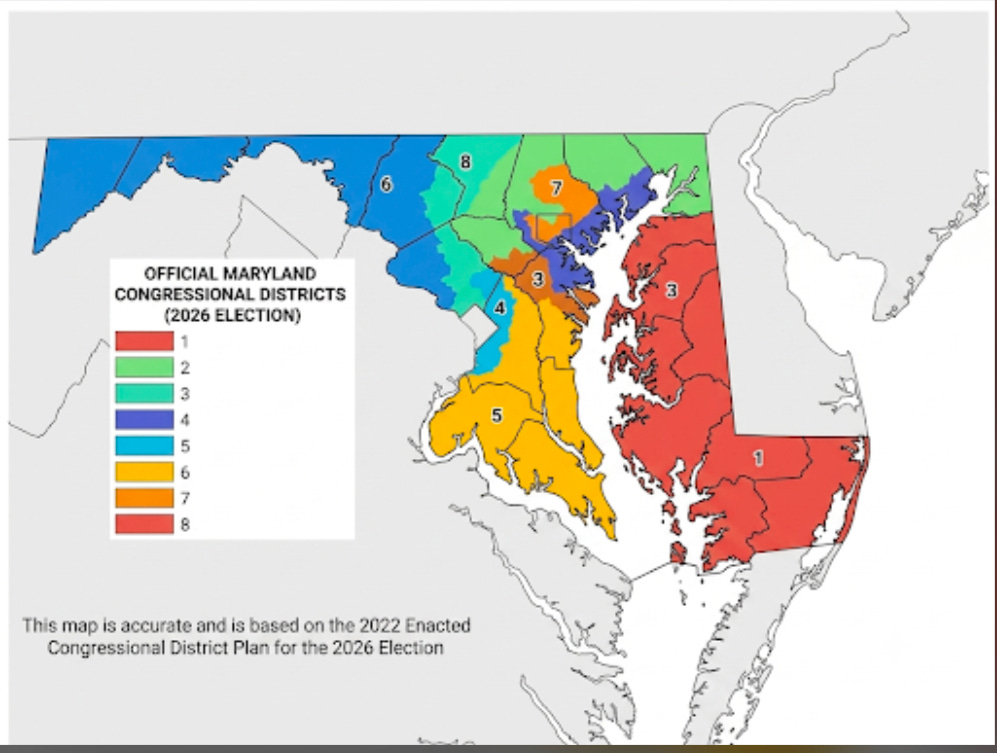
There is a comfortable myth floating around the halls of Annapolis: if you draw the congressional map just right, the election night math takes care of itself. The theory goes that by slicing a bit of Montgomery, stretching across the Chesapeake Bay, and rearranging Central Maryland, the Democratic Party can secure a clean 8–0 delegation in Washington.
It sounds brilliant on a whiteboard. But as anyone who actually runs campaigns knows, maps don’t vote—people do.
While a aggressive redistricting map might look like a blue blueprint, the reality on the ground is far more precarious. Pushing for eight seats doesn’t create eight fortresses; it creates a landscape where candidate quality, local dynamics, and raw political grit determine who actually wins.
The Untouchable Inner Core
Let’s be clear: some incumbents will sleep fine no matter how the lines are carved.
The Powerhouses: Congressman Glenn Ivey in the 4th District isn't facing a red wave anytime soon. That seat remains an unassailable stronghold.
The Rising Stars: Looking down the road at state-level talent, leaders like Delegate Adrian Boafo are built for long-term political durability. In heavily favorable territory, candidates with strong constituent roots and sharp operational teams will cruise to victory without breaking a sweat.
Districts 2 and 3 carry a bit more geographic rearrangement, but their core Democratic pluralities mean that a solid candidate will comfortably hold the line.
The Vulnerability Trade-Off: District 1 vs. District 6
The real gamble of redistricting lies on the edges—specifically in the 1st and 6th Districts.
District 6: The Fragile Western Wall
April McClain Delaney demonstrated real political muscle in her first outing. She navigated a grinding Democratic primary against David Trone and pulled off a clean, hard-fought victory to secure the 6th District. She has proven she knows how to run a real campaign.
However, District 6 is inherently volatile. By its very geography, it stretches from the conservative strongholds of Western Maryland down into the suburban precincts of upper Montgomery County. If line-drawers siphon off Montgomery Democrats to fix adjacent seats, District 6 shifts from a lean-blue district to a flat-parity dogfight. McClain Delaney has the candidate quality to win tough races, but a carved-up map turns her seat into a perpetual battlefield.
District 1: Lean Isn't a Guarantee
On paper, dragging Western Shore voters across the Bay to dilute the Eastern Shore’s Republican base turns District 1 into a "Lean Democratic" seat. But in political science terms, "Lean Democratic" is not a slam dunk.
Andy Harris and the Eastern Shore GOP base are not going to simply pack up and leave. An extended District 1 creates a competitive arena, not a guaranteed takeover. If national headwinds shift or turnout sags, a "lean" district can easily flip right back.
The Bottom Line
A new map can create the opportunity for an 8–0 delegation, but it cannot guarantee it.
By stretching resources and diluting safe bases to chase eight seats, the party risks trading one guaranteed Republican district for two highly unpredictable swing seats. In the end, maps just set the stage—it's up to candidates like McClain Delaney and the ground game in Annapolis to actually cross the finish line.
For official boundary documentation and state redistricting archives, visit the Maryland General Assembly Redistricting Portal. For voting, registration, and statewide election administration details, refer directly to the Maryland State Board of Elections.