

The Asphalt Engine: How State Highway Dollars Rewire the Electorate
Executive Summary
When politicians debate infrastructure, the discussion almost always centers on immediate, transactional metrics: travel time savings, job creation, or localized commercial development. But asphalt outlives campaign promises. In the long run, transportation policy is the single most powerful driver of political geography.
When state executives prioritize car-centric highway expansions over urban mass transit, they trigger an unintended chain reaction. By lowering the "friction of distance" between dense urban job centers and surrounding rural borders, state highway projects build a demographic pipeline. Over a 10-to-20-year horizon, the very highway corridors constructed to satisfy suburban and rural voters end up importing a white-collar, college-educated electorate—fundamentally altering the partisan baseline of outer-suburban counties.
This case study examines how transportation decisions, real estate economics, and regional migration converged along the I-270 corridor in Maryland, offering a template for understanding electoral realignment across the American suburban fringe.
1. The Transit Trade-Off: Capital Diversion in Practice
In mid-2015, Maryland’s state transportation policy underwent a sudden structural pivot. The executive branch canceled the proposed $2.9 billion Red Line light rail project in Baltimore, turning back nearly $900 million in committed federal funding. The remaining state matching funds—roughly $736 million—were reallocated into the State Highway Administration’s capital program.
From an immediate political standpoint, the shift fit a classic suburban-versus-urban paradigm. Urban mass transit projects primarily serve high-density core populations, while highway widening and interchange overhauls cater to regional drivers, commuters, and suburban logistics networks.
[Urban Mass Transit Cancellation] ──> [Capital Reallocated to Highways]
                                                 │
                                                 ▼
[Lower Commute Bottlenecks]  <─── [Interchange & Lane Expansion]
However, highway investments do not simply move existing cars faster; they alter the economic calculus of surrounding real estate.
2. The Mechanics of Infrastructure-Driven Infill
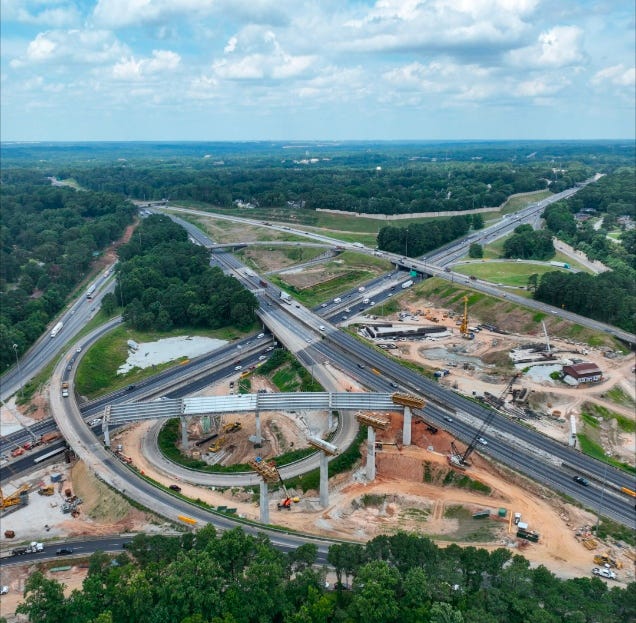
Every highway project is fundamentally an economic catalyst. When a state spends tens of millions of dollars to upgrade a major junction—such as the $93 million overhaul at I-270 and MD-85 in Frederick County—it instantly changes the "highest and best use" of the surrounding land.
+-----------------------------------------------------------------------+
|                       THE INFRASTRUCTURE CONVEYOR                     |
|                                                                       |
|  1. State Highway Upgrades (e.g., I-270 / MD-85 Overhauls)            |
|     └─ Reduces commute friction to primary job hubs (D.C. / Mont. Co) |
|                                                                       |
|  2. Land Valuation Shift                                              |
|     └─ Agricultural/low-density land becomes high-density infill     |
|                                                                       |
|  3. Private Real Estate Acceleration                                  |
|     └─ Developers build targeted subdivisions for commuting pros      |
|                                                                       |
|  4. Demographic & Electoral Realignment                               |
|     └─ Influx of college-educated suburban voters flips county baseline|
+-----------------------------------------------------------------------+
Unlocking Land Value: Parcels that were previously considered too congested or remote for large-scale development become viable primary-residence hubs for regional commuters.
Private Capital Infill: Developers move in to build residential subdivisions, master-planned communities, and commercial centers targeted directly at workers fleeing higher housing costs in inner-ring suburbs.
The Commuter Funnel: The availability of new, relatively lower-cost housing connected to job centers via expanded highway infrastructure creates a powerful draw for young professionals and families.
3. The Demographic Trojan Horse
The long-term consequence of this infrastructure funnel is demographic realignment.
Over the last two decades, the primary indicator of partisan voting behavior in suburban and exurban America has shifted from household income to educational attainment and occupational sector. Knowledge-economy workers—such as technology consultants, healthcare professionals, government contractors, and legal specialists—vote overwhelmingly for Democratic candidates, regardless of their income bracket.
┌─────────────────────────────────────────────────────────────────┐
│              HISTORICAL VS. MODERN SUBURBAN DRIVERS             │
├───────────────────────────────┬─────────────────────────────────┤
│ 20th Century Alignment        │ 21st Century Realignment        │
├───────────────────────────────┼─────────────────────────────────┤
│ • Income-driven voting        │ • Education-driven voting       │
│ • Higher earners = Conservative│ • White-collar pros = Progressive│
│ • Suburbs as conservative base│ • Outer suburbs become purple   │
└───────────────────────────────┴─────────────────────────────────┘
When state highway projects make exurban counties accessible to the D.C., Montgomery County, and Baltimore workforce, the incoming residents bring their partisan preferences with them.
The Frederick Model: Historically a reliable conservative stronghold in Maryland, Frederick County underwent rapid suburbanization as commuters moved up the I-270 corridor. By 2020, the county had flipped at the presidential level, voting for Joe Biden, and continued its leftward shift in 2024 by backing Kamala Harris.
The physical highway infrastructure built to serve a suburban population ultimately accelerated the demographic transformation that altered the county's political baseline.
4. Policy Takeaways for Government Relations & Analysts
For policy analysts, campaign strategists, and corporate site selectors, this phenomenon yields three core lessons:
Asphalt Outlives Ideology: Executive administration choices on transportation spending often reflect short-term political or economic priorities. However, physical roads remain in place for 30 to 50 years, permanently reshaping where populations grow.
Infrastructure as Real Estate Subsidy: State capital allocations directly dictate private land valuation. Public investments in interchanges and lane expansions function as indirect subsidies for surrounding residential and commercial development.
Predicting Political Shifts via Paving Budgets: To forecast where exurban counties will turn competitive over the next decade, look at state Department of Transportation 10-year capital improvement plans. The counties receiving the largest highway capacity upgrades today are almost universally the counties that will undergo political realignment tomorrow.
Conclusion
Governors and state legislatures often treat transportation budgets as straightforward policy levers—either to relieve traffic congestion or to stimulate immediate construction activity. But infrastructure is never politically neutral in the long run. By building the physical bridges between dense urban job centers and rural outer counties, state highway programs act as the primary engine of modern suburban realignment.