

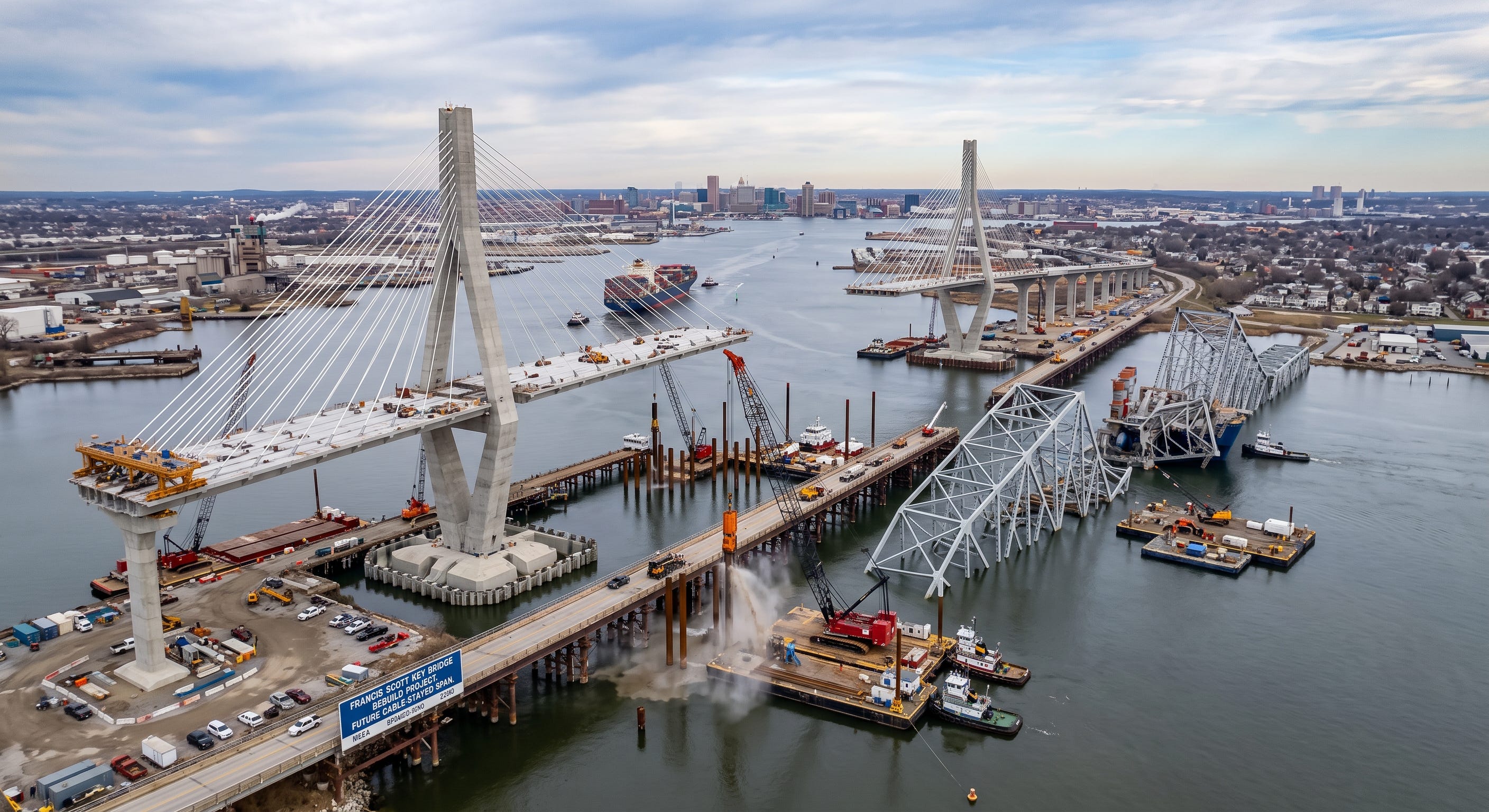
The Francis Scott Key Bridge wasn’t just a transportation artery—it was a sudden, brutal stress test for how government works under extreme pressure.
For the general public, it is a masterclass in executive leadership, crisis management, and the raw political mechanics of funding major infrastructure. But for the insiders—the government relations professionals, lobbyists, and policy strategists—the real story lies beneath the surface: in the complex mechanics of progressive design-build contracting, federal subrogation, and interagency regulatory bypasses.
Here is how both sides of that story come together.
The Anatomy of a Crisis: Leadership, Logistics, and the Key Bridge Rebuild
When the M/V Dali struck the Francis Scott Key Bridge, it severed more than just Interstate 695. It pinched off one of the East Coast’s most critical maritime corridors and tested the operational capacity of state and federal government overnight.
The Executive Test: Leadership Under Fire
In modern politics, executive leadership is rarely judged on steady-state governance; it is measured in hours following a crisis.
For Governor Wes Moore, the Key Bridge collapse transformed a political honeymoon into a trial by fire. The immediate response required balancing acute tragedy with cold economic reality: six workers lost their lives, the Port of Baltimore stood completely blocked, and supply chains across the Mid-Atlantic began backing up into local communities.
The administration’s playbook leaned heavily into operational transparency and unified command. By coordinating federal agencies, local first responders, and maritime authorities in the initial hours, the state established a cadence of execution that defined the response. Removing 50,000 tons of steel and concrete to reopen the Fort McHenry Channel in 11 weeks wasn't just an engineering feat—it was a political imperative to prevent lasting economic damage to the region.
┌───────────────────────────────────────────────────┐
│ CRISIS RESPONSE TIMELINE │
├────────────────────────────────────────────────────┤
│ March 26: Impact & Immediate Channel Closure │
│ June 10: Full Restoration of Fort McHenry Channel │
│ July: Categorical Exclusion NEPA Approval Granted │
│ August: MDTA Awards $73M Phase 1 Progressive Contract │
└───────────────────────────────────────────────────┘
The Federal Funding Fight
While the physical clearing moved at record speed, the legislative heavy lifting shifted to Capitol Hill. President Biden’s early commitment to cover 100% of the rebuild costs via federal funds immediately ran into the reality of a divided Congress.
Team Maryland—led by the state’s congressional delegation—had to construct a bipartisan coalition to navigate fiscal conservative pushback. The core argument rested on precedent and national impact: the Port of Baltimore is a federal trade node, and emergency relief funds (via the Federal Highway Administration’s Emergency Relief program) had historically stepped in for major infrastructure disasters. Securing federal backing through the Baltimore BRIDGE Relief Act required delicate political trade-offs, proving that keeping the delegation united was just as vital as the engineering plans.
Paid Subscriber Content Below
Upgrade your subscription to access our policy mechanics deep dive: an analysis of MDTA’s progressive design-build contracting, the legal subrogation framework for federal cost-recovery, and how interagency permitting fast-tracks bypassed multi-year NEPA delays.
Procurement Strategy: The Shift to Progressive Design-Build
For government relations professionals and industry contractors, the most notable aspect of the Key Bridge rebuild is how the Maryland Transportation Authority (MDTA) structured its procurement. Traditional Design-Bid-Build models—where state agencies fully design a project before accepting construction bids—would have added years to the timeline.
Instead, MDTA opted for a Progressive Design-Build (PDB) model.
TRADITIONAL DESIGN-BID-BUILD
[ Full Design Phase ] ──► [ Open Bidding ] ──► [ Construction ]
(High friction, lengthy timeline, rigid cost adjustments)
PROGRESSIVE DESIGN-BUILD (PDB)
[ Integrated Owner + Contractor Team ]
├── Phase 1: Scope, Risk Assessment & Early Design ($73M)
└── Phase 2: Guaranteed Maximum Price (GMP) & Full Build
(Compressed schedule, early risk-sharing, flexible scope)
By awarding a initial $73 million Phase 1 contract to Kiewit Infrastructure Co., MDTA brought the builder onto the engineering team immediately.
* Early Collaboration: Rather than litigating scope changes later, Kiewit and MDTA collaborated on risk assessment, material sourcing, and foundation designs before finalizing total costs.
* Off-Ramp Options: Phase 1 gave Kiewit exclusive negotiating rights for Phase 2 (final design and construction) under a Guaranteed Maximum Price (GMP). If the state and contractor cannot agree on the final price, MDTA retains the right to take the fully developed design out to a separate bid mechanism.
Legal Mechanics: Subrogation, Insurance, and Recovery
How the federal government and the State of Maryland recover costs from private parties establishes a critical legal blueprint for future maritime infrastructure claims.
| Funding & Recovery Source | Amount | Institutional Mechanism & Status |
|---|---|---|
| State Property Insurance | $350 Million | Direct payout received by Maryland from insurer Chubb to cover initial property damage. |
| DOJ Civil Settlement | $101.98 Million | Resolved federal claims against Grace Ocean & Synergy Marine under the Oil Pollution Act and Rivers/Harbors Act to cover channel cleanup. |
| FHWA Emergency Relief | 80% - 100% initial | Federal Highway Administration emergency funds backing initial construction outlays. |
| State Litigation Claims | TBD | Ongoing claims filed by the State of Maryland against the vessel owner/operator. |
The structural takeaway for GR professionals is the subrogation pipeline. Under federal emergency relief statutes, any dollars recovered by the state through third-party lawsuits or insurance claims must ultimately be remitted back to the Federal Highway Administration to offset initial federal outlays. The quick $102 million DOJ settlement cleared the federal government’s channel response costs without entangling the state’s separate litigation for the actual bridge structure.
Regulatory Fast-Tracking: Environmental Categorical Exclusions
A key point of interest for infrastructure developers is how MDOT and the Federal Highway Administration navigated the National Environmental Policy Act (NEPA) without triggering multi-year delays or environmental lawsuits.
In July 2024, FHWA granted a formal Categorical Exclusion (CE) for the rebuild project. The regulatory logic was straightforward: because the replacement span is being constructed within the former bridge’s existing right-of-way and maintains the same four-lane capacity, the agency determined it had no significant incremental impact on surrounding natural or cultural resources.
By establishing that replacing destroyed infrastructure within an established footprint does not require a fresh Environmental Impact Statement (EIS), MDOT shaved an estimated 18 to 24 months off pre-construction prep—providing a clear framework for future rapid-replacement projects across the country.
Ok, you are really, really good.
The research is phenomenal!
My essays are a bit more akewed towards my gOP congressman in the 1st district, but I enjoy doing the research.
Keep up the good work. !