

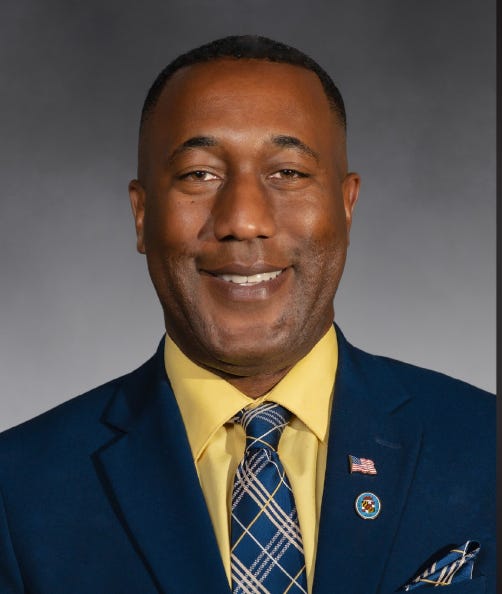
Ralph Patterson II’s Ballot Whiplash Raises Questions — and Underscores a Family Legacy
CHARLES COUNTY — In a cycle already defined by procedural skirmishes and paperwork landmines, the brief disqualification — and rapid reinstatement — of Ralph E. Patterson II stands out as one of the more unusual turns in Southern Maryland politics this spring.
Patterson, a candidate for the Charles County Board of Education, was removed from the ballot in late March after the county elections office determined that his 2025 financial disclosure form had been filed late, a requirement that Maryland law treats as a bright‑line compliance issue.
Two days later, after an emergency March 25 hearing, the Board reversed course and restored Patterson to the ballot, concluding that the deficiency had been corrected and did not warrant permanent exclusion.
For most candidates, that would be the whole story — a paperwork stumble, a quick fix, and a return to the race. But Patterson is not just any candidate. He is part of one of Charles County’s most visible political families, and that context matters.
A Family With Deep Roots in Public Service
The Patterson name carries weight in Charles County. His mother, Delegate Edith Patterson, has long been one of the county’s most respected public servants — a steady, community‑grounded legislator whose career spans education, county government, and the Maryland General Assembly.
Her reputation for diligence and constituent focus is well‑established, and even her political opponents tend to speak of her with a kind of professional respect that is increasingly rare in modern politics. In a county where personal credibility still matters, her presence in the background of this story is impossible to ignore.
That doesn’t mean the Board of Elections treated her son differently — there’s no evidence of that, and the timeline suggests a straightforward compliance issue followed by a straightforward cure. But it does mean that any turbulence around the Patterson name lands with more visibility than it might for a lesser‑known candidate.
A Procedural Issue, Not a Political One
The available reporting points to a simple sequence:
- Patterson filed his 2025 financial disclosure after the deadline.
- The Board issued a disqualification, as required.
- Patterson corrected the issue.
- The Board held an emergency hearing and reinstated him.
Maryland’s election law is strict about disclosures, but it also allows for reinstatement when a candidate cures the deficiency before ballots are finalized. That appears to be exactly what happened here.
Still, the speed of the reversal — and the confusion created by conflicting early reports — left many voters wondering what had actually occurred.
The Political Impact
For Patterson, the episode is likely to be a footnote rather than a defining moment. School board races in Charles County tend to turn on community ties, visibility, and trust — all areas where the Patterson family has long-standing strength.
But the incident does highlight a broader trend this cycle: procedural compliance is becoming a quiet but consequential battlefield, especially in local races where volunteer‑driven campaigns can easily miss a filing deadline or misinterpret a requirement.
In that sense, Patterson’s brief detour off the ballot is less a scandal than a reminder — even well‑known families with deep experience in public life are not immune to the technicalities of Maryland’s election machinery.