

🗳️ Race-Packing in Baltimore County: The Deleted Post, the Backlash, and the Quiet Deal Behind the Map
By Barry O’Connell
Strategic Editorialist | Reputational Architect | Conscience of Maryland Politics


🔥 The Post That Sparked a Firestorm
Early this morning, a wave of Democratic activists woke up to a chain message circulating via text and email—one that referenced a now-deleted post from the Villanova Community Association’s Facebook page. The post, reportedly shared by a sitting councilmember, attacked the “Woodlawn Approach” redistricting map with language that many are calling racially inflammatory and reminiscent of 1960s-era fear-mongering.
The message that followed was blunt:
> “Shame! Shame! Shame! on whoever put out this racist propaganda against the Woodlawn Approach map… If indeed this garbage… was produced with the knowledge, consent, at the behest of, or by Councilman Izzy Patoka… he has just eliminated any reason for any Black person in Baltimore County who is not self-hating to support his proposed Amended 2-2-5 map…”
The post was taken down swiftly—but not before it was screenshotted, shared, and dissected by dozens of Democratic insiders. The damage was done. And the deeper question remains: What kind of map are we fighting over—and who benefits from it?
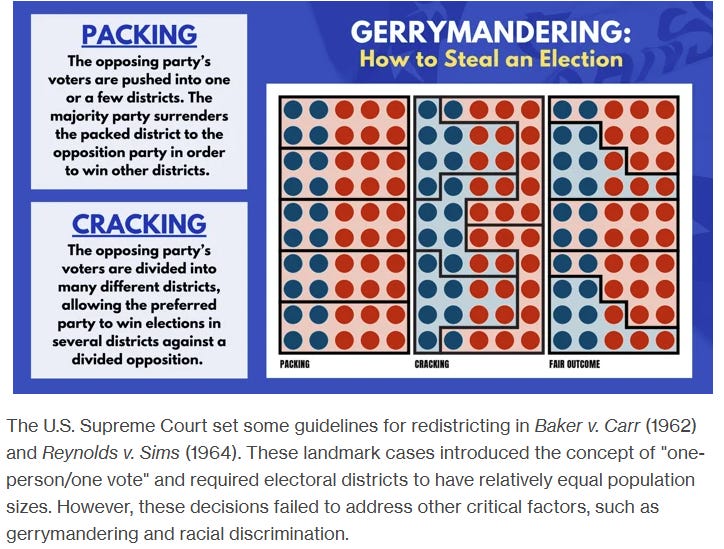
🧠 What Is Race-Packing—and Why It Matters
At the heart of this controversy is a tactic known as race-packing: the deliberate concentration of voters of color into a single district, often under the guise of “representation,” but with the real effect of limiting their influence elsewhere.
Here’s how it works:
- When you jam 74.5% of Black residents into one district (as proposed in the Woodlawn/Lochearn corridor), you reduce the number of Black voters available to form coalitions in surrounding districts.
- This allows adjacent districts—especially in North County—to remain safely white, safely conservative, and safely Republican.
- The result? A map that looks inclusive on paper but is strategically designed to protect incumbents and suppress broader Black political power.
This is not just a technical issue. It’s a moral one. And it’s why so many activists are calling the amended 2-2-5 map a betrayal of racial equity.
In light of Baker v. Carr (1962) and Reynolds v. Sims (1964) it is likely a legal issue as well. Is Izzy breaking the law to please his Orthodox contributors and his Republican allies.
🤝 The Quiet Deal Behind the Map
According to multiple sources close to the redistricting process, Councilman Izzy Patoka has struck a quiet alliance with North County Republicans—offering them safe districts in exchange for their support in his upcoming run for Baltimore County Executive.
This is the real story behind the map:
- Republicans get protection: Their districts remain untouched, their incumbents unchallenged.
- Patoka gets a coalition: A bipartisan bloc to boost his executive ambitions.
- Black voters get boxed in: Their influence confined to one or two district, their voices diluted elsewhere, especially on thee East Side.
One insider described Patoka as a “crooked weasel”—a term that, while harsh, reflects the growing frustration among activists who feel betrayed by a Democrat willing to trade away racial equity for political gain.
🧭 What Comes Next
This isn’t just about one map. It’s about the future of Baltimore County politics. Will we allow race-packing to masquerade as representation? Will we let quiet deals override public trust?
The deleted post may be gone, but the backlash is real. And the fight for fair maps is just beginning.
📚 Footnotes
1. Understanding Race-Packing and Its Impact on Voting Power — Brennan Center for Justice
2. Redistricting in Baltimore County: The 2-2-5 Map Controversy — Baltimore Sun
3. Villanova Community Association Facebook Page (Archived) — Internet Archive
4. Councilman Izzy Patoka’s Redistricting Proposal — Baltimore County Council
5. The Woodlawn Approach Map Explained — NAACP Legal Defense Fund