

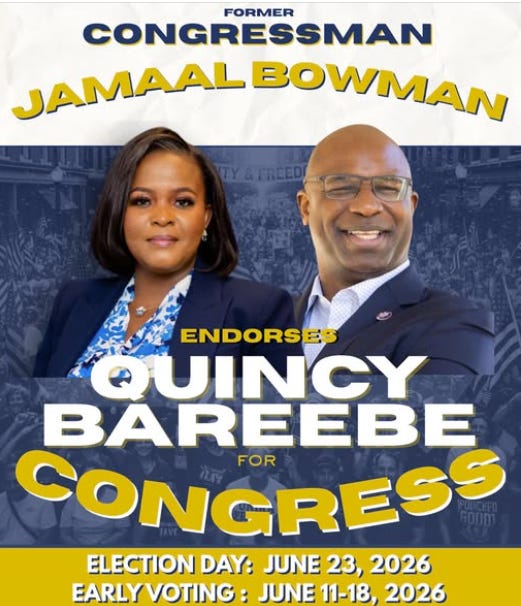
1. Who is Jamaal Bowman
- Former U.S. Representative from NY‑16 (Bronx/Westchester).
- Elected in 2020 as part of the progressive left aligned with Alexandria Ocasio‑Cortez.
- Former middle‑school principal who ran as an anti‑establishment reformer.
- Lost his 2024 Democratic primary to George Latimer after a highly contentious race.
Bowman is widely described as a “Squad” member, meaning he is part of the small group of House Democrats who take left‑progressive, activist‑driven positions and often break with party leadership.
2. What he stands for (in broad terms)
These are the positions he is publicly associated with:
- Abolishing ICE and major immigration enforcement reforms
- Defunding or dramatically restructuring The Military and police departments
- Green New Deal–style climate policy
- Aggressive criticism of U.S. foreign policy, especially toward Israel
- Opposition to Biden‑backed infrastructure and spending compromises
- Movement‑style politics — rallies, protests, activist coalitions
These positions are not unusual inside the Squad, but they are well to the left of the median Democratic voter nationally.
3. What made him controversial inside the Democratic Party
This is where Bowman differs from a typical Democratic member of Congress:
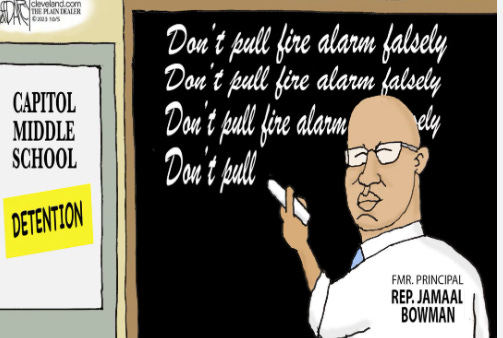
A. The fire‑alarm incident
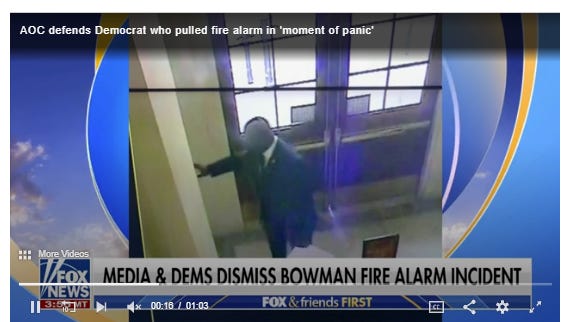
He pulled a fire alarm in a House office building during a key vote.
He later pleaded guilty to a misdemeanor and was censured by the House.
Even Democrats called it “reckless” and “embarrassing.”
B. Past 9/11 conspiracy‑theory writings
Old blog posts and poems surfaced where he questioned the official 9/11 narrative.
He later disavowed them, but the damage was done.
C. Hard‑line positions on Israel
He took positions that were far left even within the Squad, including rhetoric that alienated Jewish voters in his district.
This became a major factor in his primary defeat.
D. Voting against Biden’s infrastructure bill
He opposed the Infrastructure Investment and Jobs Act, a core Biden achievement.
This angered moderates, unions, and mainstream Democrats.
E. Style: confrontational, activist‑first
He often framed disagreements as moral failings of other Democrats.
This created friction with colleagues who prefer coalition‑building.
4. How this compares to the typical voter in Maryland’s 5th District
MD‑05 is a mainstream Democratic district with:
- Federal workers
- Retirees
- Active‑duty and retired military
- Small business owners
- Black middle‑class suburban voters
- Rural Southern Maryland moderates
This is not a district known for far‑left politics. It is a district known for:
- Stability
- Federal jobs
- Defense spending
- Moderate Democratic governance
- Pragmatic, not ideological, politics
Where Bowman diverges from MD‑05 norms
| Issue / Behavior | Bowman’s Position | Typical MD‑05 Voter Position | Why It Diverges |
| Israel / Gaza | Very critical of Israel; aligned with activist left | MD‑05 has many moderate Black, suburban, and military voters who prefer balanced or pro‑Israel positions | Seen as too extreme |
| Police / Public Safety | Supported “defund”‑adjacent rhetoric | MD‑05 voters (especially PG/Charles) want reform, not defunding | Safety is a top concern |
| Defense / Military | Skeptical of Pentagon spending | MD‑05 includes thousands of active‑duty and retired military | Defense cuts are unpopular |
| Biden Infrastructure Bill | Voted against it | MD‑05 voters rely heavily on federal investment | Seen as anti‑Biden |
| Fire‑alarm incident | National embarrassment | MD‑05 voters value professionalism | Seen as unserious |
| Conspiracy‑theory baggage | Past writings resurfaced | MD‑05 voters are pragmatic, not fringe | Damages credibility |
5. So why is he “hit” so hard?
Because he combined:
- Ideological positions outside the mainstream
- Personal controversies
- A confrontational style
- A high‑profile censure
- A voting record that broke with Biden
- And a district that rejected him decisively
Even many Democrats said his defeat was not about ideology alone — it was about judgment and fit.
6. Why this matters in Maryland
If Bowman is campaigning for Quincy Bareebe, the political signal is:
- She is aligning with the national progressive activist left,
- Not the traditional MD‑05 establishment,
- And she is comfortable bringing in a figure who is controversial even among Democrats.
This is not advocacy — it’s simply explaining how political actors are interpreted inside the Democratic Party.
Len Foxwell liked this.