

When “Not a Lobbyist” Still Looks Like Lobbying in Frederick
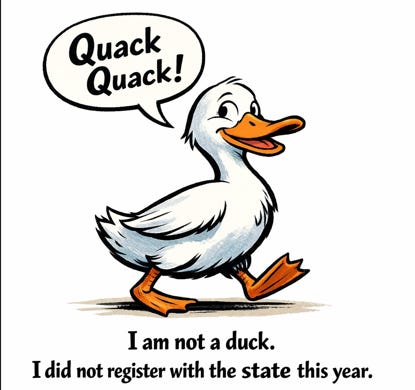
There’s an old test for figuring out what you’re looking at: if it walks like a duck and quacks like a duck, it’s probably a duck.
But in Frederick, we’re now being asked to accept a new variation: if it walks like a duck and quacks like a duck, it’s still not a duck — because the duck didn’t register with the State Ethics Commission this year.
Quack quack Katie!
That’s the position Council Vice President Katie Nash has put this city in. And residents are noticing.
Nash recently told the Frederick City Council that she is “no longer a lobbyist,” that she is “not registered with the state,” and that she has stepped away from that line of work. Technically, that statement is true. Her name no longer appears on Maryland’s list of registered lobbyists. She has withdrawn her registration. She has, in the narrowest legal sense, exited the business.
But politics is not lived in the narrowest legal sense. It is lived in the space between what is technically permissible and what the public can plainly see.
And what the public sees right now is a council member with a long, well‑documented history of lobbying for the firefighters’ union — IAFF Local 3666 — now appearing in Annapolis, testifying on their behalf, identifying herself as someone who has “worked with them for years,” and urging lawmakers to pass the union’s priority legislation.
If that’s not lobbying, it is close enough that the distinction becomes academic.
Residents aren’t imagining this. They aren’t overreacting. They aren’t being partisan. They’re responding to a pattern that keeps repeating itself: Nash says one thing in Frederick, and then does something very different in Annapolis. And every time, the explanation is a technicality, a loophole, or a semantic dodge.
Let’s revisit the record. In 2022, the City of Frederick Ethics Commission reviewed allegations that Nash used city Neighborhood Advisory Councils to advance the interests of IAFF Local 3666 — her paying client at the time. The commission cited the city’s conflict‑of‑interest rules, including the prohibition on using the prestige of office to benefit a private party “whether or not for compensation.” The case was ultimately closed without a finding of a violation, but the concerns were serious enough that the city’s top elected official filed the complaint.
Fast‑forward to today. Nash is again under ethics scrutiny — this time over data‑center legislation and potential conflicts — and again she is assuring the public that she is not a lobbyist. Yet the video from Annapolis shows her doing exactly what the public associates with lobbying: speaking for an organized interest, advocating for their bill, and presenting herself as someone who has represented them for years.
Maybe she’s doing it for free. Maybe she’s doing it as a volunteer. Maybe she’s doing it out of long‑standing loyalty. Those are possibilities. But they are not explanations. And they certainly are not answers.
Maryland’s lobbying laws are clear: you must register if you are compensated above certain thresholds or spend a certain amount of time influencing legislation. But the law also leaves wide space for people to operate just under the threshold — advocating, testifying, shaping policy — while still claiming the title “not a lobbyist.”
That may satisfy the State Ethics Commission. It does not satisfy the public.
Frederick residents deserve to know:
- Is Nash currently being compensated by IAFF Local 3666 or any related organization?
- If not, when did that compensation end?
- Has she received any reimbursement — travel, meals, consulting fees — related to her testimony?
- Does she believe that appearing in Annapolis on behalf of a past or present client is consistent with her statement that she is “no longer a lobbyist”?
- Why did she not disclose her ongoing advocacy when addressing the council?
These are not “gotcha” questions. They are the bare minimum of what any elected official should be willing to answer when their public statements and public actions diverge.
And let’s be candid: this divergence is not subtle. It is not hidden. It is not buried in paperwork. It is right there on video, in front of the General Assembly, in her own words.
Some residents have gone further, telling me they feel misled. They feel that Nash has a pattern of saying whatever is convenient in the moment, and that her relationship with the truth bends when circumstances require it. I am not making that allegation myself. But I am acknowledging that this perception exists, and that it exists for a reason.
When an elected official insists she is not a lobbyist while simultaneously doing the things the public associates with lobbying — testifying for an organized interest, identifying herself as part of that interest, and advocating for their legislation — it erodes trust. It invites skepticism. It raises questions that only she can answer.
And until she answers them, the cloud remains.
Frederick deserves better than technicalities. It deserves transparency. It deserves honesty. It deserves elected officials who understand that public trust is not a box to be checked but a standard to be upheld.
If Katie Nash is no longer a lobbyist, she should have no trouble explaining why her conduct still looks so much like lobbying. If she is acting as a volunteer, she should say so plainly. If she is being compensated, she should disclose it. And if she believes her testimony is consistent with her statements to the council, she should make that case directly to the people she serves.
Silence is not an answer. Semantics are not an answer. The residents of Frederick are asking real questions. They deserve real answers.