

A quiet revolution in Maryland politics played out not in Annapolis hearing rooms, but in cul‑de‑sacs, real estate offices, and one now‑legendary basement in Prince George’s County. The story of Parris Glendening, Wayne Curry, and the 2002 governor’s race is, at its core, the story of how the Democratic establishment struggled—and often failed—to adapt to a county transforming from a white suburban stronghold into the beating heart of Black political power in Maryland.
From white suburb to Black power base
By the late 1960s, Prince George’s County was beginning a demographic transition that would fundamentally reorder Maryland politics. Housing discrimination and de facto “sundown” practices, especially in inner‑beltway towns like Cheverly, began to break down after 1968, opening doors—reluctantly—for Black families priced out of, or pushed out of, Washington, D.C.
The 1968 riots in D.C. accelerated a suburban exodus. Black middle‑class families, fearing for their homes and their children’s safety and seeking both stability and opportunity, looked outward. Prince George’s became the most accessible, plausibly welcoming suburban destination, even if “welcome” often meant police cruisers rolling up to moving vans and demanding proof that new Black homeowners were “allowed” to live there. Each such encounter was both an insult and an omen: the county’s racial composition was changing faster than its power structure.
At the state level, the old-line Democratic leadership understood the arithmetic even if it did not fully embrace the implications. For figures like Steny Hoyer and Senate President Mike Miller, a growing Black electorate in Prince George’s was a hedge against Republican gains elsewhere in Maryland. Concentrating and encouraging Black Democratic voters in the county helped lock down a base for Hoyer’s congressional seat and shored up Miller’s machine in the Senate. It was demographic engineering in service of institutional stability.
But what served the interests of the statewide machine did not necessarily serve the emerging local Black leadership—or the Black residents whose votes fueled the new order. The party was happy to bank their support. It was far less eager to surrender real power.
The old machine and the basement revolt
For years, Prince George’s remained, formally, a white‑run Democratic county even as Black residents became an ever larger share of its population. The county’s political culture still bore the imprint of the Sasscer‑era courthouse machine: clubby, insular, transactional, and overwhelmingly white. Black candidates could win legislative seats, but the executive suite and the levers of patronage were another matter.
Parris Glendening rose within, and then to the top of this system. As Prince George’s County Executive, he cultivated a technocratic image and later leveraged his suburban base into the governorship. When Glendening prepared to move up, he did what governors‑in‑waiting do: he tried to hand‑pick his successor in Upper Marlboro. His establishment choice was a white council woman Sue V. Mills. The Hoyer/Miller machine backed African Anerican Senator Beatrice Tignor, whose candidacy symbolized continuity with the old order more than a reckoning with the new electorate.
What many in politics missed was the impact of the Jesse Jackson campaign for president. He ran in 1984 getting 18% of the vote but he awakened a sleeping giant. He came back in 1988 and ran second to Michael Dukakis nationally. But what people missed in politics in Maryland was that Jesse Jackson pulled very well in Prince George’s County and Baltimore because the Jackson campaign registered a lot of Black voters. One heck of a lot of black voters. Suddenly there was an apparatus in Prince George’s County politics that was not tied to the remnants of the Sasscer machine or the Hoyer Miller machine. Instead, it was the outgrowth of the Jesse Jackson for president rainbow coalition, so Mike Miller could run Senator Bea Tignor a popular Black elected official and senator from Southern Maryland. But Tignor didn’t have the impact countywide that the newly registered blacks and the former rainbow coalition players in Prince George’s County politics had. It was out of that mix of Jackson supporters that came the basement meeting when they decided to take down both the Hoyer Miller machine and the Glendenning Sasscer machine. Jesse Jackson’s campaign had told black voters, particularly in Prince George’s County that they didn’t need white permission or white direction to run a political campaign.
Black elected officials and activists in Prince George’s read Glendenning’s choice as a snub and a warning. The implicit message: you can deliver votes, but not call the shots. The response was the now‑famous “basement meeting,” where Black politicos gathered, literally underground, to decide whether they would accept Glendening’s chosen successor, The Miller backed African American candidate or back one of their own.
They chose Wayne Curry an African American attorney deeply involved in the Jesse Jackson campaign and a Jackson Delegate.
Curry’s candidacy was more than just a bid for office; it was an assertion that Prince George’s should be governed by leaders who reflected its residents. His victory made him the first Black county executive and marked a formal transfer of local power from the white machine to the Black majority. It was also the beginning of an uneasy, often bitter, co‑existence between a Black‑led county and a Democratic governor who had not fully anticipated what it meant to share power with the people whose votes had built his career.
Glendening and Curry: allies on paper, adversaries in practice
On paper, a Democratic governor from Prince George’s and a Democratic county executive from Prince George’s should have been natural partners: same party, overlapping constituencies, shared interests in schools, development, and transportation. In practice, their relationship was stiff, distrustful, and increasingly adversarial.
From Curry’s perspective, Annapolis never delivered what Prince George’s deserved. The county was a Democratic vote engine that helped keep the State House blue, yet it struggled with underfunded schools, stubborn crime, and uneven economic development. Requests for more aggressive state support frequently ran into the twin realities of tight budgets and competing regional demands, but they also ran into something more political: a sense in the old guard that Prince George’s was already “taken care of” by virtue of its loyalty.
From Glendening’s side, Curry could look like an insatiable local executive, bringing an endless list of needs and grievances while offering relatively little gratitude for what the state did provide. The personal history didn’t help. Curry had not been Glendening’s chosen heir; he was the product of a revolt that explicitly challenged the governor’s grip on the county’s future. That made every ask from Upper Marlboro feel, in Annapolis, a little like a demand from an upstart rival rather than a partner.
Press coverage through the late 1990s and into the early 2000s chronicled this tension as a series of spats over resources, priorities, and respect. Curry publicly broke with Glendening in earlier cycles by supporting rivals and signaling that the old deference to the governor’s office no longer applied. Their disagreements weren’t just about policy; they were about who got to define what Democratic power in Prince George’s—and Maryland—should look like.
2002: When the fault lines reached the governor’s race
All of that history detonated in 2002.
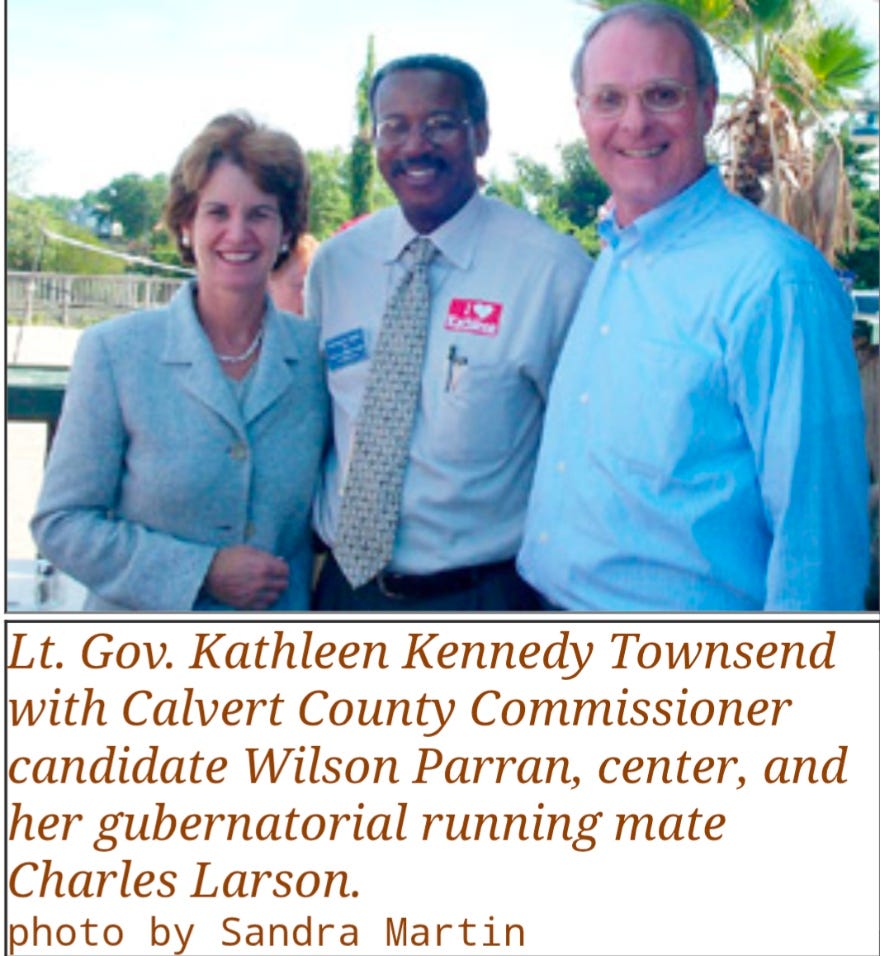
Kathleen Kennedy Townsend, Glendening’s lieutenant governor, emerged as the Democratic nominee for governor, carrying all the baggage of the outgoing administration into a race against Republican Congressman Bob Ehrlich. Townsend’s campaign made a series of strategic choices that alienated Black leaders already frustrated with Glendening, none more symbolically potent than her choice of running mate: Admiral Charles Larson, a white former Republican.
To many Black Democrats, especially in Prince George’s and Baltimore City, that selection was a loud confirmation of a quiet pattern. Black voters were indispensable to Democratic victories, but Black leaders were dispensable when real power was allocated. In a state where multiple Black Democrats were qualified to run statewide, Townsend’s decision was read not as “big tent” politics but as a snub to the very people who had defended the tent for decades.
In that climate, Wayne Curry’s decision to back Ehrlich was less an ideological conversion than an act of political indictment. It said, in effect: if the Democratic establishment will not treat Black leaders as partners, it should no longer assume Black leaders will function as its enforcers.
The electoral math underscores the point you want to make in your piece. Townsend carried Prince George’s County robustly—roughly three‑quarters of the vote—but not at the towering margins the county often delivers for Democrats. In a race decided by relatively narrow statewide margins, a ten‑point higher share in Prince George’s, or a stronger turnout and margin in Baltimore City, could plausibly have changed the outcome. The Ehrlich‑Townsend contest showed what happens when a party’s most loyal base becomes merely “reliable” instead of enthusiastic.
Ehrlich, for his part, understood the optics. By choosing a Black running mate, he gave Black voters—especially men—a sanctioned way to defect or underperform for the Democratic ticket without feeling that they were voting against their identity or interests. Even modest erosion of the Democratic share in Prince George’s and Baltimore City, combined with strength in Baltimore County and outer suburbs, was enough to break a decades‑long Republican drought in the governor’s office.
Growing pains and a lesson in power
The Glendening–Curry conflict, the basement revolt, and the 2002 governor’s race were all expressions of the same unresolved question—how quickly and how fully Maryland’s Democratic establishment would adapt to a world in which Prince George’s County was no longer a white suburb with Black voters, but a Black suburb with its own power brokers.
The old white machine was willing—even eager—to welcome Black residents as a demographic solution to statewide electoral problems. It was far slower to welcome Black leaders as equal partners in distributing resources, making appointments, and deciding succession. The basement meeting that elevated Wayne Curry was the county’s way of saying it would no longer wait for permission. The clash between Curry and Glendening was what happened when that declaration met a governor who had risen under the old rules.
By 2002, those unresolved tensions spilled into the open in the most visible way possible: a Black Democratic county executive from the state’s most critical Democratic county signaling support for a Republican gubernatorial candidate, while the Democratic ticket failed to fully energize the very voters it most depended on. Townsend’s loss to Ehrlich was not solely the product of Prince George’s politics, but it cannot be separated from them.
This is both a local story is about one county’s transition from white to Black—and a statewide cautionary tale. Parties that rely on demographic change to cement their power eventually must decide whether those new voters will be treated as mere numbers on a spreadsheet or as partners at the table. Prince George’s County, in the Glendening–Curry era, shows what happens when that decision is delayed too long.
The Mathematician in the Basement:

By all accounts, it was just a basement meeting. A handful of insiders, a few folding chairs, and a chalkboard of possibilities. But what happened in that room would alter the trajectory of Prince George’s County—and, eventually, the state of Maryland. At the center of it all sat a quiet man with a mathematician’s mind and a revolutionary’s patience: Er…