

The Cable News Odds Fallacy: Why Political Betters Don't Have Polling Data (and Don't Pay State Taxes)
If you have watched cable news lately, you have likely seen analysts staring at line graphs showing Candidate A at "97%" and Candidate B at "3%." The commentators often discuss these numbers with breathless urgency, treating them as if they are live, hyper-accurate polling updates.
They aren't. They are order books from financial prediction exchanges like Kalshi and Polymarket.
Understanding what these numbers actually mean—and exposing the regulatory illusion behind them—is critical if you need to explain political risk and election dynamics to clients, boards, or stakeholders.
1. "97% Certainty" Is Not "97% of the Vote"
The biggest mistake commentators make is conflating win probability with voter support.
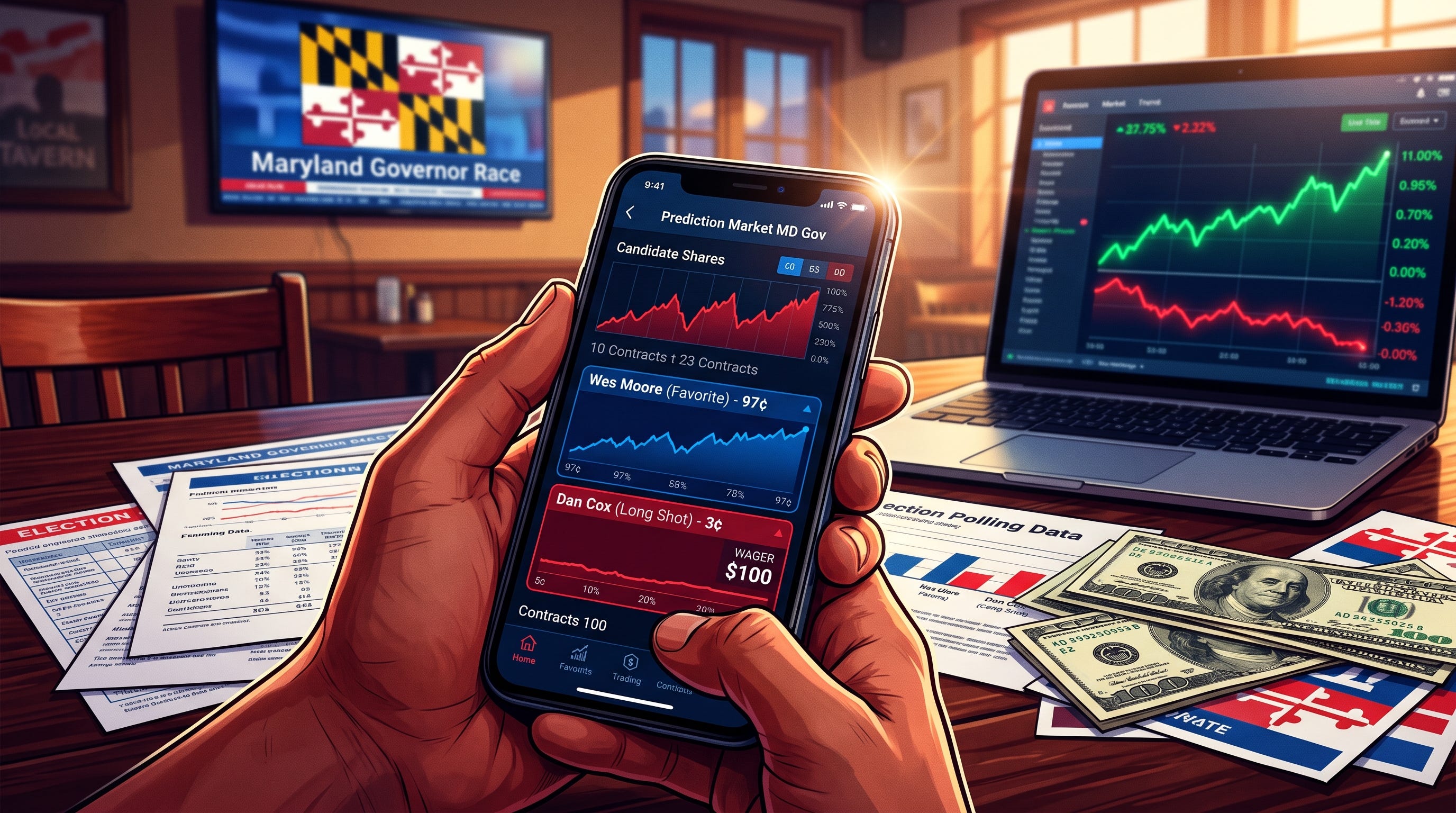
Take the Maryland gubernatorial contest between Democrat Wes Moore and Republican Dan Cox. In recent traditional polling from the Institute for Politics, Media & Public Affairs at UMBC, Wes Moore leads Dan Cox 51% to 24% among likely voters.
A 27-point polling lead in a blue state is a mountain to climb. Because traders recognize that demographic reality, the prediction markets price Moore’s winning contract at around 97¢ and Cox’s at around 3¢.
Here is what that math actually means for a $100 wager:
$100 on Dan Cox (The Long Shot): At 3¢ per share, $100 buys you roughly 3,333 contracts. If Cox pulls off a miracle and wins, every contract pays $1.00. Your $100 payout transforms into $3,333—a 32-to-1 return ($3,233 net profit).
$100 on Wes Moore (The Favorite): At 97¢ per share, $100 buys you about 103 contracts. If Moore wins, you collect $103, earning a grand total of $3.00 in net profit.
When cable news says Moore is at "97%," it does not mean he has 97% of Maryland voters behind him. It means traders believe there is a 97% chance he wins by any margin—even if he wins by a single vote. Polling measures voter preference; prediction markets measure trader consensus on victory.
       TRADITIONAL POLLS                       PREDICTION MARKETS
  [ Sample of Representative Voters ]         [ Financial Speculators ]
                │                                         │
                ▼                                         ▼
   "Who do you plan to vote for?"           "What are you willing to risk?"
                │                                         │
                ▼                                         ▼
     Measures Voter Share (51% v 24%)          Measures Win Chance (97% v 3%)
2. The Legal Illusion: Bookmaking by Another Name
How are these platforms operating legally across the country? By dressing gambling up as "financial risk management."
Twenty years ago, I was advising officials close to the president in an Islamic government in the Middle East. Under Twelver Shi'ite jurisprudence, general sports gambling is strictly forbidden (haram). However, classical religious law made a narrow exception for horse racing—permitting wagers, but strictly only among the horse owners or riders themselves, prohibiting outside spectators from betting.
Because leadership wanted horse racing, I proposed a legal workaround (hiyal shar'iyyah): construct a financial syndicate where spectators briefly purchased fractional equity in a horse seconds before the gate opened, becoming temporary "owners," and then sold the equity back to the original owner after the race at a predetermined price.
They ended up taking a different path, but the logic remains identical to today’s political betting exchanges.
Prediction platforms use financial engineering to circumvent state gambling bans:
They stop calling wagers "bets" and start calling them "binary event contracts."
They stop calling themselves "bookmakers" and apply for status as "designated contract markets" regulated by the Commodity Futures Trading Commission (CFTC).
By claiming to be federal derivatives exchanges, they bypass state regulation entirely.
3. The Policy Arbitrage: Zero State Taxes
This legal re-labeling creates a stark tax imbalance for state governments:
Licensed Maryland Sportsbooks (DraftKings, FanDuel): Pay a 15% state tax on gross gaming revenue, generating millions of dollars annually for Maryland public education, while adhering to strict state oversight.
Prediction Platforms (Kalshi, Polymarket): Argue they trade federal financial commodities. As a result, the exchange platforms pay $0 in Maryland state gaming taxes.
While individual traders are still required to pay capital gains taxes on their personal profits, the platforms operate as untaxed, unlicensed bookmakers within state borders under the protection of federal financial preemption.
The Cheat Sheet for Your Clients
When your clients or board members ask about the latest prediction market headlines, keep these three points in mind:
Markets reflect narrative velocity, not voter demographics: Traders skew heavily young, male, affluent, and tech-leaning. Markets react instantly to headlines, but they do not represent a scientific cross-section of voters.
Probability is not margin: A 95% market price indicates high confidence in a victory, not a massive landslide in voter turnout.
Liquidity drives accuracy: In high-volume markets (like presidential races), crowd wisdom can synthesize information quickly. In smaller state-level markets, a single wealthy trader ("whale") can move the odds by several points with a single transaction.
Prediction markets are a useful tool for tracking trader sentiment and breaking-news momentum, but they are not polls—and they shouldn't be treated as gospel on cable news.