Is Krystal Oriadha buckeling under tthe presure of he possibly criminal behavior?
There’s a certain kind of social media post that says everything—and nothing—all at once.
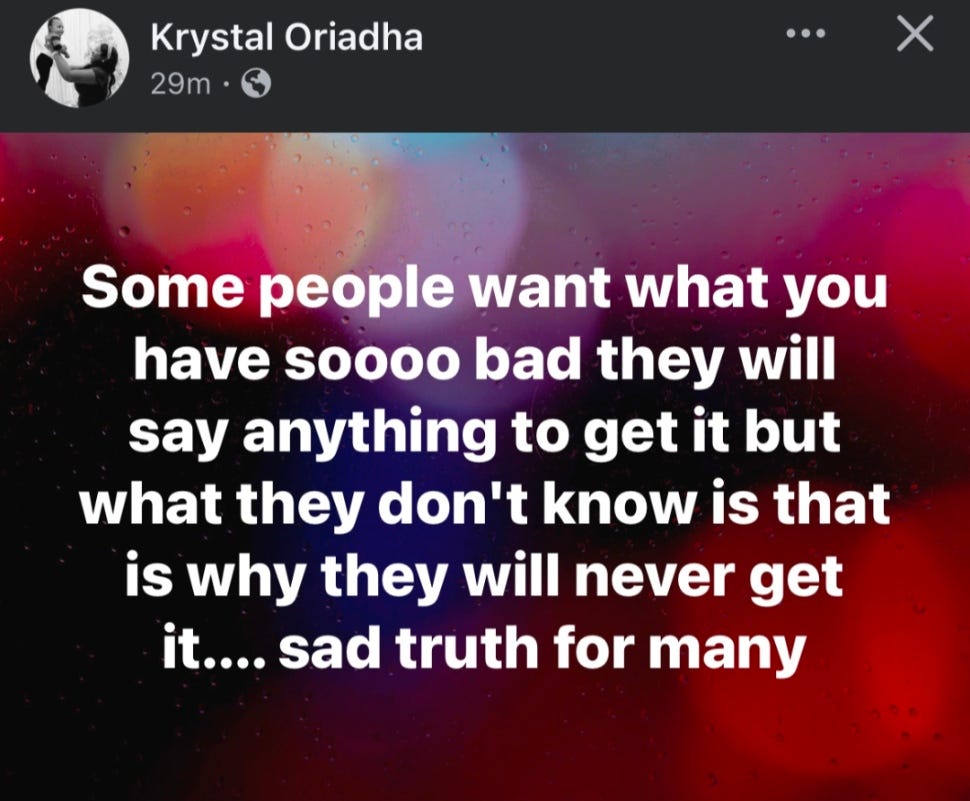
> “Some people want what you have soooo bad they will say anything to get it, but what they don't know is that is why they will never get it.... sad truth for many.”
That line, shared by a sitting Prince George’s County Councilmember, sounds like the caption to a reality TV confessional. But when it’s coming from an elected official whose recent record includes publicly funded private crab feasts and eyebrow-raising grants to questionable nonprofits, it reads less like hard-earned wisdom and more like a smoke bomb.
THE LAVISH CRAB FEAST
This councilmember, now facing increased scrutiny, recently hosted a lavish crab feast, reportedly covered by taxpayer dollars. Attendees were personal guests, not constituents, and the event offered no clear public purpose.
LOOTED THE RED CROSS GRANT
Meanwhile, allocations meant for household-name organizations such as the Red Cross and the Capital Area Food Bank were quietly siphoned off. In their place? Funding awarded to lesser-known nonprofits with direct ties to political allies—including a $500,000 grant to a group connected to the councilmember’s ““SPECIAL FRIEND” and longtime business associate.
PAY-TO-PLAY POLITICS
It’s a move that raises more than a few red flags in a county long haunted by pay-to-play politics and blurred lines between public service and private interest. While these actions may skirt the technical definition of corruption, they don’t pass the public trust test.
And yet, instead of answering to these very real concerns, we get a Facebook koan designed to cast critics as envious, manipulative climbers. “They want what I have.” It’s a telling refrain. But what exactly is being protected—power, influence, or access to a checkbook the public can’t easily track?
Prince George’s deserves better than wounded aphorisms and whisper campaigns. It deserves transparency, accountability, and leadership that doesn’t hide behind vague declarations of self-worth when the questions get uncomfortable.
There’s a difference between being criticized because you’re powerful and being criticized because you’re not being forthright. One invites respect. The other invites oversight.