

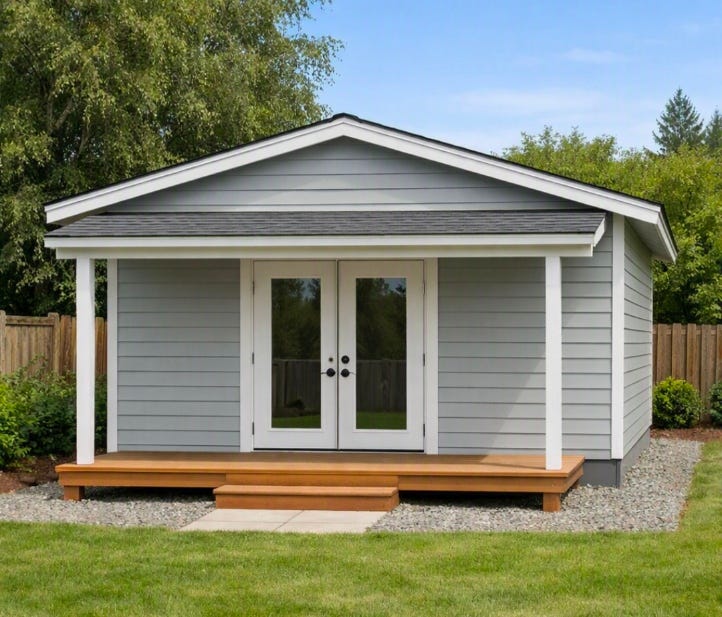
The Trouble with ADUs: How Building Codes Are Killing Maryland’s Backyard Housing Boom—and the $500M Corporate Model That Could Save It
By Barry O’Connell
If you listen to the policy architects in Annapolis, you’d think Maryland had just unlocked the golden ticket to solving its housing crisis.
With the passage of the landmark Accessory Dwelling Units Act (HB 1466 / SB 891), the General Assembly mandated that every charter county and municipality adopt local laws authorizing backyard cottages, in-law suites, and dinky side-yard bungalows by October 1, 2026.
The vision is simple and politically lucrative: allow suburban homeowners to build 400-to-600-square-foot cottages, create an ocean of naturally occurring affordable rental housing for seniors and young workers, and give middle-class property owners a crack at passive rental income.
It sounds brilliant on a press release. But if you talk to the land-use attorneys, land developers, and civil engineers tasked with actually building these things, you discover a dirty secret:
Under Maryland’s current regulatory and building code environment, the individual homeowner ADU model is dead on arrival.
The problem isn't a lack of interest. The problem is a massive, structural collision between well-intentioned housing policy and an unyielding wall of building code inflation.
The $150,000 "Dinky House" Paradox
My father once bought a small backyard bungalow—what they used to call a pool cabana. It was a single-room, ground-level timber frame structure. It was simple, affordable, and functional.
Try doing that today in Howard, Anne Arundel, or Prince George’s County.
Before a homeowner can drop a prefabricated $60,000 cottage onto a backyard pad, the regulatory apparatus steps in:
Civil Engineering & Site Prep: Site plans, stormwater management, and zoning reviews regularly drag on for six months and cost $15,000 to $25,000 in professional fees alone.
Environmental Health Overreach: County health departments frequently treat a single-occupancy 400-square-foot studio like a brand-new five-bedroom home, demanding massive primary septic retrofits or a 10,000-square-foot septic reserve field.
The Universal Fire Sprinkler Mandate: Under Maryland’s implementation of the International Residential Code (IRC) and local fire marshal mandates, every detached single-family structure—even a ground-floor studio with two immediate exterior exits—requires an NFPA 13D residential fire sprinkler system. For a backyard unit, this often means digging up the lawn, tapping water mains, or installing $15,000 holding tanks and booster pumps.
When $20,000 in engineering and $30,000 in utility upgrades are stacked onto a $60,000 factory-built cabin, a "cheap" backyard rental becomes a $150,000 to $180,000 capital asset.
At an 8% interest rate on a home equity loan, no rational homeowner is going to take on a $1,300/month debt service to rent a studio out for $1,200. The math fails. The yield evaporates.
Which raises the billion-dollar question for Maryland’s real estate industry: If mom-and-pop homeowners can't afford to build ADUs, who will? And can this broken market be packaged, scaled, and monetized at corporate volume?
[ PAYWALL BREAK — SUBSCRIBERS ONLY ] Subscribe to The Maryland Wire to unlock the full institutional analysis: including the "Solar Model" for residential ADU developments, the legal mechanics of backyard ground leases, and the three regulatory fixes that could open a $500M market in Howard and Prince George's counties.
WELCOME BACK, SUBSCRIBERS.
To understand how to monetize the ADU revolution in Maryland, you have to stop thinking like a residential remodeling contractor and start thinking like a utility-scale solar developer.
For years, the rooftop solar industry faced the exact same bottleneck: high upfront capital costs ($25,000+), complex permitting, and hesitant homeowners who didn't want to take out loans for technology they didn't fully understand.
Solar solved this through the Power Purchase Agreement (PPA) / Solar Lease model: We put the panels on your roof for zero dollars down, we absorb the permitting and installation risk, we maintain the asset, and we split the economic value with you over 20 years.
The exact same playbook can—and will—be applied to Maryland’s backyard housing market.
The "Distributed Residential Yield" (DRY) Model: Scaling 500 Backyard Homes
Imagine a private equity fund or regional real estate developer approaching a homeowner in Howard County or Prince George's County with a simple proposition:
"We will build a high-end, $120,000 eco-cottage in your backyard. Zero dollars out of your pocket. We handle the civil engineering, the fire suppression work, the county permitting, and the construction. In exchange, we sign a 20-year backyard land lease. We manage the tenant, pay you $400/month in pure ground-lease cash flow, and collect the remaining rent to amortize our capital and secure an institutional yield."
This is the Distributed Residential Yield (DRY) model, or "Backyard-as-a-Service." Here is why this model solves the very structural problems strangling individual homeowners:
1. Economy of Scale Overcomes "Soft Cost" Inflation
Where an individual homeowner gets slaughtered paying a civil engineering firm $20,000 for a one-off site design, a developer building 100 units across a single county can negotiate standardized, blanket engineering packages. They buy prefabricated, factory-certified modular units in bulk, driving unit costs down by 30% to 40%.
2. Specialized Permitting & Legal SWAT Teams
A single homeowner will get bogged down for nine months arguing with a county health officer over a septic reserve area. A specialized developer backed by high powered land-use attorneys (the Tom Coales of the world) operates with dedicated legal and entitlement pipelines. They know precisely which variance to file, which administrative exemptions apply, and how to push bulk permits through local planning boards.
3. The Institutional Capital Advantage
While a homeowner is constrained by high-interest retail HELOCs, a regional developer pools capital from private debt funds, REITs, or state affordable housing subsidies (such as DHCD financing programs). They deploy capital at institutional rates, making a $120,000 total unit deployment wildly profitable across a 500-unit portfolio.
The Legal & Financial Structure: How the Deal Works
For land-use attorneys and real estate firms, structuring a multi-unit "Backyard Portfolio" requires three core legal instruments:
+-----------------------------------------------------------------+
|                       PROPERTY OWNER                            |
|             (Owns Single-Family Detached Lot)                   |
+-----------------------------------------------------------------+
                                |
                                | 20-Year Backyard Ground Lease
                                v
+-----------------------------------------------------------------+
|                    DEVELOPER / SPE (ENTITY)                     |
|  - Installs Prefab ADU     - Manages Tenant & Leasing           |
|  - Absorbs Utility Costs   - Splits Cash Flow / Pays Land Rent  |
+-----------------------------------------------------------------+
                                |
                                | Encumbers ADU Asset Only
                                v
+-----------------------------------------------------------------+
|                       INSTITUTIONAL LENDER                      |
|             (Provides Capital for Bulk Deployment)              |
+-----------------------------------------------------------------+
The Backyard Ground Lease: Encumbers a designated 800-square-foot portion of the residential lot without subdividing the property. It grants the developer egress rights, utility easements, and operational control of the ADU footprint for 15 to 25 years.
Subordinated Utility Easements: Allows the developer to trench water, sewer, and electrical lines from the main street connection or primary home meters, utilizing sub-meters to track usage independently.
The Option to Purchase / Buyout Clause: Gives the homeowner the right to purchase the cottage at fair market value after Year 7 or 10, or automatically assumes ownership of the structure at the expiration of the 20-year lease term.
The Three Legislative Tweaks Needed to Unlock $500M
If Secretary Jake Day, the Department of Housing and Community Development, and the General Assembly want this developer-driven model to actually deliver the thousands of affordable units they promised, they must fix three specific statutory glitches before the October 2026 deadline:
Fix #1: Fire Sprinkler Proportionality (Sub-500 sq ft Exemption): Amend state building codes to exempt ground-level, single-story ADUs under 500 square feet from full NFPA 13D sprinkler requirements if the unit features two direct-to-grade exterior egress doors (e.g., standard French or sliding glass patio doors). Egress speed on a ground floor renders heavy suppression infrastructure redundant.
Fix #2: Statewide Pre-Approved Plan Catalogs: Mandate that DHCD publish a state master catalog of pre-approved modular ADU architectural designs. If a developer or homeowner uses a catalog design, county plan-review timelines must be capped by law at 30 days, and plan-review fees reduced by 75%.
Fix #3: Bedroom-Based Septic Scaling: Force local environmental health departments to calculate septic capacity strictly based on bedroom count and fixture flow rates rather than treating a studio ADU like an additional single-family home requiring 10,000 sq ft of dedicated reserve dirt.
The Bottom Line
The Maryland General Assembly passed the ADU law expecting millions of dollars in private homeowner capital to magically build affordable housing. It won't happen. Homeowners aren't real estate developers, and building codes are too complex.
The future of Maryland’s backyard housing boom belongs to the developers, attorneys, and institutional investors who realize that 500 small houses scattered across 500 suburban backyards isn't a zoning curiosity—it's a high-yield, distributed residential asset class.
The only question is which development group is going to build the first 100-unit portfolio in Howard County.
For more background on real estate development and housing policy discussions in Maryland, check out this podcast episode with attorney Tom Coale:
Aaron Dante and Tom Coale discuss housing in Maryland
This video features land-use attorney and housing lobbyist Tom Coale discussing housing growth strategy, land-use barriers, and legislative approaches to expanding housing supply across Maryland.
YouTube video views will be stored in your YouTube History, and your data will be stored and used by YouTube according to its Terms of Service
See also:
ADUs: Affordable Housing In Your Backyard

Unlocking the Backyard: How Maryland’s New Statewide ADU Law Promises Gentle Density, Family Wealth, and a Housing Breakthrough
Barry, since we talked about these last week, I'll echo my dismay at the 3 strikes ADUs face while stepping up to bat: site planning, septic designs, and fire sprinkler systems. And I'll elaborate what we face out here in the real world:
Civil engineers will get paid well over $15K to layout a property for a granny cottage. Then they'll get paid again to layout the septic drain field. IF - and that's a big maybe - we get the contract to build, we'll shell out $15K for ADUs dedicated septic system, plus the costs of the annoying fire sprinkler system.
At this point, we cannot build a 900SF ADU for less than $225K. In addition to the owner's $20K for site planning. Your numbers are far too low (rose colored glasses). Note: only doe-eyed Gen-Zers are thinking about sub-500SF living area. I have similarly-minded daughters w/ no child-rearing in their near futures...
While I appreciate your capitalism as a solution approach to scaling ADU deployment, it ignores the vast majority of what owners want in their small house: their own occupancy for boomerang kids, home offices and aging family members. We rarely hear about building to generate rental income. "Monetizing" and acting like a "utility-scale solar developer" is a tone-deaf approach to what individual families are saying: we need affordable housing for our family!
Regarding the "DRY" model, I appreciate the creative financing via Lease, but anyone with equity in their homes can go HELOC or Refi and create the same monthly payment scenario without the overbearing legal entanglements akin to a PPA. Ever talk to someone about their solar PV lease?... they do not like it, not one teensy bit. And besides, how many families today want a giant corporate developer dictating the terms of a Rental Lease so grandma and grandpa can live there?
The best component this DRY model proposes is State approved modular ADUs. Facilitating Building Permit processing is made possible when local JHAs can eliminate building plans review from their processes*. It provides the incentive often lavished on "green building" certified projects: faster permit turn-around. Just as is suggested under "Fix #2".
* Hopefully also removed are fire sprinkler plans reviews and confusing/confounding septic load calcs (via per-bedroom).
Keep up the good fight, and tell @TomCoale to jump in with both feet!
If we really wanted to solve the problem, then we would let people subdivided there property. That would allow a new owner to finance the new unit. Home size could be limited based on property size to keep it within the character of the neighborhood. Financing ADUs is difficult and not everyone wants to become landlords.