

THE SABINE TRAM CASE: THE OBSCURE 19TH‑CENTURY ODDITY THAT MARYLAND INSIDERS SWEAR EXPLAINS EVERYTHING ABOUT TODAY’S POWER LINE FIGHT
There are certain topics that, for reasons no one can fully explain, become the it conversation among Maryland’s political class. Some people gossip about cabinet reshuffles. Some obsess over budget projections. And then there are the people — the very serious, very plugged‑in, very in‑the‑know people — who will casually drop references to the Sabine Tram case as if it’s the Rosetta Stone of modern governance.
If you haven’t heard of it, don’t worry. That just means you’re normal. But among the Annapolis‑to‑Baltimore‑to‑Beltway set, invoking Sabine Tram has become a kind of intellectual handshake — a way of signaling that you’re one of the smart ones who “gets” the structural forces shaping Maryland’s current energy crisis.
And here’s the punchline:
They’re not entirely wrong.
THE CASE ITSELF: A QUIRKY LITTLE DISPUTE WITH A VERY BIG SHADOW
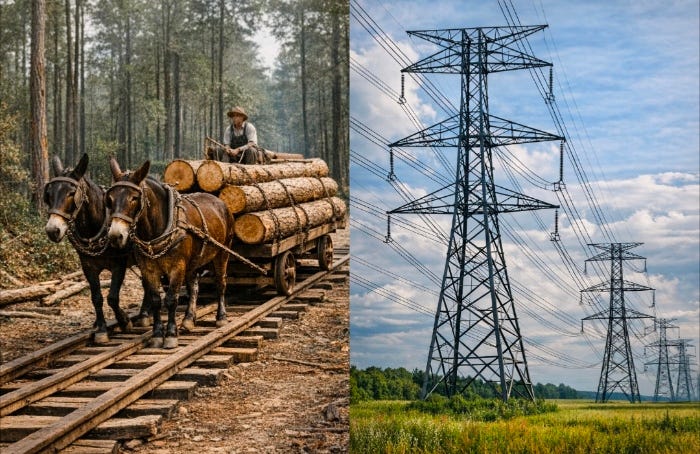
The Sabine Tram case — a dusty, late‑19th‑century dispute involving a timber tramway, interstate commerce, and the limits of federal authority — is not something most Marylanders have ever heard of. It involved a company moving goods across state lines using a rickety wooden tram system, and the federal government deciding it had the right to regulate the entire operation because it touched interstate commerce.
The ruling was simple:
If your infrastructure crosses state lines, the federal government can claim jurisdiction — even if the state bearing the burden gets little or no benefit.
Sound familiar?
This is why the insiders love it. It’s the perfect historical analogy for Maryland’s current role as the unwilling middle child in the PJM power‑grid family drama.
MARYLAND TODAY: THE SABINE TRAM PROBLEM, BUT WITH 500‑kV LINES
Fast‑forward to the 21st century, and Maryland finds itself in a nearly identical posture — except instead of logs on a mule‑powered tram, we’re talking about massive, federally blessed transmission lines carrying Pennsylvania‑generated electricity straight through Maryland farmland on its way to Virginia.
The federal mandate is clear:
Build the lines. Strengthen the grid. Don’t ask too many questions about who benefits.
And Maryland’s role is equally clear:
Absorb the ecological damage, the agricultural disruption, the property‑value hit, and the political blowback — all while receiving almost none of the power.
This is the Sabine Tram case in modern clothing.
Maryland is the corridor, not the customer.
THE PJM ANGLE: WHY THIS HITS A NERVE
PJM’s regional transmission planning has always been a delicate dance, but the new federal posture — “build big lines now, justify later” — has turned Maryland into the geographic sacrifice zone.
- Pennsylvania gets to offload excess generation.
- Virginia gets the delivered power.
- Maryland gets the towers, the easements, the environmental impact, and the lawsuits.
It’s the same structural imbalance the Sabine Tram case exposed:
interstate infrastructure where the burdens and benefits don’t match.
And Marylanders, especially in the Northern Tier and the agricultural counties, are noticing. Loudly.
WHY THE INSIDERS WON’T STOP TALKING ABOUT SABINE TRAM
Here’s where the snark comes in:
The people who bring up Sabine Tram at receptions, committee hearings, and off‑the‑record lunches aren’t doing it because they’re nostalgic for 19th‑century jurisprudence. They’re doing it because it makes them sound like the kind of person who reads dusty case law for fun.
But beneath the performative cleverness, they’re pointing to something real:
- Maryland is being told to accept infrastructure it didn’t ask for.
- The federal government is asserting authority because the lines cross state borders.
- The state’s objections are treated as procedural noise, not substantive concerns.
- And the economic benefits flow elsewhere.
In other words:
Sabine Tram is the blueprint for Maryland’s current frustration.
The insiders aren’t wrong — they’re just a little too pleased with themselves for knowing it.
THE BOTTOM LINE
The Sabine Tram case is not actually about Maryland. It’s not about electricity. It’s not about farms, wildlife, or the ecology of the Piedmont.
But it is about power — the legal kind, not the electrical kind — and who gets to make decisions when infrastructure crosses borders.
And in 2026, Maryland is living out the same dynamic:
federal authority, interstate infrastructure, and a state forced to bear the costs of a project designed to benefit someone else.
So yes, the insiders are being a little smug when they bring up Sabine Tram.
But for once, their obscure reference actually lands.