

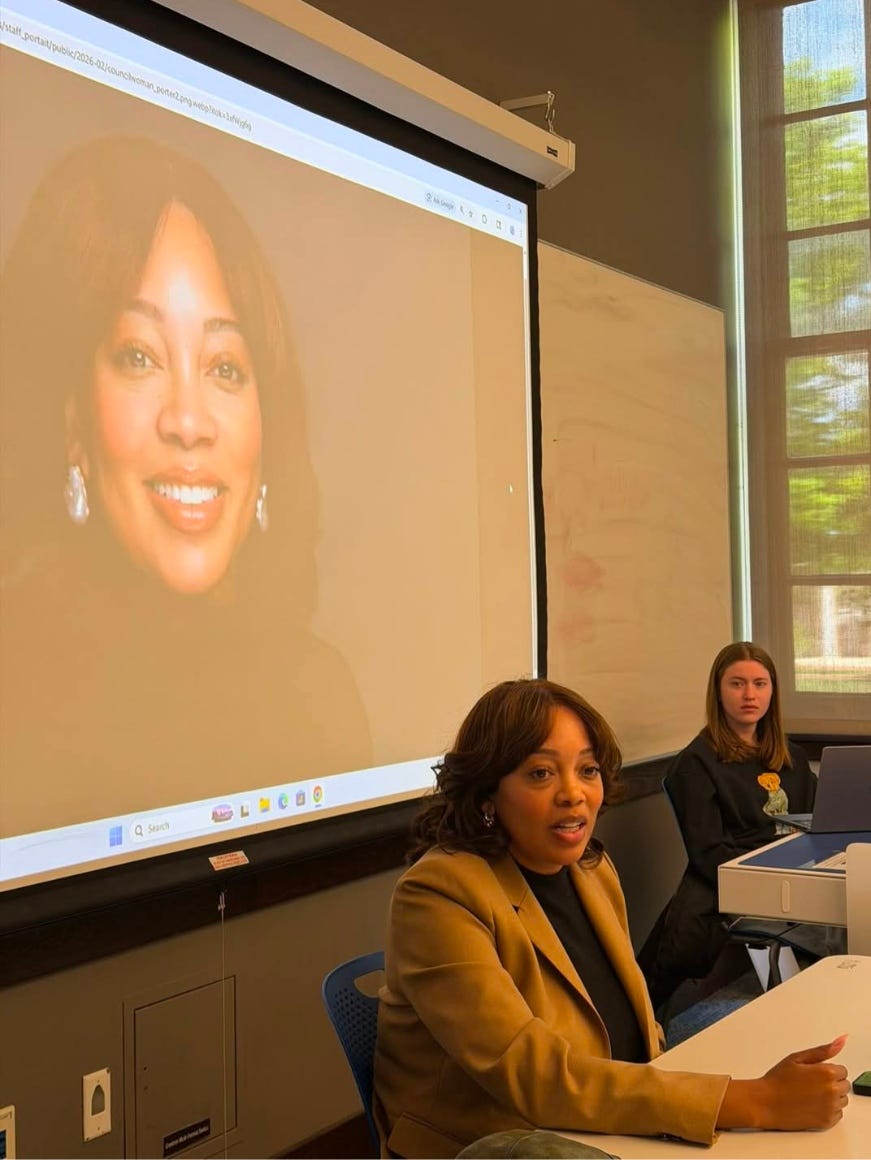
A Public Health Mind in a City That Needs One
Porter is not a generic councilmember with a generic résumé. She is a public health professional with two science degrees from Towson University and a Master of Public Health from Morgan State University, along with a Master of Science in Law from the University of Maryland Carey School of Law.
Before she ever held office, she worked in health policy and community advocacy—experience that shows up in her legislative priorities. She currently chairs the Public Health and Environment Committee and serves on committees dealing with labor, workforce, public safety, and transportation.
In a city where health disparities are not abstractions but daily realities, that background matters.
A Record of Delivering Tangible Investments
The 10th District is one of Baltimore’s most economically isolated areas. It includes neighborhoods that have been historically underserved and structurally neglected. Porter has approached that challenge with a focus on infrastructure, youth services, and economic development.
According to public records and her own legislative history:
- She has secured over $30 million in investments for South Baltimore communities through the South Baltimore Gateway Partnership, where she serves as Vice Chair.
- She championed the creation of three regional recreation centers, giving children in underserved neighborhoods safe places to play and learn.
- She delivered more than half a million dollars in direct support to community‑based organizations.
- She has been a key advocate for expanding health services in public schools, a priority consistent with her public health background (as highlighted in Foxwell’s account).
- She has pushed for grocery access in Pigtown, addressing food insecurity in a district where many residents lack nearby options.
- She played a role in standing up the South Baltimore Brewery District, a tourism and economic‑development initiative that brings outside dollars into neighborhoods that have long been overlooked.
These are not small wins. They are the kinds of structural investments that accumulate over time and change the trajectory of a district.
A Leadership Style Rooted in Community, Not Performance
Porter’s own website describes her philosophy this way:
“The people closest to the challenges are closest to the solutions.”
That framing is consistent with how she is perceived:
- A Baltimore native who still lives in Pigtown.
- A councilmember who shows up in neighborhood meetings, not just press conferences.
- A leader who is more comfortable talking about community needs than talking about herself.
Foxwell’s post makes this point explicitly: her “one flaw,” he jokes, is her refusal to take credit for her own work.
That’s not a flaw in Baltimore politics. It’s a rarity.
Why This Matters for Readers of the Maryland Wire
The Maryland Wire’s job is not to endorse candidates. It’s to give readers clarity—especially when the political conversation becomes noisy, tribal, or distorted by personalities.
So here’s the clarity:
- Phylicia Porter is a well‑credentialed public health professional.
- She has delivered measurable investments to one of Baltimore’s most underserved districts.
- She is respected by serious people across the political ecosystem.
- She leads with a community‑first approach rather than a performative one.
That doesn’t tell you who to vote for. It doesn’t predict her future. It doesn’t place her on any ideological spectrum.
It simply levels the playing field.
If someone like Len Foxwell—who has seen every type of political operator Maryland has to offer—says she’s “the real thing,” that’s worth noting. And if her record matches that assessment, that’s worth sharing.
In this case, it does.