

ANALYSIS & BREAKING NEWS DRAFT
EDITORIAL NOTE & CALL FOR INFORMATION
OPINION / INVESTIGATIVE REPORTING
By Barry O’Connell | The Maryland Wire
Is Prince George’s County Crossing the Line on Private Property Storm Cleanup? Why the "Command Center" Strategy Could Cost Homeowners Dearly
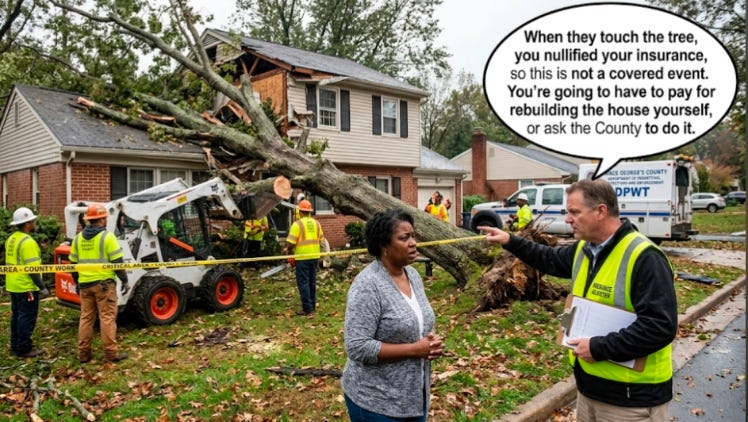
Reports are emerging that County Executive Aisha Braveboy’s administration has established an operational "command center" directing county agencies—specifically the Department of Permitting, Inspections and Enforcement (DPIE)—to actively remove storm-damaged trees that have fallen onto private homes.
While rapid emergency response sounds commendable on the surface, moving municipal crews off the public right-of-way and onto private structures creates a severe legal and financial landmine for Prince George’s County homeowners.
The Legal and Insurance Realities
When a tree falls in a public right-of-way—such as a county street, sidewalk, or easement—the local government has full legal authority and operational responsibility to clear it. However, the moment government crews cross onto private real estate to clear trees resting on a home, they cross into a dangerous gray area:
Spoliation of Evidence & Insurance Claims: Homeowners insurance policies strictly mandate that an adjuster inspect structural damage before major alteration or clearance occurs. If county crews alter the scene or remove debris before an adjuster conducts a formal evaluation, carriers can deny coverage based on a lack of documented proof regarding cause and pre-removal scope.
Secondary Damage Liability: Emergency tree extraction from a compromised roof demands specialized private contractors. If a government crew inadvertently causes additional structural collapse during extraction, private insurance carriers will almost certainly refuse to pay for the incremental damage caused by government workers—leaving the property owner trapped in legal purgatory between the county and their insurer.
Regulatory Overreach: DPIE is structured primarily as a regulatory, code enforcement, and permitting body—not an operational logging outfit. Mobilizing code inspectors to conduct heavy structural removals on private real estate blurs the line between enforcement and uncoordinated municipal intervention.
A Familiar Operational Pattern
This administrative reliance on high-visibility "command centers" echoes previous high-cost operational deployments in the county. When temporary emergency task forces or centralized hubs are established, public scrutiny surrounding procurement, emergency spending authorization, and real-world execution becomes essential.
If public funds are being funneled into centralized response units that end up invalidating private homeowners' insurance policies, the county could face staggering liability claims—leaving taxpayers on the hook and residents with uncompensated structural damage.
CALL FOR INFORMATION / READERS: HELP US INVESTIGATE
The Maryland Wire is actively gathering data on this initiative and seeking firsthand accounts from county employees, insurance adjusters, and impacted residents.
If you have information regarding this operational push, please reach out directly:
Are you a homeowner who had county or DPIE-directed crews remove a tree from your house? Has your insurance company raised concerns about your claim?
Are you a county worker, DPIE staffer, or first responder with direct knowledge of the command center’s directive, location, or budget allocation?
Are you an insurance adjuster or property attorney dealing with storm damage claims in Prince George's County?
Contact me directly:
* Email: barry@themarylandwire.com (or reply directly to this publication)
* Confidential Tips: All sources wishing to remain anonymous or background-only will be fully protected under standard editorial confidentiality guidelines.