

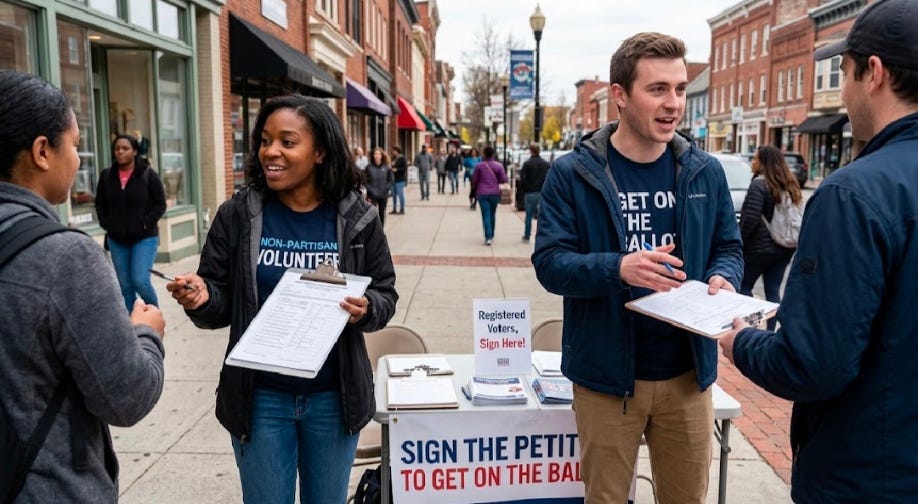
The Petition Delusion: Why Amateur Campaigns Fail the Math and Blame the System
In Maryland politics, there is a recurring character who appears every election cycle: the independent or third-party candidate who launches a campaign, fails to get on the ballot, and then claims the system was rigged against them.
We are seeing this playbook unfold once again. In Baltimore County, independent contender Rob Daniels failed to submit enough valid signatures to qualify for the County Executive ballot and subsequently filed as a write-in candidate. Rather than auditing his campaign's field operations, Daniels has taken to the sidelines, slinging allegations of corruption and fear-mongering at established contenders like County Council Chairman Julian Jones. Down in Prince George’s County, similar dynamics play out when low-budget runs miss structural benchmarks and reframe logistical failures as political suppression.
To casual observers on social media, these grievances might sound like a crusading outsider fighting "the machine." But to anyone who has ever managed a field program, sat outside a grocery store with a clipboard, or worked in government relations, these claims reveal something much simpler: a fundamental failure to understand basic campaign math.
The Psychology and Math of the Clipboard
Petition drives for independent candidates aren't an arbitrary hurdle designed by party bosses to keep people off the ballot; they are the absolute lowest bar for proving a campaign possesses baseline organizational capacity.
Anyone who has spent time collecting signatures knows two unwritten rules of field work:
Voters Lie out of Politeness: A significant percentage of people who sign a petition on their way into a supermarket are not registered to vote at that address, in that district, or at all. They sign because saying "I'm not registered" feels like admitting to a civic failing in public.
The Validation Drop-off: Because of illegible handwriting, outdated voter files, and unregistered signers, an experienced campaign expects 30% to 50% of raw signatures to be invalidated by local election boards.
If state law requires 6,000 valid signatures to reach the ballot, a competent campaign doesn't target 6,250. They target 12,000.
A serious campaign views petitioning not as a chore to collect the absolute minimum, but as a cheap, high-yield voter contact strategy. When a voter signs a petition, they experience psychological buy-in. They feel a personal connection to putting that name on the ballot, making them far more likely to volunteer, donate, or turn out on Election Day. Amateurs treat petitions as a math problem they try to barely pass; professionals treat them as a field weapon to lock in thousands of core voters early.
Insulting the Room
When candidates fail this basic test of field mechanics, they almost always shift from logistics to grievance. It is far easier to tell supporters, "Julian Jones and the party bosses are terrified of me," than it is to admit, "We didn't train our volunteers to check voter registration records."
For government relations professionals, lobbyists, and civic leaders in key economic drivers like Baltimore and Prince George's counties, these public meltdowns are almost embarrassing to watch.
The political establishment in these counties knows candidate leaders personally. They understand how county boards of elections operate, and they know the rigorous, non-partisan verification process signatures undergo. When a failed candidate stands on the sidelines slinging mud and claiming conspiracy, they aren't hurting the frontrunners—they are simply announcing to every serious insider in Annapolis and Towson that they didn't have the discipline to run a high school student council race, let alone a multi-billion-dollar county government.
The Bottom Line
A write-in campaign born out of a botched petition drive is rarely a movement; it is an exercise in noise.
Running for office requires more than passion and a fiery press release. It requires operational discipline, funding, field management, and respect for the rules of engagement. When a candidate misses the ballot because they couldn't manage a clipboard, don't blame the machine. Blame the math.