


One Day, One Ballot, One System? Maryland Reacts to the President’s Push for a National Voting Overhaul
By Barry O’Connell
Maryland Wire
The New National Voting Vision
President Trump has begun promoting a stripped‑down national voting model: one Election Day, in‑person voting only, paper ballots, and absentee ballots limited to the old‑fashioned narrow categories—military, overseas, and those physically unable to vote.
It’s a clean, simple pitch. It’s also a direct collision with how Maryland actually votes.
The proposal would unwind nearly every modernization Maryland has adopted over the last fifteen years. And it raises a constitutional question that Maryland election lawyers have been muttering about for weeks: Who actually gets to decide how Americans vote—the states or Congress?
Maryland’s System: Built for Access, Not Restriction
Maryland’s election system is designed around convenience voting. It’s not an accident; it’s the product of bipartisan commissions, court fights, and a decade of administrative reforms.
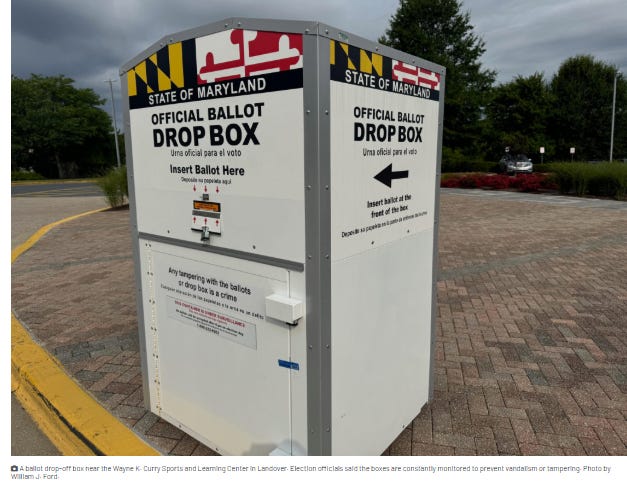
What Maryland Has Today
- Eight days of early voting
- No‑excuse mail‑in ballots
- Ballot drop boxes statewide
- Same‑day registration
- Paper ballots for all voting
- No strict photo ID requirement
In other words: Maryland is a high‑access, high‑participation state. The president’s preferred model is the opposite.
What Would Change in Maryland
If Congress ever enacted the president’s proposal—and that’s a very large “if”—Maryland would be forced to dismantle the core of its election infrastructure.
What Maryland Would Lose
- Early voting
- No‑excuse mail‑in ballots
- Ballot drop boxes
- Most absentee voting
- Same‑day registration (almost certainly)
- Maryland’s flexible, multi‑day staffing model
What Would Stay
- Paper ballots (already universal)
The practical effect: Maryland would have to push all voters into a single Tuesday. Baltimore City, Prince George’s, Montgomery, and Baltimore County would see Election Day lines that look like the early 2000s—before the state rebuilt its system to avoid exactly that.
Election administrators quietly say it would be “a logistical earthquake.”
Who Actually Has the Power Here?
The president can advocate for a national voting model, but he cannot impose it by executive order. The Constitution gives states the power to run elections. Congress can regulate federal elections, but it has never attempted to ban early voting or mail‑in ballots nationwide.
Any such law would trigger:
- Immediate lawsuits
- Federalism challenges
- A Supreme Court fight over the Elections Clause
Maryland’s attorney general would be in court before the ink dried.
The Political Interpretation: What Maryland Analysts Say
Is the goal to reduce Democratic turnout?
Here’s the Maryland‑specific analysis—not my opinion, but the consensus among political scientists, strategists, and election lawyers in the state.
Maryland’s Reality
- Early voting is heavily used by Democrats.
- Mail‑in ballots are overwhelmingly used by Democrats.
- Urban and suburban counties—Maryland’s Democratic base—depend on flexible voting options.
- A single Election Day model shifts power toward rural, whiter, more Republican counties.
So Maryland analysts generally interpret the proposal as a turnout‑shaping strategy. Not subtle, not new, and not unique to this administration—just the latest iteration of a long-running national fight over who gets to vote easily and who doesn’t.
Again: that’s the analysis circulating in Maryland political circles, not a value judgment.
Maryland’s Likely Response
If Congress ever seriously considered this overhaul, expect Maryland’s reaction to be swift and loud:
- State officials would argue it disenfranchises hundreds of thousands of Marylanders.
- County election boards would warn of unmanageable Election Day surges.
- Voting‑rights groups would mobilize instantly.
- The General Assembly would frame it as a federal intrusion into state authority.
Maryland has spent years building a system that works for its electorate. Reversing it would be a political and administrative shock.
The Bottom Line
The president’s proposal is simple. Maryland’s system is not. And the distance between the two is the story.
Maryland built an election model around access, flexibility, and participation. The president is promoting a model built around restriction, uniformity, and a single day of civic ritual. Whether Congress ever touches it is an open question. Whether Maryland would accept it quietly is not.