

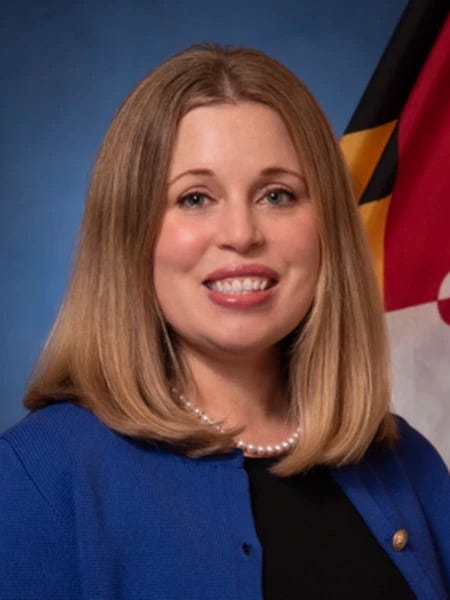
The Master Stroke: How Mollie Byron Built the Moore Administration’s Quiet Juggernaut
While political pundits parse the national tea leaves of Governor Wes Moore’s Independence Day address from the Annapolis State House, the real mechanics of his administration’s massive state-level success can be traced to a quiet power center just steps away from the executive chamber.
Enter Appointments Secretary Mollie Byron.
For those who treat Maryland politics like a blood sport, the 2026 election cycle has been nothing short of a masterclass. It is an open secret in Free State political circles that the Governor’s inner ring features a striking mix of visionary outsiders and seasoned operators. But when it comes to raw political acumen, institutional memory, and an unmatched map of the state’s power dynamics, Byron stands out as the ultimate politician in the room.
That expertise just fueled an unprecedented, down-ballot juggernaut.
The 93% Breakthrough: 200 Deep into the Down Ballot
Historically, Maryland governors protect their political capital like gold. They endorse carefully, protect their allies, and rarely dip their toes too far down the ballot.
The Moore-Miller administration blew that cautious playbook apart, backing over 200 candidates for election and reelection across the state. It was a massive, high-stakes gamble—a “master stroke” designed by a leadership team determined to build a deep, collaborative bench from western Maryland to the Eastern Shore.
Behind the scenes, it was Byron’s astute guidance that mapped out the field. The result? A staggering **93% success rate** that has left seasoned Annapolis insiders rubbing their eyes. By ensuring the administration left no down-ballot ally behind, Byron has effectively secured a historic legislative and local alignment for the Governor’s agenda.
Born into the First Family of Free State Politics
Wes Moore knows he can trust Byron’s instincts implicitly because Maryland politics isn’t just her profession—it is her DNA.
Byron is the living soul of Maryland’s deepest political heritage. She is a direct descendant of U.S. Senator Louis E. McComas, who served the state at the turn of the 20th century. Her lineage reads like a historical roster of public service, boasting two great-grandparents and two grandparents who served the state in the United States Congress (including the legendary Byron family congressional dynasty representing Western Maryland).
[Senator Louis E. McComas] (Late 1800s/Early 1900s)
│
[Two Great-Grandparents in Congress] (20th Century)
│
[Two Grandparents in Congress]
│
[Appointments Secretary Mollie Byron] (Present Day)
She grew up in the rooms where Maryland’s modern history was written. When she looks at a county map or a municipal board vacancy, she doesn’t just see numbers or resumes; she knows the families, the local gatekeepers, and the regional histories that make each community tick.
The Next Frontier: Dead Wood and 600 Boards
If Byron’s campaign season was triumphant, her governing season is about to get exponentially more intense. The Appointments Office is the unsung engine room of state government, tasked with recruiting and placing talented citizens across more than 600 volunteer boards and commissions.
These bodies wield immense power under the public radar—they license the state’s doctors and architects, set training standards for police and 911 dispatchers, safeguard African American heritage, and drive regional economic development policy.
Following a highly active legislative window that added 20 brand-new advisory boards to her plate, Byron’s team is now moving at a rolling, high-octane pace.
The Immediate Challenge: With the legislative dust settled and the 2026 midterms concluded, Annapolis is bracing for a sweeping administrative reset.
As national observers increasingly eye Governor Moore as a premier standard-bearer for the democratic mainstream—reinforced by his high-profile July 4th national address—the pressure is on to ensure the state government operates at a flawless, elite level. Insiders expect a thorough clearing out of administrative “dead wood”—replacing underperforming political appointees with high-energy, hyper-capable public servants who can execute the Governor’s “leave no one behind” mandate with total fidelity.
Staffing an entire state government to reflect the best, most representative talent is a grueling task that requires infinite patience and a razor-sharp eye. Luckily for Maryland, the woman steering the ship has been preparing for this work her entire life.
