

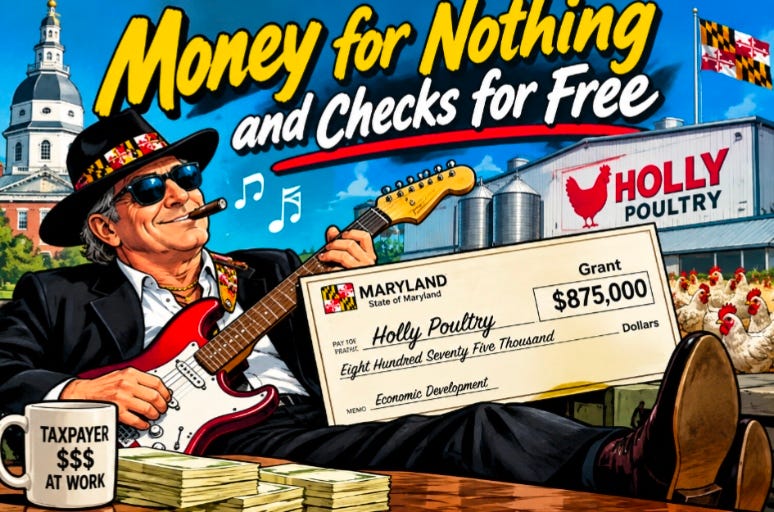
Special Report: Public Money, Private Expansion—The Holly Poultry Playbook
On September 15, 2026, Governor Wes Moore’s office announced an $875,000 state-and-county incentive package to support Holly Poultry’s expansion into a new 80,000-square-foot manufacturing and production facility in Hanover, Maryland.
On the surface, it looks like standard ribbon-cutting news: a long-standing Baltimore-based food processor adds a facility in Anne Arundel County, promising 140 new full-time jobs over the next four years.
Look past the press release. This project offers a clear view into state incentive mechanics under the Moore administration—and provides a practical roadmap for regional middle-market companies planning their next footprint expansion.
The ROI Math: $6,250 Per Job
State incentives receive significant scrutiny regarding fiscal efficiency. In this instance, the public investment per job demonstrates strategic calculation.
Advantage Maryland (MEDAAF): $750,000 conditional loan.
Partnership for Workforce Quality (PWQ): $50,000 training grant.
Anne Arundel County (AAEDC): $75,000 local matching loan.
Total Public Investment: $875,000
Target: 140 full-time positions over 4 years.
Public Cost Per Job: $6,250
At $6,250 per job, the state secures a favorable return on investment. By extending a performance-contingent loan rather than an outright tax abatement, the Maryland Department of Commerce gains a clawback mechanism if headcount goals stall. Meanwhile, Holly Poultry secures immediate capital to offset equipment and leasehold costs as it scales its consumer-packaged goods (CPG) brands, Easy Street® and One Fine Chicken™.
Key Takeaways for Business Strategy
Holly Poultry’s shift from traditional foodservice distribution into branded grocery retail (ALDI, Giant, Safeway) illustrates how companies can access state funding pools during structural pivots.
