

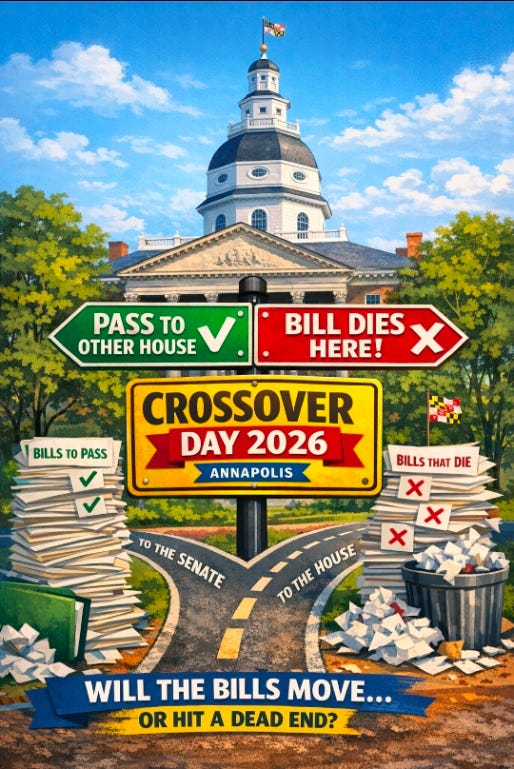
What Exactly Is Crossover Day — And Are a Lot of Bills About to Die?
Short answer: Crossover Day is the Legislature’s traffic‑control point. It’s the day each chamber — the House and the Senate — is supposed to send over the bills it actually intends to pass this year. If a bill doesn’t make it out by Monday, it isn’t automatically dead, but it gets pushed into the slow lane and must go through the other chamber’s Rules Committee. That extra step makes passage harder, especially in a short session.
But the real story this year is the difference in pace and mood between the two chambers.
🌟 What Crossover Day Really Means (In Plain English)
- A bill must pass its “home chamber” by Monday — meaning it must clear third reading in the House if it’s a House bill, or in the Senate if it’s a Senate bill.
- If it misses the deadline, it’s not dead, but it gets routed to the other chamber’s Rules Committee, which is like being told:
“Sure, you can still get through — but you’re going to wait in line.”
- Rules Committee = extra hurdle. Most bills that get stuck there never make it to the finish line unless leadership wants them.
Think of Crossover Day as the moment when Annapolis decides which bills are real and which were just for show.
📊 How Many Bills Are We Talking About?
This session is busy. The numbers tell the story:
- House committees are carrying 150–220 bills each in major committees like Ways & Means, Judiciary, and Environment & Transportation.
- Senate committees are even heavier, with Education, Energy & Environment holding 265 bills, Judicial Proceedings at 233, and Finance at 221.
That means hundreds of bills are stacked up across both chambers.
But here’s the key:
Most of the major bills that leadership actually cares about are moving.
The ones at risk are the mid‑tier bills — the niche policy ideas, local bills, and the “maybe next year” proposals.
🏛️ Is the House Really Laughing and Giggling?
Yes — and that’s not a bad sign.
Multiple floor sessions this week have been described as light, friendly, and almost celebratory, even as they move through a heavy docket. That tracks with what insiders have been saying all session:
the House is younger, looser, more progressive, and more aligned with Governor Moore’s agenda.
They’re moving bills quickly and with confidence.
🏛️ Is the Senate More Serious?
Absolutely — and that’s also not a surprise.
The Senate is still the Senate:
- Older, more cautious, more procedural.
- Still operating in the culture of the Mike Miller era.
- Still using the same tools to slow or reshape bills.
Senate President Bill Ferguson is running a tight, traditional chamber. The Senate floor agendas this week show long lists of special orders, committee reports, and third‑reading calendars, reflecting a chamber that is methodical, not breezy.
The contrast with the House is real — and meaningful.
🔥 So Are We Going to See a Lot of Bills Die on Monday?
Yes — but mostly the bills that were never going to pass anyway.
Here’s the breakdown:
Likely to Cross Over
- Major administration bills (e.g., affordability, pricing reform) — already moving in both chambers.
- High‑profile criminal justice bills (e.g., Youth Charging Reform) — Senate already passed its version; House is still working but expected to move.
- Budget and appropriations bills — these always move.
At Risk
- Bills stuck in committee with no second‑reading vote by Monday.
- Local bills without strong delegation support.
- Policy experiments that leadership hasn’t prioritized.
How many will die?
Realistically: dozens, possibly over a hundred, when you count all the low‑priority bills across both chambers.
But very few major bills are in danger.
🧭 What Readers Should Take Away
- Crossover Day is not a funeral — it’s a filter.
- The House is moving fast and in sync with the Governor.
- The Senate is cautious and old‑school, and that matters.
- Most important bills are on track.
- The bills that die Monday were mostly never going to pass.
U can't fix the 4/23?