

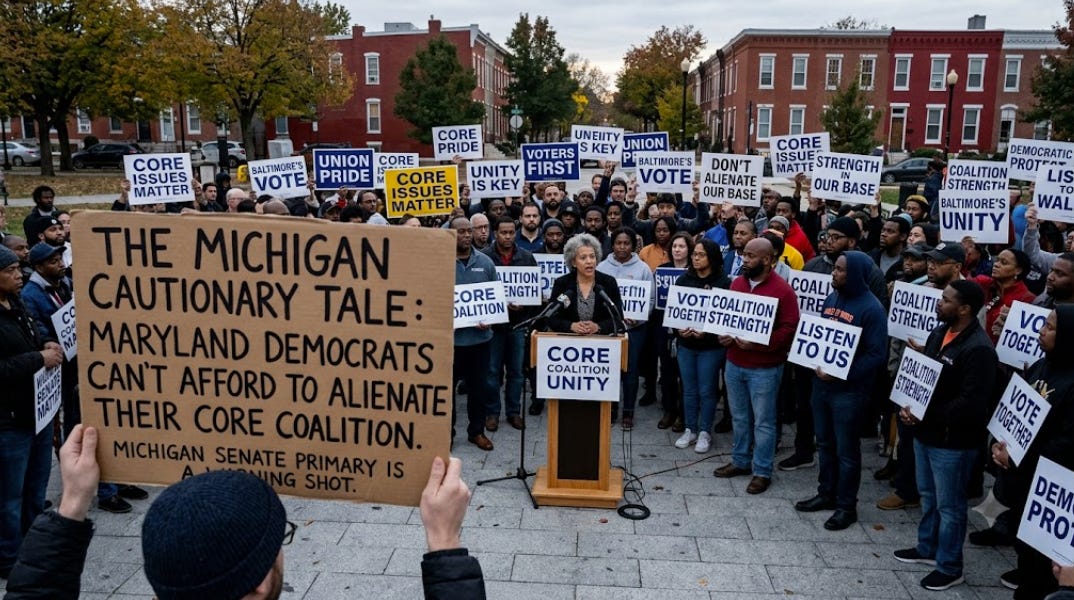
The Michigan Cautionary Tale: Why Maryland Democrats Can’t Afford to Alienate Their Core Coalition
The results out of Michigan’s Democratic Senate primary should be treated not merely as a Rust Belt anomaly, but as a direct warning shot across the bow for party strategists right here in Maryland.
When Dr. Abdul El-Sayed narrowly clinched the nomination over Rep. Haley Stevens, he did so by mobilizing a distinct, energized electorate: younger voters, campus communities, and affluent, highly educated suburbanites. But beneath that victory lies a glaring electoral vulnerability that every Democratic leader in Annapolis, Baltimore, and Prince George’s County needs to study carefully. El-Sayed lost Detroit—the dense, overwhelmingly Black, working-class engine that dictates whether a Democrat wins or loses statewide in Michigan.
If Maryland Democrats draw the wrong conclusions from primary insurgencies, we risk fracturing the very foundation of our winning coalition.
The Lessons of Detroit: Turnout Is Earned, Not Inherited
The math of statewide mid-Atlantic and Midwestern politics is unyielding. When Democratic presidential and statewide candidates perform well in Detroit, Flint, and Wayne County, they win; when Black turnout softens, the state flips. We saw it in 2016, we saw the recovery in 2020, and we saw the warning signs again in 2024.
Primary victories driven by suburban, well-off progressives can build impressive momentum, but they often leave core working-class and Black constituencies unenthusiastic. A primary candidate who enters the general election without the overwhelming backing of urban, working-class neighborhoods starts at an immediate disadvantage. Party loyalty in November can patch over some primary rifts, but it cannot replace genuine grassroots enthusiasm, field operations, and trust built over decades.
For Maryland, where Black voters form the undisputed bedrock of the Democratic electorate from Baltimore City to Prince George’s and Charles counties, the lesson is clear: Any strategy that treats our most reliable base as a secondary concern is an invitation to crisis.
The Danger of Alienating Core Pillars: Black, Working-Class, and Jewish Voters
Politics is a game of addition, yet primary insurgencies often default to subtraction—assuming long-standing coalition partners will simply stay in line out of fear of the alternative.
That assumption is becoming increasingly dangerous:
Black and Working-Class Voters: These voters care deeply about tangible economics, public safety, local investment, and reliable public services. When ideological rhetoric overshadows practical delivery, working-class voters either stay home or begin quietly cross-voting.
Jewish Voters and Community Leaders: The Democratic coalition in Maryland has long drawn strength, intellectual rigor, and vital philanthropic support from its vibrant Jewish community. Taking these voters and key contributors for granted—or signaling that their concerns are peripheral to the party's direction—erodes institutional support that takes generations to rebuild.
Suburban Reality Check: While suburban, highly educated voters have become more reliable general election voters, relying on them as a substitute for urban and working-class turnout is a fatal miscalculation. High suburban margins alone cannot overcome a depressed turnout in core urban precincts.
Moderate Pragmatism vs. Progressive Hard Labor
This isn't an argument that progressive candidates can never win. Rather, it is a sober assessment of political physics: When we stay near the pragmatic center, we build safer, broader, and more durable coalitions.
When a progressive candidate wins a primary, the campaign doesn't get a pass on the work; it inherits double the burden. They must immediately pivot, rebuild burned bridges, reassure moderate suburbanites, and actively court the working-class, Black, and Jewish voters who felt sidelined during the primary campaign.
In a state like Maryland, where our statewide leaders have traditionally won by uniting labor, urban centers, suburban moderates, and diverse religious communities, dividing the electorate into ideological factions during the primary creates self-inflicted wounds.
Michigan just demonstrated what happens when primary voters choose ideological signaling over coalition math. Maryland Democrats would be wise to read the results from Detroit carefully—and ensure we never take for granted the voters who make our victories possible.
The Far-Left Trap in Maryland

The Far-Left Trap: How Ideological Extremism Costs Elections in Maryland