

Maryland’s Hospital Warning Light Is Flashing Red
A cyberattack, overcrowded emergency rooms and growing anger in Bowie reveal a health system strained online and off
By The Maryland Wire
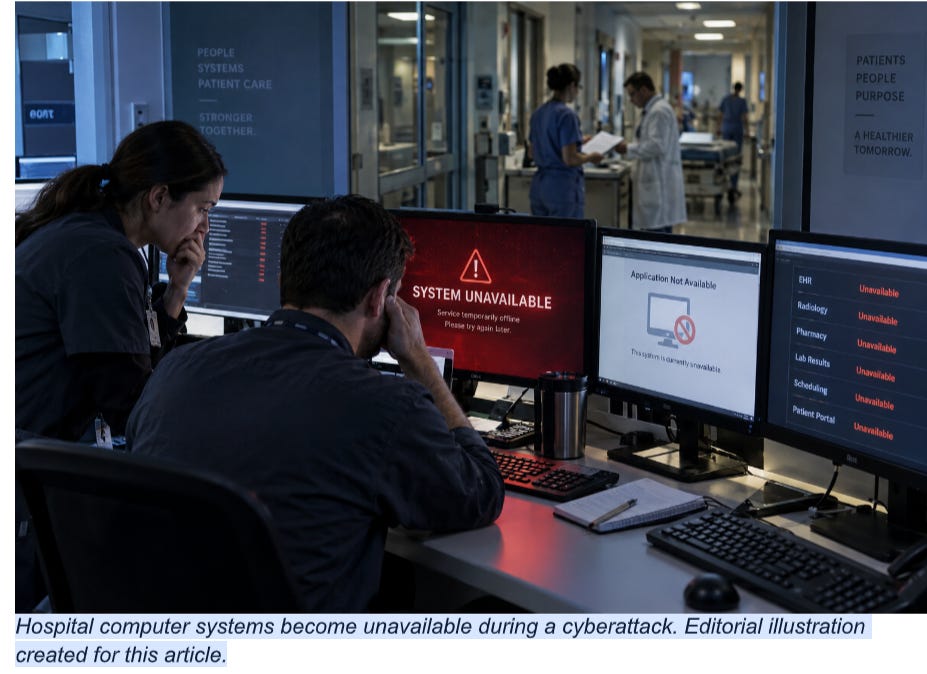
Hospital computer systems become unavailable during a cyberattack. Editorial illustration created for this article.
Maryland patients are confronting two emergencies at once.
One is visible in hospital waiting rooms, where visits lasting two to four hours have become common enough that families arrive with chargers, snacks and the emotional stamina of people preparing for a flight with three connections.
The other emergency is unfolding behind computer screens.
On September 4th, Luminis Health confirmed that an unauthorized criminal actor had attacked its computer systems. The incident affected Luminis Health Anne Arundel Medical Center in Annapolis and Doctors Community Medical Center in Lanham. It disabled MyChart and telephone services, disrupted appointments and caused some ambulances carrying noncritical patients to be rerouted. The hospitals remained open, but open does not necessarily mean operating normally.
Luminis Health said its employees and outside cybersecurity experts were working to restore the affected systems. WYPR reported that the extent of any possible exposure of patient information remained unknown.
That distinction matters. Luminis has confirmed a criminal cyber incident. It has not publicly confirmed that patient information was stolen. Until investigators establish that protected information was accessed or removed, describing the event as a confirmed data breach would go beyond the available evidence.
Accuracy should not become the first casualty of a cyberattack.
The larger story, however, reaches beyond unavailable portals and telephone lines. The disruption has exposed how interconnected and overextended the hospital systems of Prince George’s and Anne Arundel counties have become.
No Beds and Treatment in Triage
The strain reportedly reached a breaking point last night.
According to a source familiar with conditions inside the facility, there were no additional beds available and some patients were being treated in the triage area.
The hospital has not publicly confirmed the reported bed shortage or the use of the triage area for treatment. The account should therefore be understood as information provided by a source, not an official hospital finding.
If confirmed, however, it transforms the discussion from a complaint about inconvenience into a serious question about hospital capacity.
Triage is designed to assess patients, determine the urgency of their conditions and direct them to the appropriate level of care. When triage becomes a treatment area because no beds remain, the waiting room is no longer merely crowded. The hospital is operating without a meaningful cushion.
One unexpected surge, major accident or additional system failure could place even more pressure on clinicians already attempting to provide care in spaces not intended for extended treatment.
Patients wait while clinicians provide care near an overcrowded triage area. This is an editorial illustration and does not depict an actual Maryland hospital or identifiable patients.
Bowie Residents Are Losing Patience Bowie is an incorporated municipality whose residents pay city and county taxes, support local infrastructure and reasonably expect their elected leaders to facilitate access to dependable emergency medical care.
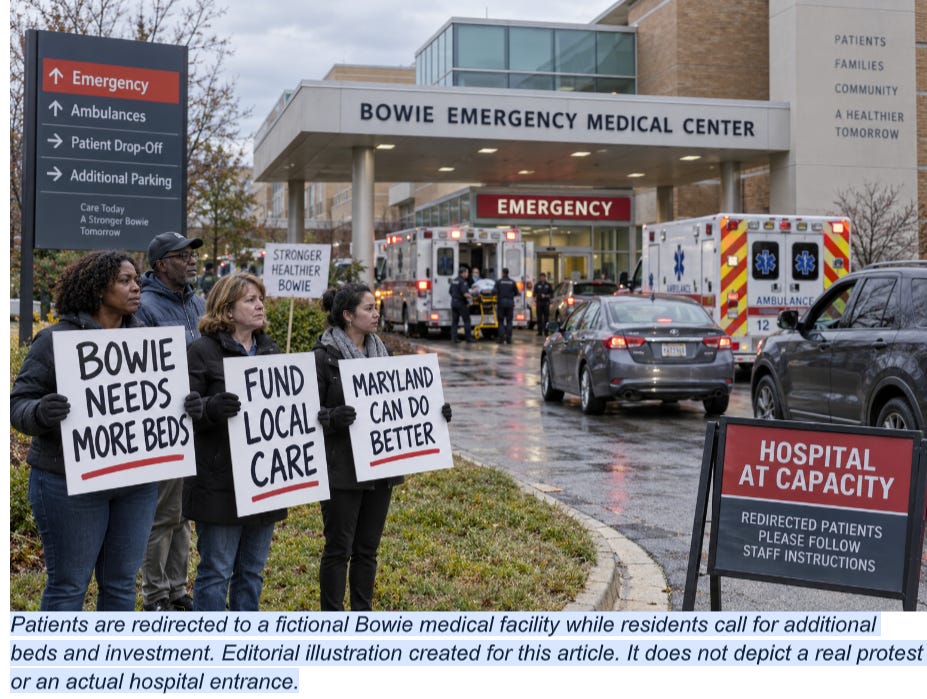
Some Bowie residents say they are increasingly frustrated by emergency visits lasting two to four hours. They believe the medical facility located within their municipality should have enough capacity to meet the needs of Bowie residents without becoming overwhelmed by patients redirected from other areas.
Residents interviewed about the situation said some patients were coming from other parts of Prince George’s County and Anne Arundel County because nearby hospitals had reached capacity, were diverting ambulances or because patients did not trust the reputations of certain hospitals and physicians in Largo and Lanham.
Their message is blunt: Maryland, Prince George’s County and Anne Arundel County can do better.
Residents believe each jurisdiction should provide enough quality medical care for its population rather than allowing longstanding shortages to spill repeatedly into Bowie. They want the governments responsible for facilitating health-care access to ensure that Bowie’s facility can adequately serve the community surrounding it.
That frustration deserves attention, but it must be directed toward the correct problem.
The City of Bowie does not own or operate the University of Maryland Bowie Health Center. The facility is part of the University of Maryland Capital Region Health system. Bowie’s municipal government can advocate for residents, improve emergency coordination and pressure state and county officials for additional resources, but it cannot legally reserve an emergency department for Bowie residents.
Emergency rooms are not municipal recreation centers with residency cards. Federal law generally requires hospitals to screen and stabilize people experiencing medical emergencies regardless of where they live, whether they have insurance or whether the waiting room has run out of chairs.
The patients arriving from outside Bowie are not doing anything wrong. They are following available care.
The failure belongs to a regional system that has not created enough dependable capacity to serve the people who need it.
Patients are redirected to a fictional Bowie medical facility while residents call for additional beds and investment. Editorial illustration created for this article. It does not depict a real protest or an actual hospital entrance.
Bowie Has an Emergency Room,
Not a Full Hospital Another important detail is often lost in the debate.
The Bowie Health Center is a freestanding emergency department, not a full-service hospital with a complete inventory of inpatient beds and medical specialties.
Patients who need admission or more advanced treatment may be transferred from Bowie to UM Capital Region Medical Center in Largo. Pediatric patients requiring specialized treatment and people requiring inpatient behavioral-health services may also need to be transferred.
The University of Maryland Medical System confirms that its freestanding emergency departments in Bowie and Laurel operate in conjunction with the main medical center in Largo.
That arrangement creates a regional chain of dependency. When Largo lacks available beds, specialists or staff, the congestion does not remain politely in Largo. It moves backward through the system and affects transfers, treatment decisions and waiting times in Bowie.
Bowie may have an emergency department within its municipal boundaries, but the facility cannot operate as an independent hospital.
That distinction is rarely printed on the sign outside.
Why Prince George’s Residents Leave the County
The movement of Prince Georg ’s patients into neighboring jurisdictions is not merely anecdotal.
A county-commissioned health-care assessment found that approximately 42 percent of inpatient care used by Prince George’s residents occurred outside the county. Anne Arundel Medical Center was among the 15 most frequently used destinations.
The assessment also found an estimated shortage of approximately 1,050 physicians across Prince George’s County, including a primary-care gap of roughly 550 physicians. It identified significant hospital-bed shortages, no hospital beds in the Inner Beltway region and specialty demand exceeding local supply.
The report estimated that approximately $2.24 billion in health-care investment would be needed over more than a decade.
More than 90 percent of the gaps were attributed to existing needs rather than projected population growth. Prince George’s County is not merely at risk of becoming short of health- care resources one day. It is already short.
The county’s assessment documents substantial shortages involving physicians, beds, primary care and specialty services.
When residents drive from Prince George’s County toward Annapolis, Bowie, Washington or Montgomery County, they may be responding rationally to those shortages.
Some are also making decisions based on reputation and personal experience.
That does not automatically prove that hospitals in Largo or Lanham provide inferior clinical care. Reputation, staffing, patient experience, specialty availability, historical mistrust and measurable outcomes are related, but they are not identical.
Still, public confidence is part of hospital quality.
If residents do not trust the nearest hospital, they will travel farther for care. That decision increases pressure on other facilities and may cause patients to delay treatment.
The politically uncomfortable question is why so many residents of one of the nation’s largest majority-Black counties believe they must cross a municipal or county boundary to receive care they trust.
Is It Poor Quality or Too Few Hospitals?
The honest answer is both, although the solution is more complicated than simply constructing another building.
Prince George’s County has a capacity problem. It needs more physicians, inpatient beds, primary-care providers, behavioral-health services and specialists.
It also has a confidence problem. Even when a hospital’s negative reputation is outdated or unsupported by current clinical measures, it influences patient behavior. Hospitals cannot dismiss that perception as public relations chatter when residents are voting with their cars and ambulances.
Quality includes more than whether a physician reaches the correct diagnosis. It includes whether patients can find a doctor, obtain an appointment, reach a specialist, get admitted when necessary and believe they will be treated competently and respectfully.
Prince George’s County created a 17-member Hospital Emergency Room Wait Times Task Force after acknowledging that the county had experienced the longest emergency-room waits in Maryland.
The problem also extends statewide.
A General Assembly-requested study found that Maryland had only 1.82 inpatient beds per 1,000 residents in 2021, compared with 2.38 nationally. Maryland ranked fifth-lowest in hospital beds per capita.
The hospital-throughput report also identified shortages involving nurses, emergency
physicians, imaging technicians, behavioral-health specialists, social workers and employees responsible for moving patients through treatment and discharge.
The emergency department has become Maryland’s waiting room for everything the rest of the health-care system failed to provide.
The Ransom Question A source familiar with the situation reports that hospital employees believe a ransom will have to be paid.
That allegation is significant, but it remains unverified.
Luminis has not publicly identified the attacker, classified the incident as ransomware, disclosed a ransom demand or announced that it intends to make a payment.
Employees working through an extensive outage may reasonably suspect ransomware.
Suspicion inside a disrupted hospital, however, is not the same as confirmation from investigators.
The federal government discourages paying ransoms because payment does not guarantee that encrypted systems or stolen information will be recovered. It may also finance future attacks.
The Cybersecurity and Infrastructure Security Agency advises organizations to isolate affected systems, preserve evidence, contact law enforcement and restore operations from secure backups whenever possible.
Luminis will eventually need to answer several questions.
Was this ransomware? Was a payment demanded? Did the attacker access or remove patient information? How many appointments, treatments and transfers were delayed? Were electronic medical records unavailable? When did Luminis detect the intrusion? Were backup and continuity systems tested before the attack?
“Cyber incident” may be the correct description during an active investigation. It cannot become a permanent curtain.
Are Government Agencies Next?
“Next” may be the wrong word. Maryland government has already been attacked.
Baltimore City’s 2019 ransomware attack disrupted municipal operations and resulted in more than $19 million in costs. In 2025, another cyberattack affected portions of the Maryland Transit Administration’s systems, including services used to schedule transportation for people with disabilities.
Hospitals and government agencies share familiar vulnerabilities: aging technology, interconnected vendors, valuable personal information, limited cybersecurity staffing and public operations that cannot tolerate lengthy shutdowns.
The Luminis attack does not prove that a coordinated assault on Maryland government is underway. No public evidence currently connects it to a planned attack against a state agency.
It does provide a warning.
State and local leaders should know whether essential operations can continue manually, whether backups are isolated from primary networks and whether vendors undergo independent
security testing. They should also know how they will communicate with residents when telephone, email and computer systems fail simultaneously.
The worst time to discover that a continuity plan is mostly a three-ring binder is after every screen in the building goes dark.
Maryland Has a Resilience Problem
The cyberattack did not create Prince George’s physician shortage, Maryland’s limited bed capacity or Bowie’s emergency-room frustrations.
It exposed how little room the system has for disruption.
Bowie residents have a right to expect their municipality, county and state to advocate for sufficient emergency capacity. Prince George’s residents should not have to leave their communities in search of care they trust. Anne Arundel residents should not have to watch their hospitals become the permanent pressure-release valve for shortages elsewhere.
The solution is not blaming patients for crossing an invisible border. Sick people are not outsiders or medical tourists. They are following beds, specialists, reputations and the hope of receiving timely care.
Maryland needs measurable expansion of primary care, specialty medicine, behavioral-health services, hospital beds and the health-care workforce. It also needs enforceable cybersecurity and continuity standards for hospitals, contractors and government agencies whose failure could endanger human life.
The question is no longer whether Maryland has too few resources or a quality problem.
It has both.
More fundamentally, Maryland has a resilience problem.
The waiting rooms are crowded. The computer systems are vulnerable. The patients have noticed.
Now the people in charge must decide whether they intend to notice before the next attack.
Sources
1. Luminis Health Cybersecurity Incident Update Official confirmation that an unauthorized criminal actor attacked Luminis Health systems, affecting telephone service and MyChart.
2. WYPR: Two Maryland Hospitals Hit by Cyberattack Reporting on the effects at Anne Arundel Medical Center and Doctors Community Medical Center, including ambulance rerouting and uncertainty about whether patient information was exposed.
3. CBS News Baltimore: Luminis Health Systems Unavailable After Cyberattack Additional reporting on unavailable systems, affected appointments and the health system’s initial response.
4. Prince George’s County Healthcare and Social Needs Assessment Supports the findings concerning physician and hospital-bed shortages, the estimated $2.24 billion investment need and approximately 42 percent of inpatient care occurring outside Prince George’s County.
5. Prince George’s County Hospital Emergency Room Wait Times Task Force Official county information acknowledging persistently long emergency-room waits and identifying bed availability, access and other systemic causes for investigation.
6. Maryland General Assembly Hospital Throughput Work Group Report Supports the statewide findings about limited hospital-bed capacity, workforce shortages, behavioral-health bottlenecks and delayed patient discharge.
7. University of Maryland Capital Region Health: Emergency Departments Confirms that Bowie and Laurel are freestanding emergency departments operating with UM Capital Region Medical Center in Largo and that patients may require transfers for admission or advanced care.
8. Maryland Emergency Department Wait Time Reduction Commission Official state information about Maryland’s continuing effort to reduce emergency-department wait times.
9. CISA StopRansomware Guidance Federal guidance on ransomware prevention, reporting, system isolation, evidence preservation and recovery.
10. CISA Healthcare and Public Health Cybersecurity Resources
Supports the discussion of hospitals as critical infrastructure and the operational risks created by cyberattacks.
11. Reuters: Guilty Plea in Baltimore’s 2019 Ransomware Attack Supports the article’s reference to Baltimore City’s ransomware attack and its costs.
The emergency room overcrowding is an issue everywhere. My husband had a stroke last November (he is fine). We live in Howard County, and the emergency room was full, so we were taken to Frederick Hospital where he waited overnight for a room. My 93 year old mother, who has since passed sat in the emergency room at Carroll County hospital in for 2 days (one of those days in the hall) with pneumonia before getting a room. All Maryland hospitals should increase the number of beds available to provide the care we need.