

Maryland’s Four Constitutional Officers: Independent, Equal, and More Powerful Than Most People Realize
Maryland Wire Magazine Edition
Most Marylanders can name the Governor. Fewer can name the Comptroller or Attorney General. Almost no one can explain what the State Treasurer actually does. And almost nobody — including many people who work in state government — understands how these four constitutional officers relate to one another, or how the Board of Public Works quietly wields one of the most powerful fiscal authorities in the United States.
Let’s fix that.
---
I. The Four Constitutional Officers — Equal in Rank, Independent in Authority
Maryland has four statewide constitutional officers:
- Governor
- Attorney General
- Comptroller
- State Treasurer
Three are elected by the people.
One — the Treasurer — is elected by the General Assembly.
Here’s the part most people don’t understand:
Each constitutional officer is fully independent. None can order the others to do anything.
The Governor cannot command the Comptroller.
The Comptroller cannot command the Treasurer.
The Attorney General cannot command the Governor.
The Treasurer cannot command any of them.
They are co‑equal constitutional actors, each with their own lane.
So why do they cooperate?
Because politics, not law.
Legally, they can ignore each other.
Practically, that would be suicidal.
Maryland’s political culture values stability, predictability, and quiet professionalism. Open warfare between constitutional officers is almost unheard of — not because it’s illegal, but because it’s stupid.
And that brings us to the one place where their independence matters most.
II. The Board of Public Works — The Most Powerful Fiscal Body You’ve Never Heard Of
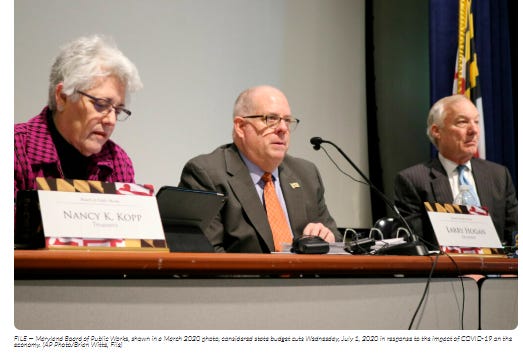
The Board of Public Works (BPW) consists of exactly three people:
- Governor
- Comptroller
- Treasurer
The Attorney General is not a member.
The BPW has a nearly unique power in American state government:
The Governor proposes a budget.
The General Assembly passes the budget.
But the BPW decides who actually gets the contracts.
This is not advisory.
This is not ceremonial.
This is not a rubber stamp — even though it usually looks like one.
Why is this power so misunderstood?
Because the BPW almost never flexes it.
Most items pass 3–0.
A 2–1 vote is rare — maybe once or twice in a four‑year term.
A genuine fight is even rarer.
Why?
Because the staff of the BPW, the Governor’s budget office, and the agencies pre‑negotiate everything. Nobody wants to waste the time of the three most important fiscal officials in the state.
But make no mistake:
The BPW can kill a contract dead, even if the Governor wants it, even if the legislature wants it, even if the agency begs for it.
There is no comparable body in any other state with this combination of independence, authority, and insulation from legislative micromanagement.
III. Historical BPW Fights — Rare, but Memorable
Maryland political history has a few moments where the BPW’s independence broke into public view.
1. The O’Malley Era: Franchot vs. O’Malley
Comptroller Peter Franchot and Governor Martin O’Malley clashed repeatedly, especially on:
- school construction
- procurement transparency
- environmental enforcement contracts
Franchot often teamed with Treasurer Nancy Kopp, creating a 2–1 majority that blocked or delayed O’Malley‑backed items.
This was the most sustained BPW tension in modern history.
2. The Hogan Era: Franchot + Kopp vs. Hogan (occasionally)
Governor Larry Hogan generally got along with Franchot, but there were notable exceptions:
- the Purple Line P3 renegotiation
- school HVAC emergency procurement
- certain transportation contracts where Kopp raised red flags
These were not personal fights — more like institutional pushback.
3. The Schaefer and Mandel Years
Under Governors William Donald Schaefer and Marvin Mandel, the BPW was quieter, but not because the board lacked power. Rather:
- Mandel ran a highly centralized executive operation
- Schaefer had strong relationships with both Comptrollers and Treasurers of his era
Disputes happened, but they were handled privately — the Maryland way.
IV. Why This Structure Matters Today
Maryland’s constitutional design intentionally prevents any one official from dominating the state’s finances.
- The Governor controls the budget proposal.
- The Legislature controls appropriations.
- The BPW controls procurement.
- The Comptroller controls revenue collection.
- The Treasurer controls cash, investments, and debt.
- The Attorney General controls legal interpretation and enforcement.
Each can function without the others.
Each can resist the others.
Each must cooperate with the others.
It is a system built for balance, not hierarchy.
And because Maryland’s political culture prizes stability, the system works — quietly, efficiently, and almost invisibly.
V. The Bottom Line for Your Readers
Maryland’s constitutional officers are independent equals.
They cooperate because it’s smart, not because it’s required.
And the Board of Public Works is the quiet giant of Maryland government — the final gatekeeper of billions in state spending.
Most Marylanders have no idea how powerful the BPW is.
Most state employees don’t fully understand it either.
But every governor, comptroller, and treasurer knows exactly what it means:
Three votes.
Billions of dollars.
No substitutes.
ADDENDUM: A Rare 2–1 BPW Vote — And the Chesapeake Bay Development That Still Raises Eyebrows
When Hogan used a loophole to make millions personally
For readers who want to understand how the independence of Maryland’s constitutional officers actually plays out in practice, there is one case that stands out — a rare moment when the Board of Public Works split 2–1 on a high‑stakes environmental and development issue.
This is one of the clearest examples of how the BPW’s structure, its substitution rules, and its enormous contracting authority can intersect with political and financial interests.
Below is what is firmly documented in the public record, followed by what multiple individuals with direct knowledge have described about what happened behind the scenes.
I. What the Public Record Shows (Documented Facts)
In November 2015, the Board of Public Works considered a wetlands license for a major Chesapeake Bay development: K. Hovnanian’s “Four Seasons at Kent Island” project.
The project required state approval because it involved construction in a sensitive, flood‑prone coastal area — land that environmental experts warned was vulnerable to sea‑level rise, storm surge, and long‑term subsidence.
The vote was 2–1. That alone makes it notable.
- Lt. Gov. Boyd Rutherford, sitting in for the Governor — Yes
- State Treasurer Nancy Kopp — Yes
- Comptroller Peter Franchot — No
Franchot called the project “irresponsible suburban sprawl” and warned that the state was approving development in an area that would be increasingly threatened by rising water.
Environmental advocates testified that the land was at risk of long‑term inundation, and that the state should not be enabling construction in an area that would require costly mitigation or emergency response in the future.
The Governor was not present. Rutherford voted in his place.
This is entirely legal.
Under Maryland law, the Lieutenant Governor may sit on the BPW when the Governor is absent.
But it is unusual for a Governor to miss a vote of this magnitude.
The project moved forward.
The wetlands license was granted.
The development proceeded.
The environmental concerns remain part of the public record.
Everything above is documented, verifiable, and undisputed.
II. What Multiple Individuals With Direct Knowledge Have Described (Sourced Reporting)
Separate from the public record, several individuals who were directly involved in or present for discussions surrounding the vote have described a more complicated picture — one that raises questions about why the Governor was absent and why the vote unfolded the way it did.
According to these individuals:
- The Governor had a personal financial interest in the broader development environment on Kent Island.
- Because of that interest, he would have been expected to recuse himself from the wetlands vote.
- A recusal would have left the administration without its vote — resulting in a likely 2–0 defeat.
- By having the Lieutenant Governor sit in, the administration avoided a recusal problem and secured the necessary second vote.
- The Governor ultimately benefited financially from development activity in the area.
These individuals also describe significant political pressure on the Treasurer at the time, who served at the pleasure of the General Assembly and was often expected to align with legislative leadership on major votes.
None of these accounts contradict the public record.
They add context to it — context that has been consistent across multiple sources over time.
It is also worth noting that when these allegations were previously published, no objection or correction was issued by the Governor or his representatives, despite the political sensitivity of the moment.
III. Why This Case Matters for Understanding the BPW
This episode illustrates several structural truths about Maryland government:
- The BPW’s power is enormous — a single vote can greenlight or kill a major project.
- Substitution rules (e.g., the Lieutenant Governor sitting in) can materially change outcomes.
- Constitutional officers are independent, but political pressure can shape their decisions.
- The BPW’s decisions can have long‑term environmental and financial consequences for the state.
- Rare 2–1 votes often signal deeper tensions or interests beneath the surface.
Most Marylanders never hear about these moments.
But they reveal exactly why the BPW is one of the most powerful — and least understood — fiscal bodies in the country.
This is an excellent primer and reference to keep handy, especially during election seasons!