

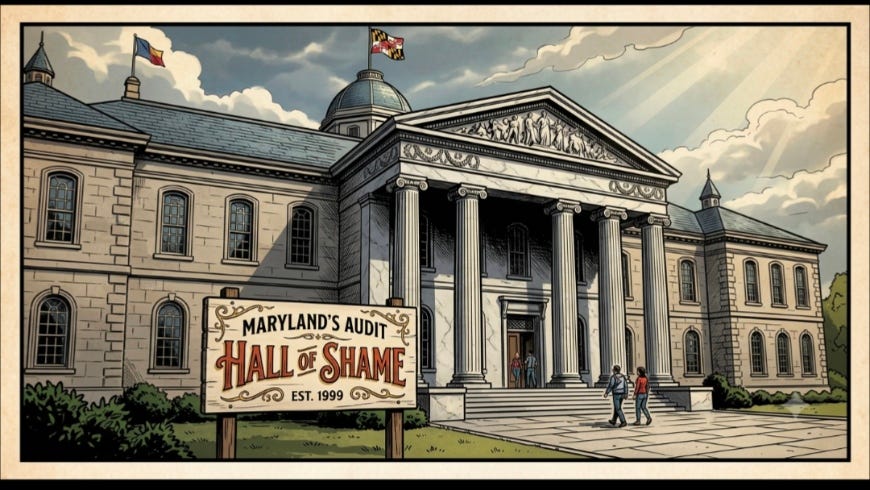
MARYLAND’S AUDIT HALL OF SHAME
The State Agencies That Keep Getting Told to Fix the Same Problems
The Maryland Wire reviewed years of state audits, repeat findings and legislative actions to identify the agencies with some of Maryland’s most persistent governance problems. One agency has findings repeated from audits dating back to 2008. Others have had money withheld until problems were fixed. At some point, Maryland has to ask a simple question: Are these agencies actually listening to the auditors?
By The Maryland Wire
Maryland does not have an audit shortage.
It may have a listening problem.
Every year, the Maryland Office of Legislative Audits sends professional auditors into state agencies to examine how government is spending money, protecting information, administering programs and following state law.
The auditors find problems.
The agencies respond.
Corrective action is promised.
Everyone eventually goes home.
Then the auditors come back.
Sometimes they find the same problem.
Again.
That is called a repeat audit finding.
And Maryland has enough of them that the General Assembly has begun doing something considerably more serious than writing strongly worded letters.
Lawmakers have actually withheld portions of agency administrative budgets until agencies demonstrate that repeat findings have been corrected.
That is the governmental equivalent of your parents saying:
We have already discussed this.
So The Maryland Wire decided to look deeper.
Which Maryland agencies have developed the most troubling records of repeat findings, unresolved problems, extraordinary legislative intervention and questionable governance?
This is not an official State of Maryland ranking.
It is The Maryland Wire Audit Accountability Ranking, based on publicly available audits and legislative records.
And some of what we found is remarkable.
HOW WE RANKED THEM
We considered five factors.
Repeat findings: Was the agency previously told about the problem?
Longevity: How long has the problem survived?
Financial exposure: How much taxpayer money, federal funding or state resources are potentially involved?
Human consequences: Could the deficiencies affect children, people with disabilities, unemployed Marylanders or other vulnerable residents?
Legislative escalation: Did the problem become serious enough for lawmakers to restrict money or require special reporting?
This produces a somewhat different list than simply ranking the biggest dollar figures in recent audits.
A spectacular new finding is troubling.
A problem government was told about three audits ago and still has not fixed tells us something different.
It tells us something about governance.
🔒 PAID SUBSCRIBER EXCLUSIVE CONTENT BELOW
You have reached the end of your free preview. Become a supporting subscriber to The Maryland Wire to read the remaining breakdowns article:
[ Click Here to Unlock Full Access – $8/month or $80/year ]
HOW WE RANKED THEM
We considered five factors.
Repeat findings: Was the agency previously told about the problem?
Longevity: How long has the problem survived?
Financial exposure: How much taxpayer money, federal funding or state resources are potentially involved?
Human consequences: Could the deficiencies affect children, people with disabilities, unemployed Marylanders or other vulnerable residents?
Legislative escalation: Did the problem become serious enough for lawmakers to restrict money or require special reporting?
This produces a somewhat different list than simply ranking the biggest dollar figures in recent audits.
A spectacular new finding is troubling.
A problem government was told about three audits ago and still has not fixed tells us something different.
It tells us something about governance.
NO. 7
DEPARTMENT OF GENERAL SERVICES
When the people responsible for procurement and state property get repeat audit findings, everybody should pay attention.
DGS manages state buildings, leasing and major procurement functions.
Its recent record provides two different reasons for concern.
First came the Office of State Procurement.
The General Assembly specifically identified OSP as having four or more repeat audit findings and restricted $100,000 in administrative funding pending corrective action and verification by OLA. (Maryland General Assembly)
Then came DGS itself.
The July 2025 fiscal compliance audit contained 11 findings, four of them repeats from the previous January 2022 audit. Legislative budget documents say those findings included deficiencies involving due diligence and transparency in decisions over whether state agencies should remain in state owned facilities or move into privately leased space. (Maryland General Assembly)
Those decisions ultimately involved hundreds of millions of dollars in leases.
That does not automatically mean the decisions were improper.
It does mean Marylanders should expect the agency responsible for government procurement and real estate to maintain an unusually high standard of documentation.
If DGS cannot show its work, who exactly is supposed to?
THE MARYLAND WIRE GOVERNANCE GRADE: C
NO. 6
MARYLAND HIGHER EDUCATION COMMISSION
Apparently higher education occasionally needs remedial coursework too.
MHEC is easy to overlook beside Maryland’s giant Cabinet departments.
The General Assembly did not overlook it.
In 2024 budget deliberations, lawmakers identified MHEC as having four or more repeat audit findings and proposed withholding $250,000 from its administrative appropriation until corrective actions were completed and verified. (Maryland General Assembly)
That is important.
The Legislature was not merely asking MHEC to respond to an audit.
It was essentially saying:
Show us that you fixed it before you get all of your administrative money.
That moves an agency beyond the category of routine audit disagreement.
THE MARYLAND WIRE GOVERNANCE GRADE: C MINUS
NO. 5
MARYLAND DEPARTMENT OF LABOR
Division of Unemployment Insurance
Maryland learned during the pandemic that unemployment insurance is not some obscure government program hiding in a filing cabinet.
When Marylanders lose their jobs, this system becomes their financial lifeline.
That makes the history of repeat findings particularly important.
OLA’s November 2022 unemployment insurance audit reported that three findings from the preceding audit were being repeated as four findings. Problems involved controls and oversight in the unemployment system. (Ola Maryland)
The situation became serious enough that the General Assembly subsequently attached funding restrictions to Labor.
Legislative budget language specifically referenced repeat findings involving foreign Internet Protocol addresses, supervisory reviews of claims and adjudications, manual wage entries and controls over reissued debit cards. (Maryland General Assembly)
And OLA did not simply disappear after issuing the audit.
Special follow up work continued.
That is what makes Labor significant to this ranking.
The issue is not merely that auditors discovered problems.
It is that some problems had already been discovered before.
Marylanders applying for unemployment benefits generally do not have several audit cycles available to wait for government to perfect the system.
Their rent is due now.
THE MARYLAND WIRE GOVERNANCE GRADE: D PLUS
NO. 4
MARYLAND DEPARTMENT OF INFORMATION TECHNOLOGY
The agency responsible for helping Maryland government manage technology has required considerable oversight of its own.
DoIT’s March 2024 fiscal compliance audit contained 16 findings.
One of the most startling involved MD THINK.
Auditors reported that DoIT could not adequately explain or justify how costs increased from an initial $166.4 million to $588.8 million. (Ola Maryland)
Read those numbers again.
$166.4 million.
$588.8 million.
That is a difference of more than $400 million.
The story did not end with that audit.
OLA conducted a follow up review in March 2025. DoIT was required to provide quarterly status reports regarding corrective actions associated with all 16 findings. (Ola Maryland)
Then lawmakers escalated matters further.
The General Assembly identified DoIT as an agency with four or more repeat audit findings and placed $250,000 of its administrative appropriation at risk unless corrective action occurred and OLA verified the results. (Maryland General Assembly)
That is why DoIT ranks this high.
Maryland government increasingly depends on technology for everything from benefits to financial systems.
An IT governance problem rarely stays inside the IT department.
THE MARYLAND WIRE GOVERNANCE GRADE: D (There was disagreement over this among the staff. Finaly we stood behind the D even though there was a strong position that Katie Olsen Savage is a seperate problem and should be fired.)
NO. 3
MARYLAND DEPARTMENT OF HEALTH
This may be Maryland’s broadest institutional audit problem.
Ranking MDH is difficult because the department is enormous.
That is also part of the problem.
Health administers Medicaid, developmental disability programs, behavioral health programs and numerous regulatory and public health functions.
The audit concerns are not concentrated in one small corner.
Consider the Developmental Disabilities Administration.
Its October 2022 audit contained four repeat findings addressed by eight recommendations. OLA subsequently performed a special review specifically examining DDA’s progress in resolving them. (Ola Maryland)
This was not DDA’s first difficult audit cycle.
An earlier DDA audit contained 11 findings, including five repeat findings, and OLA had previously classified DDA’s accountability and compliance level as unsatisfactory. (Ola Maryland)
Then the Legislature escalated.
For fiscal 2026, lawmakers included language providing that because DDA had four or more repeat findings, $250,000 in administrative funding could not be expended unless corrective actions were completed and verified. (Maryland General Assembly)
This is where audit language stops being abstract.
DDA serves Marylanders with developmental disabilities.
These are not merely accounting entries.
They represent services, providers, families and people who often depend on government programs for fundamental parts of daily life.
Maryland Health may therefore have the broadest governance challenge on this list.
But two operations have records that are even harder to ignore.
THE MARYLAND WIRE GOVERNANCE GRADE: D
NO. 2
DEPARTMENT OF HUMAN SERVICES
Family Investment Administration
DHS manages programs that Maryland families depend on when they are struggling.
That makes repeat findings particularly consequential.
The Family Investment Administration has accumulated enough repeat findings that the Maryland General Assembly put actual money on the line.
Fiscal 2026 budget language explicitly states that FIA had four or more repeat audit findings.
Lawmakers responded by restricting $250,000 of administrative funding unless corrective action was taken and OLA confirmed that the repeat findings had been corrected. (Maryland General Assembly)
That is an extraordinary sentence when you think about it.
The Maryland General Assembly essentially created a financial incentive for part of state government to fix problems that auditors had already told it to fix.
And FIA is not the only part of DHS with a repeat finding problem.
Which brings us to No. 1.
THE MARYLAND WIRE GOVERNANCE GRADE: D MINUS
NO. 1
THE ABSOLUTE WORST
DEPARTMENT OF HUMAN SERVICES
Social Services Administration
Six repeat findings. Fourteen total findings. And some trace back to audits dating to 2008.
This is where Maryland’s audit problem becomes almost impossible to explain away.
The most recent Social Services Administration audit contained 14 findings.
Six were repeat findings.
But the number six does not adequately describe the problem.
OLA reported that some of those findings had been repeated from one or more prior audits dating back to October 2008. (Ola Maryland)
October.
2008.
For perspective, Barack Obama had not yet been elected president.
The first iPhone had been released the previous year.
Netflix was still primarily known for mailing DVDs to people’s houses.
And Maryland auditors were identifying problems at the Social Services Administration that have echoes in audit findings nearly eighteen years later.
That deserves more than a bureaucratic response saying corrective action is underway.
It deserves an explanation.
OLA’s September 2025 audit reported that SSA had not sufficiently resolved six of eight findings from its preceding audit. (Ola Maryland)
That is precisely what this ranking measures.
Not whether government ever makes mistakes.
Government will make mistakes.
The question is what happens after somebody identifies them.
SSA’s responsibilities make the findings considerably more serious.
The agency oversees Maryland’s child welfare system.
Its work touches children in foster care, investigations of abuse and neglect and families interacting with local social services departments.
The original October 2008 audit itself reported concerns involving federal child welfare outcomes related to child safety, permanent living arrangements and child and family well being. (Ola Maryland)
Nearly eighteen years is not a learning curve.
It is an institutional era.
That is why, based on the criteria used for this analysis, the Social Services Administration earns the unfortunate distinction of being The Maryland Wire’s worst repeat audit and governance offender in Maryland state government.
THE MARYLAND WIRE GOVERNANCE GRADE: F
WAIT. WHERE ARE SHA AND MSDE?
Readers familiar with recent Maryland audits may notice two major agencies missing from the top seven.
That is intentional.
State Highway Administration
SHA has one of the most consequential recent financial control stories in Maryland government.
But this ranking measures repeat audit failures and governance persistence, not simply the largest dollar amount appearing in an audit.
A massive new finding can be more financially significant than a repeat finding without demonstrating the same history of management being warned and failing to correct the problem.
SHA deserves its own investigation.
It does not automatically deserve to outrank an agency with documented problems stretching across multiple audit cycles.
Maryland State Department of Education
Education presents another complication.
OLA reported in 2023 that its most recent audits of Maryland’s 24 local education agencies had collectively produced 318 findings, including 171 repeat findings. (Ola Maryland)
That is staggering.
But those findings concern 24 local school systems, not simply failures attributable to MSDE itself.
Maryland subsequently enacted additional requirements for local school systems to publicly report progress addressing repeat audit findings. (Maryland General Assembly)
That deserves scrutiny.
But it would be misleading to dump every local school system finding onto MSDE and declare the state agency Maryland’s worst offender.
The Maryland Wire will not manipulate the methodology simply to produce a more dramatic headline.
The actual findings are dramatic enough.
THE BIGGER PROBLEM IS NOT ANY ONE AGENCY
The most important story may not be which agency finishes first.
It is that Maryland has needed to develop increasingly aggressive mechanisms just to get agencies to correct findings.
For years, the statewide repeat finding rate declined.
It reached approximately 21 percent in 2013.
Then it began moving in the wrong direction.
By the audit cycle ending June 30, 2023, the statewide rate was 27 percent. For the cycle ending June 30, 2024, it climbed to 30 percent. (Maryland General Assembly)
That means nearly one out of every three findings was something auditors had essentially encountered before.
Maryland taxpayers should understand what that means.
They pay for the government operation.
They pay for the auditors who discover the problem.
They pay government employees to develop the corrective action.
Then, in some cases, they pay auditors to return and discover that the problem still exists.
That may be the most Maryland sentence ever written.
WHEN THE LEGISLATURE STARTS HOLDING THE MONEY
The General Assembly’s response tells us how seriously lawmakers view the issue.
Maryland’s Joint Audit and Evaluation Committee has recommended withholding administrative appropriations from government units with four or more repeat findings.
Fiscal 2026 budget documents identify agencies including DoIT, DDA, DHS Family Investment Administration and Maryland Labor’s unemployment operation for funding restrictions tied to repeat audit remediation. (Maryland General Assembly)
The approach is remarkably straightforward.
Fix the repeat findings.
Have OLA verify that you fixed them.
Then the money can be released.
This raises an uncomfortable question.
Why should lawmakers have to financially incentivize state agencies to correct deficiencies identified by the state’s own auditors?
That question is bigger than any secretary.
It is bigger than any governor.
It is about whether Maryland has developed a culture in which an unfavorable audit can be treated as a temporary communications problem instead of a management problem.
THIS DID NOT START WITH WES MOORE
It would be politically convenient for critics to dump every problem in this article at the feet of Governor Wes Moore.
The evidence does not support that conclusion.
Some of these findings predate his administration.
Some predate the Hogan administration.
SSA’s history reaches all the way back to the O’Malley years.
Maryland’s repeat audit problem is therefore not exclusively Democratic or Republican.
It is institutional.
That distinction matters.
Governors come and go.
Cabinet secretaries come and go.
Deputy secretaries come and go.
Press secretaries definitely come and go.
The findings apparently have remarkable job security.
AN AUDIT IS NOT A SUGGESTION BOX
Government officials sometimes disagree with auditors.
They are allowed to.
Auditors can interpret circumstances differently from agency management.
Some recommendations require significant funding or technology changes.
Others may require legislation.
And an audit finding alone does not prove corruption, incompetence or criminal misconduct.
Those distinctions matter.
But repeat findings are different.
When the same or substantially similar weakness survives multiple audits, leadership has to explain why.
Not communications staff.
Not consultants.
Leadership.
What prevented correction?
Who was responsible?
Was sufficient money appropriated?
Did management reject the auditor’s recommendation?
Was corrective action attempted and unsuccessful?
Did somebody simply fail to follow through?
Those answers should be public.
MARYLAND DOESN’T NEED MORE AUDITS SITTING ON SHELVES
The Office of Legislative Audits appears to be doing exactly what Maryland pays it to do.
It finds weaknesses.
It documents them.
It makes recommendations.
And eventually it comes back.
The next stage of Maryland’s accountability system should focus much more aggressively on what happens between those visits.
Every significant repeat finding should have a responsible executive.
Every corrective action should have a deadline.
Every missed deadline should have a public explanation.
Agency budget hearings should prominently identify unresolved repeat findings.
And when serious deficiencies survive multiple audit cycles, the performance of the executives responsible for correcting them should become part of the conversation.
Because there is an enormous difference between discovering a problem and accepting one.
THE FINAL SCORECARD
The Maryland Wire’s review produces this ranking:
7. Department of General Services
6. Maryland Higher Education Commission
5. Maryland Department of Labor, Division of Unemployment Insurance
4. Maryland Department of Information Technology
3. Maryland Department of Health
2. Department of Human Services, Family Investment Administration
1. Department of Human Services, Social Services Administration
But perhaps Maryland should stop obsessing over who wins first place.
There is no trophy for this competition.
There are children, families, people with disabilities, unemployed workers and taxpayers on the other side of these audit findings.
They are the reason the audits matter.
An audit is essentially government being handed the answers before taking the test again.
If an agency fails the first time, fix it.
If it fails again, investigate why.
If the same problem survives year after year after year, stop calling it a finding.
Start calling it a governance failure.
SOURCES AND DOCUMENTS
Maryland Office of Legislative Audits, Social Services Administration, September 2025. OLA reported 14 findings and six unresolved findings from the preceding audit. (Ola Maryland)
Maryland Office of Legislative Audits, Social Services Administration presentation, February 2026. OLA reported that the 14 findings included six repeat findings from one or more prior audits dating to October 2008. (Ola Maryland)
Maryland Office of Legislative Audits, Social Services Administration, October 2008. The historical audit provides context for the long running child welfare findings. (Ola Maryland)
Maryland Office of Legislative Audits, Developmental Disabilities Administration follow up, May 2024. The review identifies four repeat findings from DDA’s October 2022 audit. (Ola Maryland)
Maryland Office of Legislative Audits, Department of Information Technology, March 2024. The audit includes 16 findings and discusses the increase in MD THINK costs from $166.4 million to $588.8 million. (Ola Maryland)
Maryland Office of Legislative Audits, DoIT Follow Up Review, March 2025. Documents subsequent monitoring of corrective actions. (Ola Maryland)
Maryland Office of Legislative Audits, Division of Unemployment Insurance, November 2022. Documents prior findings repeated in the unemployment insurance audit. (Ola Maryland)
Maryland General Assembly, House Appropriations Committee Fiscal 2026 Budget Report. Documents administrative funding restrictions tied to repeat findings at DoIT, DDA, DHS Family Investment Administration, Maryland Labor and other government units. (Maryland General Assembly)
Maryland General Assembly budget documents concerning DGS and MHEC. Documents legislative restrictions associated with four or more repeat findings. (Maryland General Assembly)
Maryland General Assembly, Legislative Policy Committee reports. Documents the statewide history and percentage of repeat audit findings. (Maryland General Assembly)
Maryland Office of Legislative Audits, MSDE review. Documents 318 findings among Maryland’s 24 local education agencies, including 171 repeat findings. (Ola Maryland)
Editor's Note: Following the 2026 legislative session, the General Assembly enacted HB 1369 (Chapter 364), creating a public dashboard and specialized oversight mechanism to monitor repeat audit resolutions between OLA visits—a direct step toward the structural accountability outlined above.