

Maryland’s 2026 Governor’s Race: A Campaign Season Still Waiting to Begin
By Barry O’Connell
Disclaimer:
This article is based on publicly available reporting, online information, and conversations with political observers across Maryland. If any campaign believes its activity is being overlooked, I welcome updates and will gladly include them in future coverage. The goal here is fairness, clarity, and an honest snapshot of where things appear to stand — not to embarrass anyone.
A Race Without a Rhythm
Maryland’s 2026 gubernatorial contest is technically underway, but it doesn’t feel like a campaign season. Not yet. The Democratic side is quiet because Governor Wes Moore remains the prohibitive favorite for renomination. The Republican side is quiet for a different reason: no one has yet demonstrated the money, organization, or statewide presence needed to mount a serious challenge.
What we have instead is a field of Republicans who are earnest, energetic, or well‑connected — but not yet showing the kind of structure that wins a statewide race in a deep‑blue state.
And that contrast defines the early mood of the race.
Ed Hale: A Candidate With Means, But Not Yet Momentum
Ed Hale’s entry into the Republican primary was the first moment that made insiders sit up. A wealthy businessman switching parties and stepping into a wide‑open GOP field should have been a major story. Instead, the story has been the campaign’s uneven rollout.
Hale has already cycled through two early anchors:
- Shannon Leadbetter, the Anne Arundel County Council member who briefly served as campaign manager before being dismissed.
- Jill Cohen, a well‑known Baltimore County socialite and business leader whose departure was, by multiple accounts, not amicable.
Those early fractures matter because they feed a broader perception: Hale has not yet committed the kind of resources that signal a serious statewide run. He has paid for signs. He has paid for some literature. But for a wealthy man, these are pocket‑change expenditures — not the kind of investment that builds a statewide operation.
The campaign’s current structure rests on two experienced but very different figures:
- Clayton Mitchell Sr., son of the former Speaker of the House (Clayton Mitchell, who served from 1987–1993). Clay spent his career as a government lawyer at the Maryland Department of Labor. He knows Annapolis. He knows the players. What remains unclear is whether he knows how to build a modern statewide campaign from scratch.
- Patrick Gonzales, the respected pollster. But Gonzales is not working on speculation. He will poll when Hale writes the check — and the word circulating is that Hale has not been writing many checks.
The result is a campaign that exists on paper, has recognizable names attached, but has not yet shown the financial muscle or organizational discipline that statewide Republicans are quietly hoping for.
John Myrick: The Hustler With Heart, Not Yet a Machine
If the Republican nomination were awarded on hustle alone, John Myrick would be the frontrunner by a mile.
He is everywhere — county dinners, club meetings, small‑town breakfasts, rural meet‑and‑greets, suburban Republican gatherings. He shakes every hand, takes every photo, and speaks to every room that will have him. Volunteers like him. Local activists appreciate the effort. He is running the kind of campaign that wins friends.
But enthusiasm is not infrastructure.
There is no visible campaign manager. No paid strategist. No sign of polling. No evidence of a professional fundraising operation. Myrick is running what looks like a classic grassroots, volunteer‑driven, shoestring campaign — admirable, earnest, and spirited, but not yet scaled to the demands of a statewide race.
Still, in a field where others are barely visible, Myrick’s energy makes him the de facto frontrunner for now.
The Rest of the Field: Present, But Not Prominent
There are other Republican candidates, but they are not yet making noise. Not in the press. Not in fundraising. Not in statewide travel. Not in the conversations that county chairs and activists are having.
This isn’t a criticism — it’s simply the reality of a race where visibility matters, and visibility is currently scarce.
Where Is the Republican Fundraising?
One of the most striking features of the early 2026 cycle is the absence of major Republican fundraising activity.
You would expect Congressman Andy Harris — chair of the House Freedom Caucus and married to the state GOP chair — to be able to fill a ballroom, bring in a cabinet‑level speaker, or at least generate some buzz. But so far, the events have been routine, not remarkable. Nothing that signals a party gearing up for a statewide fight.
The Republican Governors Association is also quiet. They typically invest only when a race is winnable, and right now, Maryland does not look winnable. Not without a candidate who can raise millions, build a statewide operation, and appeal to independents in a state where national Republican branding is deeply unpopular.
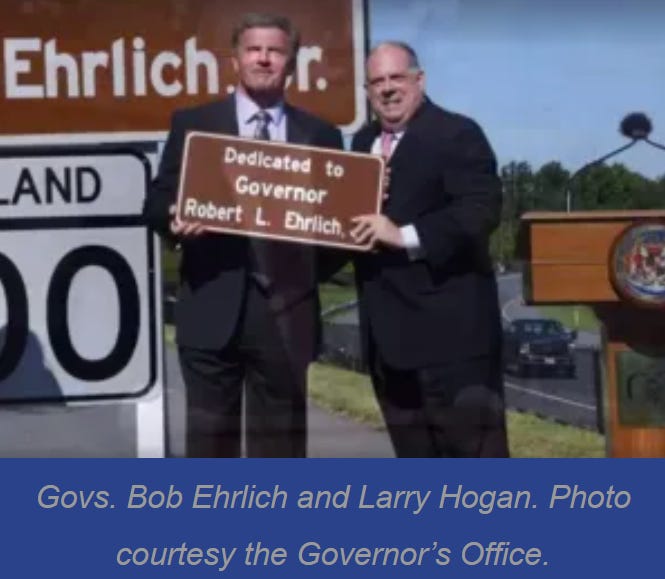
The Hogan–Ehrlich Shadow
If Maryland Republicans could choose their nominee, they would pick a Hogan or an Ehrlich — candidates with proven statewide appeal, crossover credibility, and the ability to raise real money.
But neither appears inclined to run.
And without a Hogan‑style figure, the GOP field looks like a collection of earnest contenders facing a steep climb
The Trump Factor
In another era, a Democratic governor with middling approval numbers might look vulnerable. But Maryland is one of the states where Donald Trump is least popular, and that reality shapes everything.
Any Republican candidate — even one who distances themselves from Trump — must navigate a political environment where the national party brand is a heavy anchor.
That alone makes Wes Moore’s path to renomination and reelection smoother than it might otherwise be.

A Race Waiting for a Spark
The 2026 Maryland governor’s race is not frozen — but it is suspended in a kind of political early spring. The Democratic side is settled. The Republican side is unsettled. And the voters are not yet paying attention.
What the GOP needs is a spark: a candidate who writes a check, hires a team, launches a poll, or stages a breakout moment.
Until then, the race remains defined by potential rather than performance.
And the clock is ticking.