

There is no Maryland law, constitutional provision, or 2022 court ruling that categorically prohibits congressional or legislative districts from crossing the Chesapeake Bay. In fact, such crossings have been historically common and remain legally permissible.
Here’s a breakdown of the legal and historical context:

🗺️ Historical Precedent: Bay-Crossing Districts Are Common
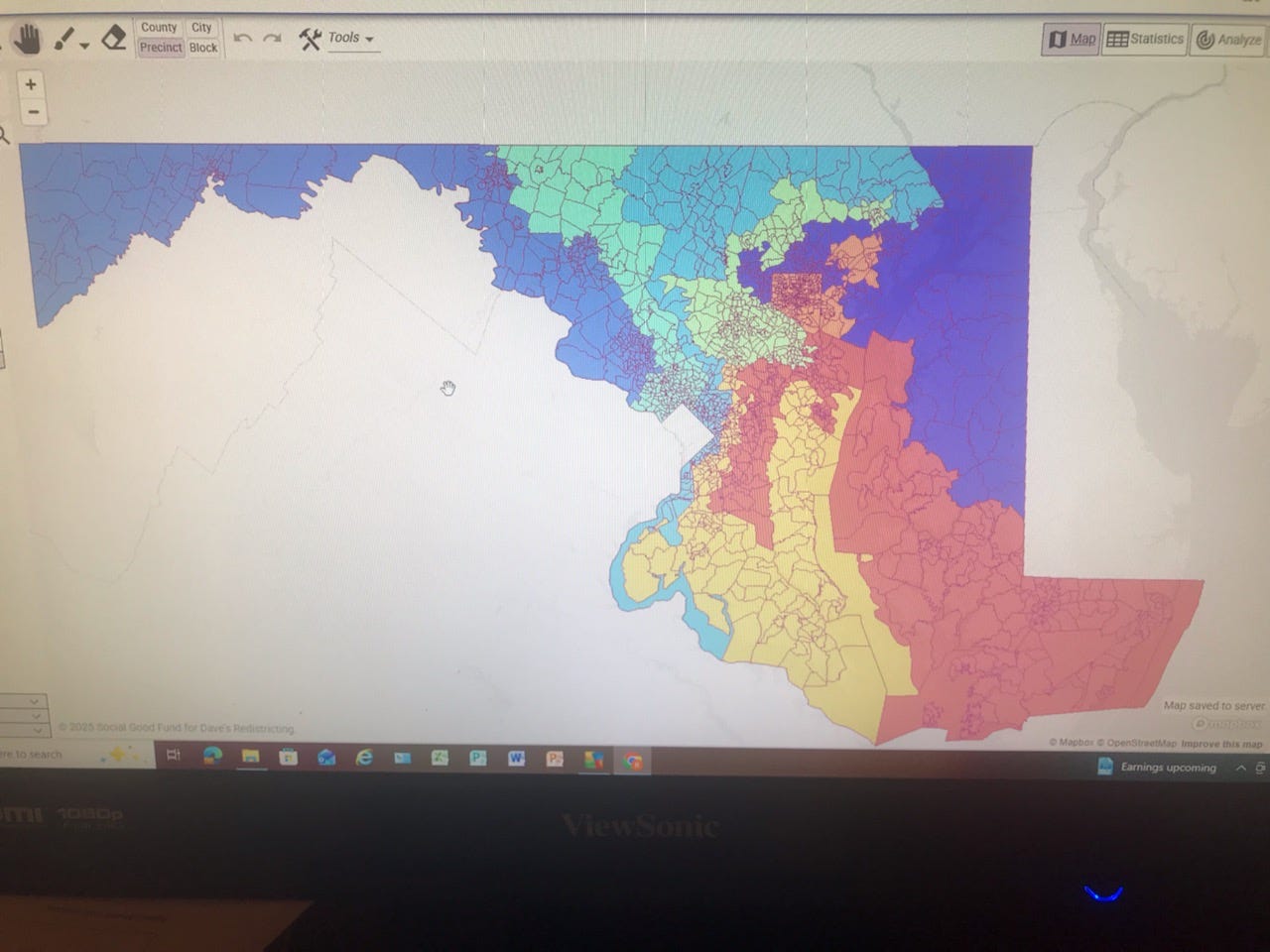
- Maryland’s 1st Congressional District has crossed the Chesapeake Bay for decades, often linking the Eastern Shore with parts of Anne Arundel County or Southern Maryland via the Bay Bridge.
- Former Congressman Wayne Gilchrest, who represented such a district, explicitly stated that the regions are “contiguous” and “connected by the Chesapeake Bay Bridge”.
- The 2022 redistricting maps continued this tradition: the revised 1st District still crosses the Bay to include land north of Annapolis.
⚖️ Legal Standards Post-2022: No Ban on Water Crossings
- The 2022 redistricting cycle in Maryland was shaped by a court ruling that struck down an earlier map for excessive partisan gerrymandering—not for violating natural boundaries.
- The revised maps were adopted after Judge Lynne Battaglia’s ruling, which emphasized fairness and compactness, but did not prohibit water-crossing districts.
- Maryland law and constitution require districts to be contiguous, but contiguity includes connections via bridges or ferries. The Chesapeake Bay Bridge satisfies this requirement.
🌊 Why the Susquehanna River Comparison Doesn’t Hold
- The Susquehanna River is narrower and more easily bridged, but its legal status is no different from the Chesapeake Bay in terms of redistricting.
- Both bodies of water can be crossed in district maps as long as the areas are physically connected (e.g., by a bridge) and the district remains contiguous.
🧭 Bottom Line
- Crossing the Chesapeake Bay is legal and historically accepted in Maryland redistricting.
- No law or court ruling from 2022 prohibits such crossings.
- The claim that the Bay is off-limits while the Susquehanna is not is factually incorrect and unsupported by legal precedent.