

Maryland Nonprofits Get a New Voice — Right as the $3 Billion Squeeze Hits
The sector’s statewide association changes captains in two weeks, in the middle of the worst state budget fight in a generation. If your organization runs on state money, the decisions that matter are being made this fall — in rooms most nonprofits never enter.
Maryland’s nonprofit sector is enormous, and most people in Annapolis still treat it like background scenery. More than 41,000 charitable organizations work in every county in this state. Nonprofits employ roughly one in ten Maryland workers, by Johns Hopkins’ long-running count — a bigger share than almost any other industry. And a huge slice of that sector runs on state money: state grants, state contracts, Medicaid rates, county pass-throughs. When Annapolis sneezes, Maryland nonprofits catch pneumonia.
Somebody should tell them the forecast.
A new captain
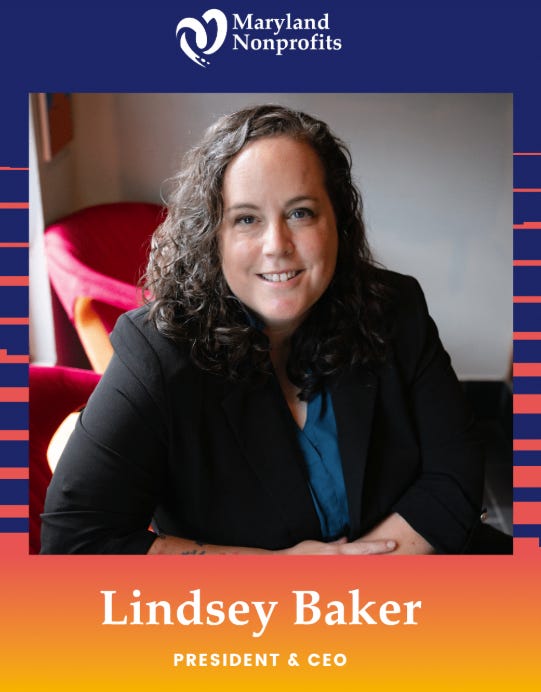
Maryland Nonprofits — the statewide association, with 1,800-plus members and partners — picked Lindsey Baker as its next president and CEO in September. She starts October 19. Baker is a Maryland nonprofit executive with nearly two decades in the sector; board chair Will Pass announced the hire after a national search run by Good Insight, with board member Tom Riford chairing the search committee. Interim president and CEO Carmen Marshall, who carried the association through the 2026 session (including testifying for the Keeping Charities Nonpartisan Act), hands over the gavel in about two weeks.
So the sector’s Annapolis voice changes hands on October 19. The question is what Lindsey Baker is walking into.
The squeeze
She’s walking into a $3 billion structural budget gap. The Board of Revenue Estimates’ latest forecast puts Maryland’s fiscal 2028 shortfall at roughly $3 billion. State agencies have been told to find about 3 percent in cuts, and their budget proposals are due in January — which means the real decisions about whose funding survives are being drafted right now, this fall, inside agency budget offices, months before the General Assembly gavels in.
Nonprofit funding is the definition of discretionary spending. It has no constitutional protection, no dedicated revenue stream, no funding formula with its name on it. When Budget Secretary Jake Weissmann’s people go looking for 3 percent, community grants and provider contracts are where the pencil lands first.
Where it’s decided
If you do government relations for a Maryland nonprofit, here is your fall calendar. Agency budget submissions go to the Department of Budget and Management this autumn. House Appropriations Chair Ben Barnes and Senate Budget and Taxation Chair Guy Guzzone run the committees where those numbers get defended or cut. Comptroller Brooke Lierman sits on the Board of Revenue Estimates, which sets the revenue reality everyone else has to live inside. And the governor’s budget lands in January — after which the Budget Reconciliation and Financing Act becomes the vehicle where funding quietly appears and disappears.
Most nonprofits show up in January with testimony. The smart ones were in the room in October.
The other ratchet
Money isn’t the only pressure. This spring, Maryland created an Audit and Finance Compliance Unit with a public dashboard — fully operational by October 2027 — that will display, agency by agency, how many years each audit finding sits unresolved. State-funded nonprofits already live under audit scrutiny; that scrutiny is about to get a public scoreboard. If your organization’s name can appear next to an unresolved finding, that’s a government-relations problem, not just an accounting one.
Welcome to the village
Here’s what people in my world understand and people in yours are learning: nonprofit government relations is government relations. Same building, same committees, same budget math — different letterhead. The Maryland Wire covers that terrain every day: who’s moving, who’s deciding, and what’s about to happen to state money. If that’s your job, this is your trade paper now.
If you want one live test case, look at the Commerce Department and Office of Tourism Development and the Advisory Commission on Maryland Alcohol Manufacturing and Promotion Fund.
A live grant cycle - the grant opened September 14 and closes October 13: no award amounts are listed and multiple grant control questions posed in Office of Tourism grant applicant remote Google Meet session on October 1 were answered: YET TO BE DETERMINED.
We have NOT been able to identify 390k awarded to the Maryland Wineries Association in 2025 for:
1. A 70k wine coffee table book
2. 320k for “wine trail refresh” and an alcohol promotion app update.
P.S. The tourism office removed the wine trails and the web app was removed from app stores fall of 2025.
The Commerce Department request for records related to the Commission and Fund were met with demands for a range of fee walls through Public Information Act ranging from 5k to 193k.
Then the Commerce Department retaliated submitting a complaint to the PIACB.
The PIACB handed down a 13-page decision against Commerce on June 30.
The Commerce Department has refused to publish or relinquish close out reports and the grant contract for the Maryland Wineries Association. Lack of producing a close out report makes a nonprofit not eligible.
A live cycle happening right now. The Commission Fund is dispensing over a million.
If any reporter would like 15 months of records and complete spreadsheet analysis, we are happy to provide all documents, emails and research.
The piece is useful because it puts a spotlight on something we have been encountering from the operational side: Maryland’s nonprofit sector is not separate from the State’s governing and funding architecture.
It is deeply embedded in it through grants, contracts, pass-throughs, commissions, advisory bodies, and advocacy networks. That much is structural fact.
Evidence of favoritism, conflicts, weak competition, repeat funding without performance, or inadequate oversight has to be established organization by organization through oversight.
A few parts of the article are solidly grounded. Maryland Nonprofits has in fact selected Lindsey Baker as its new president and CEO effective October 19, after a search chaired by board member Tom Riford; the association says it represents roughly 1,800 members and partners.
Baker’s résumé is also directly relevant to the point the article is making: Maryland Nonprofits says that at Maryland Humanities she cultivated $3.25 million in dedicated state funding and built relationships with the General Assembly and other statewide institutions.
The budget pressure is also real, although “$3 billion” should be treated as shorthand rather than a fixed current number. The General Assembly’s post-2026-session fiscal analysis projected a $2.57 billion structural deficit in FY2028, growing to $3.44 billion by FY2030.
Earlier projections were somewhat higher. And the article is exactly right about the calendar: Maryland’s formal budget cycle has agencies submitting requests in late August through late September, followed by DBM review and gubernatorial decisions from September through December. By January, much of the executive-branch architecture is already built.
That is why the most important sentence analytically, is probably:
“Most nonprofits show up in January with testimony.”
The implication is that the consequential access point is upstream: agency program design, budget-request development, grant-program architecture, interagency discussions, and executive-budget formulation. Legislative testimony is only one downstream stage.
The audit point needs one qualification. Chapter 365 of 2026 does establish the DBM Audit and Finance Compliance Unit and requires a public dashboard showing agency audit findings, including how long repeat findings remain unresolved and the status of corrective actions; the dashboard must be fully operational by October 1, 2027.
But the statutory dashboard is principally framed around Executive Departmental units and their audit findings, not as a general public scoreboard listing every nonprofit grantee by name.
State-funded nonprofit problems could certainly surface through agency audits, grant monitoring, subrecipient oversight, or related records, but the article compresses that distinction.
The more revealing research question is not simply, “Which nonprofits receive money?”
It is:
How does an organization move from being an outside nonprofit to becoming a recurring institutional participant in state program design, advisory structures, funding streams, contracts, grant programs, and implementation — and what controls exist at each transition?
You can test the architecture: repeat awards, sole-source or limited competition, board/commission overlap, fiscal sponsorship arrangements, grant closeouts, performance measures, renewal criteria, lobbying/advocacy relationships, state-created intermediaries, and whether measurable outcomes actually determine subsequent funding.
If repeat recipients can continue moving through a state-created funding system without clearly documented closeout, objective performance measurement, or transparent weighting of program objectives, the governance question is systemic regardless of who the recipients are. The evidentiary trail is what makes that argument durable.