

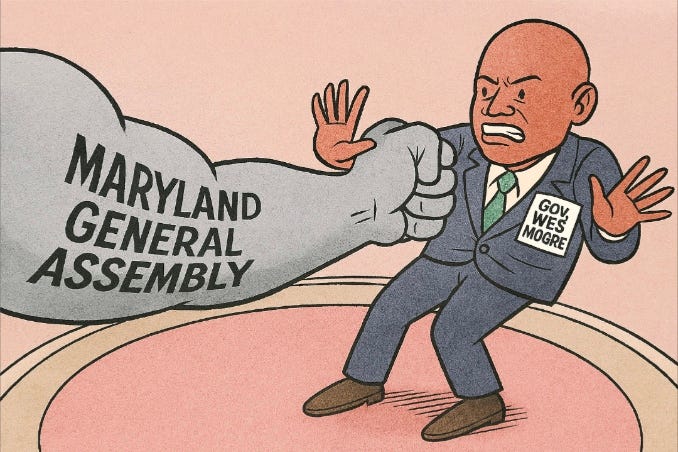
Maryland Lawmakers Override Key Vetoes in December Session
While most Marylanders were focused on the holidays, the General Assembly returned to Annapolis this week for a brief veto session — and handed Governor Wes Moore a series of decisive rebukes. Lawmakers overrode five administration vetoes spanning technology oversight, disability rights, education, and racial equity initiatives, while deferring action on two others until 2026.
The most notable override came on HB 270/SB 116, requiring state agencies to conduct impact analyses for large data centers — a measure aimed at balancing economic development with environmental and infrastructure concerns. Both chambers easily swept aside the governor’s veto (Senate 43–0; House 109–21).
Also overridden was HB 384/SB 157, establishing the Maryland Disability Service Animal Program, championed by Del. Lehman and Sen. Simonaire, which creates a state-supported structure for training and certifying service animals. That vote was nearly unanimous (Senate 43–0; House 123–7).
In education, lawmakers restored HB 1316, directing the State Department of Education to produce a youth-focused technology and social media guide — an initiative aimed at digital literacy and student well-being.
Another key override, SB 587, formally creates a Maryland Reparations Commission to study and propose restorative policy options for descendants of enslaved people in the state. The measure cleared the House on a 93–35 vote following spirited debate earlier this year.
Two House bills — HB 482 (occupational licensing and criminal history review) and HB 1116 (missing persons clearinghouse modernization) — were tabled until next session after motions by Del. David Moon to special order the veto votes were adopted.
One additional proposal, SB 980, concerning adjustments to Maryland Heritage Areas Authority grant funding, was postponed indefinitely in the Senate by motion from Sen. Nancy King, effectively ending its consideration.
In all, it was a productive but pointed veto session that reaffirmed the legislature’s willingness to assert its independence heading into the 2026 election cycle — with many of these overridden bills now set to become law despite executive hesitation.