

THE MARYLAND WIRE | EXECUTIVE INTELLIGENCE
INSIDER REPORT: Post-Election Cabinet Scrutiny & The Operations Pivot at the Maryland Department of Health TARGET AUDIENCE: Government Relations, Health System Executives, Legislative Strategists, & Annapolis Lobbyists PAYWALL ACCESS LEVEL: Premium Subscriber / Executive Edition
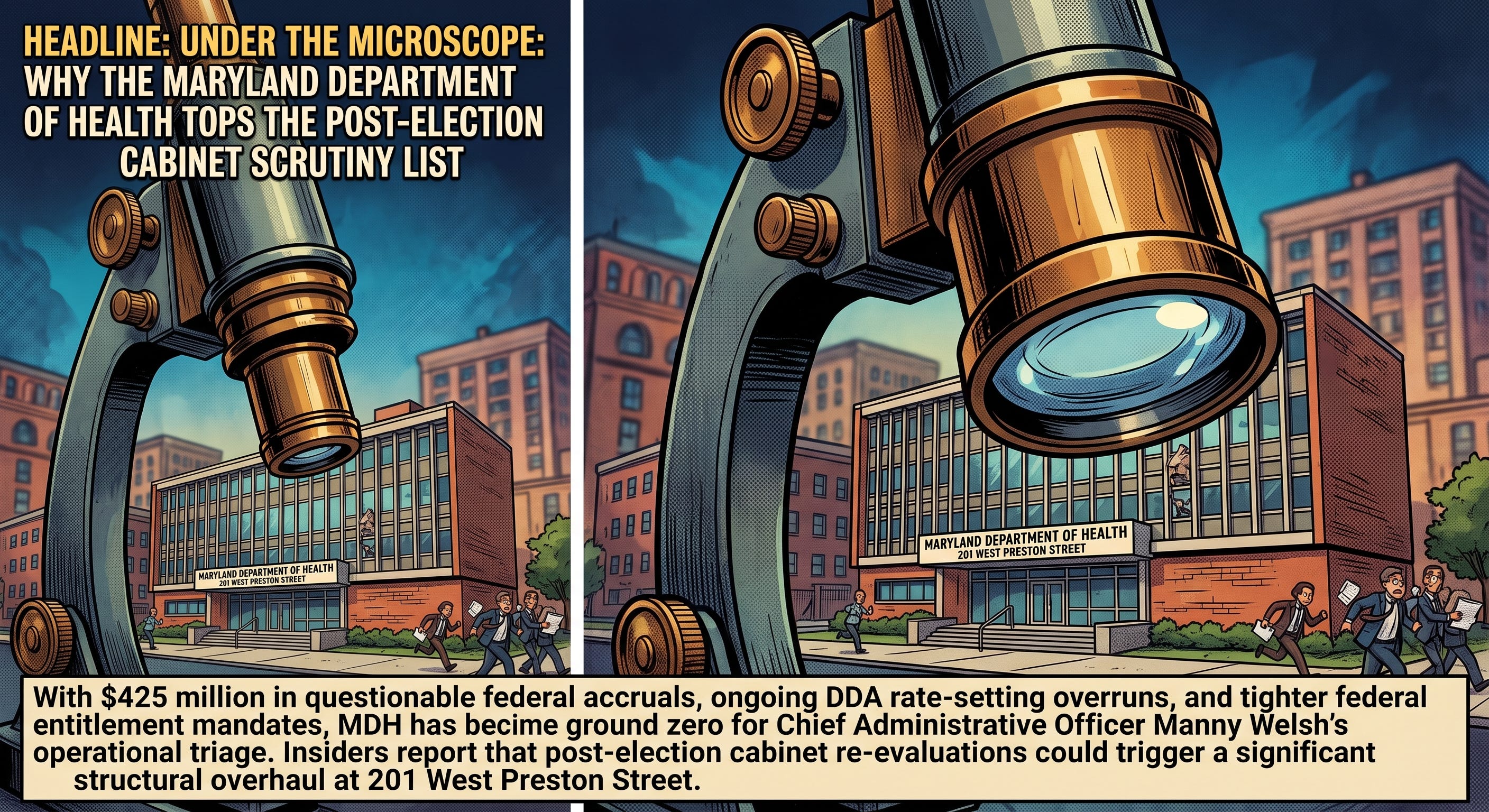
HEADLINE: Under the Microscope: Why the Maryland Department of Health Tops the Post-Election Cabinet Scrutiny List
With $425 million in questionable federal accruals, ongoing DDA rate-setting overruns, and tighter federal entitlement mandates, MDH has become ground zero for Chief Administrative Officer Manny Welsh’s operational triage. Insiders report that post-election cabinet re-evaluations could trigger a significant structural overhaul at 201 West Preston Street.
The Executive Summary
While political observers focus on electoral polling and legislative races heading into the fall, senior leadership in the Moore-Miller administration is quietly conducting a systematic operational review of state executive agencies.
At the center of that review sits the Maryland Department of Health (MDH).
As the state’s largest operating budget consumer, MDH represents both the administration's greatest policy opportunity and its most acute fiscal vulnerability. With Governor Wes Moore signaling zero tolerance for operational drag as he positions the state for high-execution delivery, health care lobbyists, hospital executives, and government relations professionals should prepare for major leadership and structural shifts at MDH post-election.
1. The Factual Pressure: Audit Scars & Fiscal Exposure
To understand why MDH is under intense scrutiny from senior executive staff—specifically Chief Administrative Officer Manny Welsh and Chief of Staff Lester Davis—one needs only to look at the paper trail left by the Office of Legislative Audits (OLA).
Federal Revenue Accounting Discrepancies: OLA’s Statewide Review of Budget Closeout Transactions flagged $425 million in unsupported federal revenue entries at MDH. While accounting mechanics sound dry to outsiders, to DBM and the Governor's second floor, unresolved federal accruals create immediate, multi-million-dollar general fund exposure.
The Governor’s February 2026 Audit Directive: The administrative pressure became explicit on February 6, 2026, when Governor Moore issued a formal directive ordering cabinet secretaries to review, remediate, and resolve repeat audit findings within strict 60-day and 180-day windows. MDH’s historical legacy of IT procurement hiccups and revenue tracking gaps makes it primary Target A under this order.
DDA System Transition Cost Overruns: The Developmental Disabilities Administration’s (DDA) transition to the Long Term Services and Supports (LTSS) fee-for-service model saw actual spending dramatically outpace legislative appropriations. The General Assembly responded by withholding executive budget funds pending quarterly fiscal reports—a clear sign that legislative budget committees are losing patience with agency forecasting.
2. The Inferred Scrutiny: Strategic Realignment Ahead
Beyond the audit numbers, political and operational logic dictates why MDH is prime territory for post-election executive intervention:
A. The Federal Entitlement Shift
Federal shifts in SNAP administration and Medicaid redetermination rules are forcing state agencies to absorb higher cost-shares and administrative burdens. In Maryland, error-rate penalties and tighter eligibility tracking mean MDH and DHS must operate with surgical precision. Any administrative bottleneck in Annapolis directly translates to general fund shortfalls in DBM.
B. The "Turnaround Operator" Standard
The administration's operational playbook—demonstrated by the elevation of turnaround talent across other state authorities—demands leaders who can step into high-wire crises, clean up backend mechanics, and maintain clean legislative relations. MDH’s sheer footprint requires an executive who is as much a master of Medicaid enterprise system architecture as they are a public health strategist.
3. Strategic Outlook for Health System Lobbyists & Consultants
For government relations professionals advising health systems, MCOs, behavioral health providers, and life science vendors, the next 6 to 12 months require a tactical recalibration:
Area of ConcernOperational RealityStrategic Guidance for Clients Procurement & IT ContractingHeavy scrutiny on sole-source and emergency contract modifications following past OLA critiques.Expect longer approval timelines; ensure all vendor proposals include rigid audit compliance mapping. Provider Reimbursements (LTSS/DDA)Strict legislative fence-line controls on fee-for-service transitions.Do not rely on historical budget projections; verify rate-setting assumptions against DBM compliance benchmarks. Cabinet Leadership & ReorganizationHigh likelihood of post-election executive staff slotting or deputy-level shakeups.Map relationships down to the Deputy Secretary and Assistant Secretary level; do not rely solely on top-tier political appointments.
The Bottom Line
Expect the post-election transition period to bring a quiet but firm operational audit of MDH’s top administrative tier. For the Annapolis lobbying core, the winning strategy will not be pitching big-ticket policy ideas, but positioning clients as compliant, operationally reliable partners who help the administration solve its backend fiscal and audit challenges.
Manny Welsh: Maryland’s Quiet Technocrat thrust into the Spotlight

Manny Welsh: Maryland’s Quiet Technocrat thrust into the Spotlight
Thank you for this!