


MARYLAND 2025: The Year the Center Strained
Maryland Wire — Year‑End Magazine Feature
Maryland entered 2025 with the usual optimism of a state that prides itself on stability. But by the time lawmakers walked out of Annapolis in April, and certainly by the time the final veto letters landed in December, it was clear that this had been a year unlike any other. The seams of Maryland’s political fabric didn’t just stretch — they groaned. And in that tension, the state revealed something essential about itself: its limits, its ambitions, and its fault lines.
This is the story of a year defined by austerity, ambition, and a quiet but unmistakable shift in political gravity.
I. The Budget Crisis That Rewrote the Script
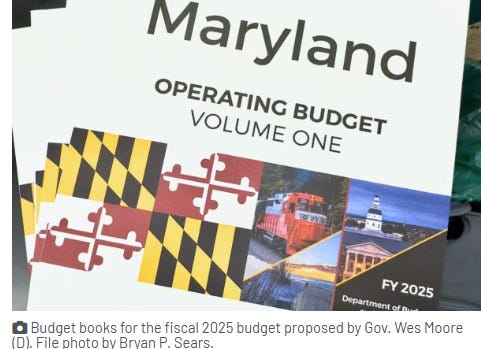
The defining story of 2025 wasn’t a scandal, a personality, or even a policy fight. It was math.
Maryland’s structural deficit — a yawning, stubborn, $3 billion gap — forced the General Assembly into a posture it hadn’t adopted in more than a decade. The era of easy surpluses was over. The state’s fiscal house, long buoyed by federal largesse and pandemic-era stimulus, suddenly looked fragile.
The cuts were deep and symbolic. The University System of Maryland absorbed a $155 million reduction. Agencies that had been quietly struggling — DDA, Medicaid, juvenile services — found themselves exposed. And the looming threat of federal workforce reductions cast a long shadow over Montgomery, Prince George’s, and Anne Arundel counties.
For the first time in years, Maryland politics felt constrained. The state that had grown accustomed to saying “yes” was forced to relearn the art of “not this year.”
II. A Governor and a Legislature Drift Apart
If 2023 was the honeymoon and 2024 was the adjustment period, then 2025 was the year the relationship between Gov. Wes Moore and the General Assembly finally cracked.
The break didn’t come with fireworks. It came with veto letters.
Moore rejected more bills in 2025 than in his first two years combined — and not fringe bills, but core Democratic priorities: climate impact studies, energy planning requirements, a reparations commission, and several environmental oversight measures that had passed with comfortable margins.
Legislators were stunned. Advocates were furious. And the governor’s office, once the gravitational center of Maryland’s political universe, suddenly felt off‑balance.
By December, the mood in Annapolis was unmistakable: the governor and the legislature were no longer rowing in the same direction. The 2026 session now looms as a test of whether that rift is temporary or structural.
III. The Crime Story No One Expected
Amid the fiscal gloom and political friction, Maryland delivered one of the most remarkable public‑safety turnarounds in the country.
Baltimore ended the year with fewer than 150 homicides — a number not seen since the 1960s. Prince George’s County recorded its lowest homicide count since 2020. The shift wasn’t just statistical; it was atmospheric. Neighborhoods that had grown accustomed to trauma felt the first hints of relief.
For a state that has spent decades wrestling with crime narratives, 2025 offered something rare: a success story that crossed partisan lines and defied national trends.
IV. A Legislature That Kept Working Anyway
Despite the budget constraints and the political tension, the General Assembly produced one of its most substantive sessions in years.
Lawmakers passed nearly 900 bills, touching every corner of Maryland life:
- sweeping criminal justice reforms, including expungement and shielding measures
- a major energy package that embraced nuclear, natural gas, solar, and battery storage
- the Maryland Values Act, passed in the final minutes of session
- expanded health insurance subsidies for young adults
- new authority to regulate prescription drug prices
It was a session defined by contradiction: a government under strain that nevertheless delivered a heavy policy load.
V. The Hogan Ethics Reckoning
Former Gov. Larry Hogan’s real estate entanglements — thrust into the national spotlight by investigative reporting — triggered a bipartisan ethics overhaul that will shape Maryland’s executive branch for decades.
Future governors will now face strict requirements: blind trusts, divestment, or both. The message was unmistakable: Maryland’s political class was no longer willing to rely on norms and goodwill.
In a year defined by fiscal discipline, this was the moral discipline story — a rare moment of consensus in a polarized environment.
VI. The Housing Crisis That Wouldn’t Move
Maryland’s housing market remained frozen in place. Prices climbed. Sales fell. Inventory evaporated. And Gov. Moore’s claim that the state needed 96,000 new units became a political flashpoint.
Developers said the number was too low. Local governments said it was too high. Advocates said it was too vague.
What everyone agreed on was this: Maryland’s housing crisis is no longer a policy challenge. It’s a political one.
VII. The Quiet Turbulence Inside State Agencies
While the headlines focused on budgets and vetoes, Maryland’s administrative machinery showed signs of strain.
The departure of Health Secretary Laura Herrera Scott — amid Medicaid underestimates and DDA funding controversies — signaled deeper issues. Clifton T. Perkins Hospital Center continued to struggle with staffing, safety, and oversight. And several agencies reported difficulty meeting mandates passed during the Moore administration’s first two years.
It was the kind of story that rarely leads the news but shapes the lived experience of thousands.
VIII. A Congressional Delegation in Transition
With four new members joining Maryland’s congressional delegation, 2025 marked the largest turnover in years. Their early verdict on Washington was blunt: the dysfunction looks even worse from the inside.
For Maryland, a state deeply intertwined with federal institutions, this turnover matters. It reshapes influence, seniority, and the state’s ability to navigate federal turbulence.
Where Maryland Stands at Year’s End
Maryland closes 2025 as a state caught between ambition and austerity, progress and pressure. The year revealed a political ecosystem that is still capable of big policy wins but increasingly constrained by fiscal reality and internal friction.
The story of 2025 is not one of collapse. It is one of recalibration.
A state that once moved confidently toward expansive goals now finds itself asking harder questions about what it can afford, what it can sustain, and what it truly values.
And as 2026 dawns the stakes only grow: a budget gap still to be closed, a governor seeking to regain footing, a legislature asserting its independence, and a public watching closely.
Maryland didn’t break in 2025. But it did bend — and the shape it takes next will define the decade.