

Maryland–D.C. Labor Dynamics: Why a Regional Power Doesn’t Always Travel
When Dyana Forester entered the D.C. Council At‑Large race, many observers assumed she would consolidate labor support quickly. After all, she had served as president of the Metropolitan Washington Labor Council, AFL‑CIO, and later held a senior labor relations role in the Moore administration — a résumé that, on paper, should have made her a formidable contender.
But labor politics in the Washington region don’t operate on paper.
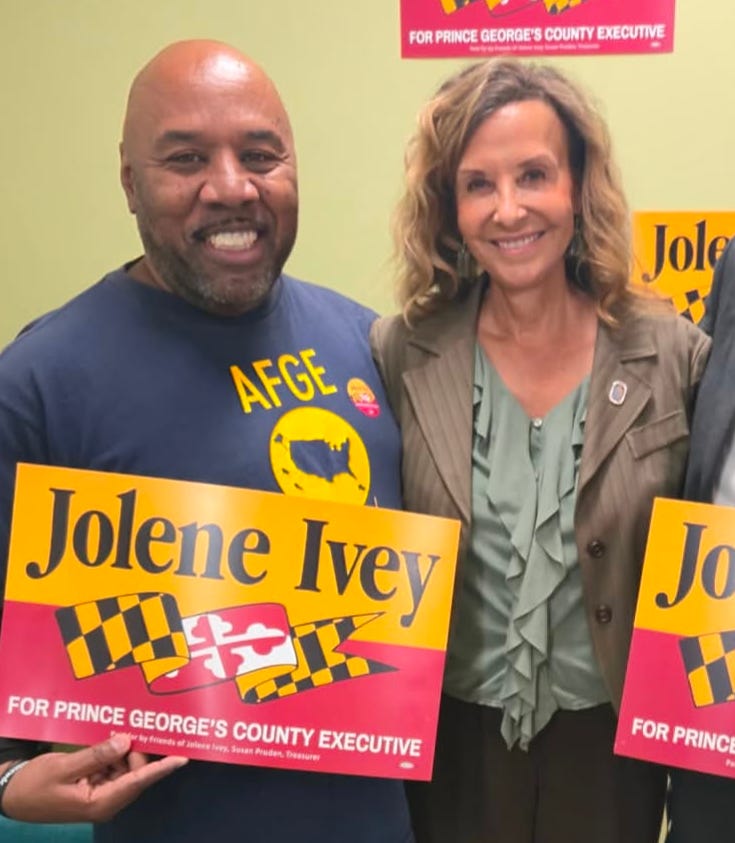
They operate on two different gravitational systems that only appear unified from a distance.To understand why a labor heavyweight in Maryland can find herself on uncertain footing in D.C., I turned to a range of sources — including conversations with Anthony Lee Wright, a prominent union‑based political operator who works in both jurisdictions and has become an increasingly influential figure in the region’s labor–political ecosystem. Wright, who is currently supporting Robert White for D.C. Delegate, Kevin Chavous for At‑Large, and Kenyan McDuffie for Mayor, while also advising campaigns in Prince George’s County where his home union has 80,000 members, helped illuminate the structural forces at play. His insights, combined with independent research, reveal a deeper story about how labor power actually functions across the Maryland–D.C. line.
Maryland Labor: Institutional, Hierarchical, and Government‑Centered
Maryland’s labor movement is anchored in Annapolis and dominated by large public‑sector unions — AFSCME, MSEA, SEIU 1199 — along with the building trades. Their influence is built on:
- long-standing relationships with governors
- collective bargaining structures
- predictable endorsement processes
- a culture that rewards stability and seniority
In Maryland, labor is a governing partner.
It values reliability, institutional experience, and the ability to navigate state bureaucracy. Forester’s role in the Moore administration fit neatly into this model.
D.C. Labor: Fragmented, Factional, and Movement‑Driven
Cross into the District, and the terrain changes completely.
D.C. labor is a patchwork of competing power centers — SEIU, ATU, teachers unions, building trades, and neighborhood‑based organizing groups — each with its own ideological commitments and internal politics. Endorsements are shaped by:
- activist credibility
- community alliances
- personal relationships
- factional rivalries
- hyper‑local political histories
Where Maryland labor rewards institutional experience, D.C. labor rewards movement energy.
Where Maryland values stability, D.C. values visibility and ideological alignment.
A candidate who thrived in Maryland’s structured environment can find D.C.’s fluid, personality‑driven landscape far less predictable.
Why Forester’s Résumé Didn’t Guarantee D.C. Labor Support
Forester’s background gives her broad regional credibility, but it also places her in a political no‑man’s‑land:
- In Maryland, she is respected but not part of the old‑line Annapolis hierarchy.
- In D.C., she is respected but not a pure local insider with decades of neighborhood‑based organizing.
Her experience in the Moore administration — an asset in Maryland — does not automatically translate into endorsements in a city where labor groups often distrust candidates with recent government ties.
This isn’t a reflection on her talent or record.
It’s a reflection of two labor cultures that operate by different rules.


The Cross‑Jurisdictional Operator
This is where figures like Anthony Lee Wright become increasingly important.
Wright is one of the few political actors who moves comfortably between Maryland and D.C., advising candidates in both systems and understanding the fault lines that separate them. His work with Robert White, Kevin Chavous, and Kenyan McDuffie in D.C., alongside his advisory role in Prince George’s County, positions him as a connector in a region where most operatives stay siloed.
He’s not the center of this story — and shouldn’t be — but his vantage point helps explain why a candidate with Forester’s credentials can be formidable in one jurisdiction and face headwinds in another.
The Larger Lesson
Forester’s at‑large race is not a referendum on her career.
It’s a case study in how regional labor power does not travel evenly across borders.
Maryland labor is institutional.
D.C. labor is factional.
A leader who excels in one system may find the other requires a different set of alliances, a different style of politics, and a different kind of legitimacy.
Understanding that divide — and the operatives who navigate it — is essential to understanding why the race is unfolding the way it is.