

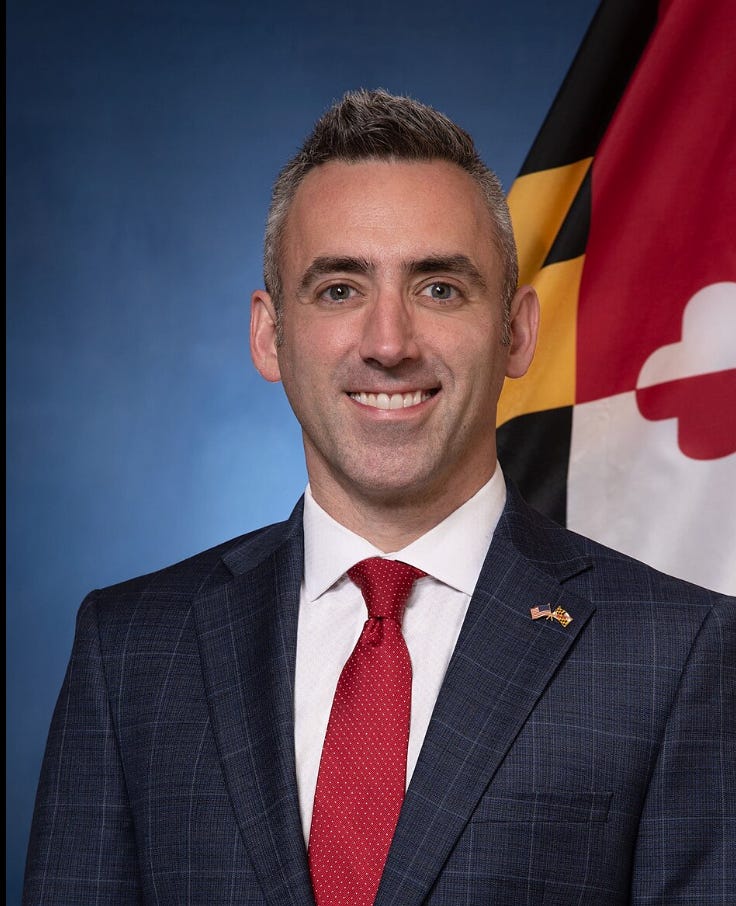
The Developer Whisperer
How Jake Day turned Maryland’s housing department into the friendliest door in state government
On Thursday, while most of Annapolis was watching the budget, Governor Wes Moore signed two executive orders that the development world in Maryland should read twice. One creates a Housing Innovation Incubator to push modular construction, pre-approved building plans, and new housing businesses. The other creates PLAT, a Permitting and Licensing Acceleration Team charged with cutting the time it takes to get a permit, a license, or a certification anywhere in Maryland state government. Both roads run through the same office: Secretary Jake Day and the Department of Housing and Community Development.
This is the part of the Moore administration that is quietly outperforming. Since the “Housing Starts Here” executive order of September 2025 put DHCD in charge of speeding up housing production, the numbers have moved the way developers pray numbers move. Multifamily application reviews at DHCD are running 26 percent faster. Permit processing at the Maryland Department of the Environment is 25 percent faster. On-time permit processing at the State Highway Administration has climbed from 87 percent to 95 percent. More than 300 acres of surplus state-owned land have been identified and are being reviewed for housing. These are not press-release numbers; they are the friction points where projects live or die, and they are going the right direction.
The most interesting hire in Maryland government this year may be Steven A. Palmer. In January, Day named Palmer, an Olney native who practiced law at Covington & Burling and took his law degree at Harvard, as Maryland’s first Housing Ombudsman. The job description is the one every developer in Maryland has written in his head: a named human being whose assignment is to unstick projects stalled in state and local permitting. Seven months in, Palmer’s office has supported 50 housing projects across the state. If your project is stuck, there is now a door, and there is a name on it.
The money is moving, too. In fiscal 2026, DHCD awarded more than $1 billion in tax credits, bond financing, and rental housing funds to create or preserve 3,025 affordable units. The newest round, announced this week, puts $17.6 million into seven projects, 555 units, in seven counties and Baltimore City, including Woda Cooper Development’s 50-unit Gillis Memorial GrandFamily Apartments in Park Heights, where Woda Cooper’s Malik Jordan stood with Mayor Brandon Scott to announce it. And Day has attached a string the industry feels: tax-credit projects must now close their financing within 12 months. Build, or give the credits back. That one rule changes behavior in every development office in Maryland.
Why does the machine run this way? Because the man running it is a builder by training. Jake Day took an architecture degree at the University of Maryland, a master’s in urban design at Carnegie Mellon, and a master’s in environmental policy at Oxford. He was national president of the American Institute of Architecture Students before most lobbyists in Annapolis had framed their first diploma. As the 28th mayor of Salisbury, he ran a downtown resurgence with roughly $650 million in new construction and built a Housing First program for chronic homelessness. He remains a major in the Army National Guard, with a combat deployment to the Horn of Africa. Architects think in systems and deadlines; soldiers think in missions. Developers recognize both.
“Secretary Day is one of the most passionate advocates for new housing in the country,” says Tom Coale, the Annapolis land-use lawyer. “He is both zealous in his advocacy and understanding of the common objections to housing development. In many respects, Maryland is leading the country on housing policy, and that is thanks to Governor Moore and Secretary Day.” When the land-use bar says that about a housing secretary, on the record, the village should listen.
Here is the fact that tells you the most about the man: he could have run for Congress. Polling in the First District showed Jake Day making Andy Harris sweat, a statistical tie once voters heard the two men’s stories. Day looked at it and went back to work, saying his priority was finishing Moore’s housing agenda. Cabinet secretaries who turn down a plausible seat in Congress to keep running a housing department are not common in any state.
So mark the name. In a state government full of people managing decline, defending process, and explaining why things cannot be done, Jake Day is doing the unfashionable thing: performing. The projects that get built in Maryland over the next decade will increasingly have his fingerprints on them, and the people who need those projects built have figured out where the friendly door is.