


Bridging the Bay: How Jake Day Is Proving His Vision for Baltimore—and Maryland’s Future
When the Baltimore Banner published its dive into Baltimore’s vacant lot dilemma, the conversation could have easily stayed within local municipal circles. But a key response came from a voice that represents both the state's executive leadership and a distinct regional background: Maryland Housing Secretary Jake Day.
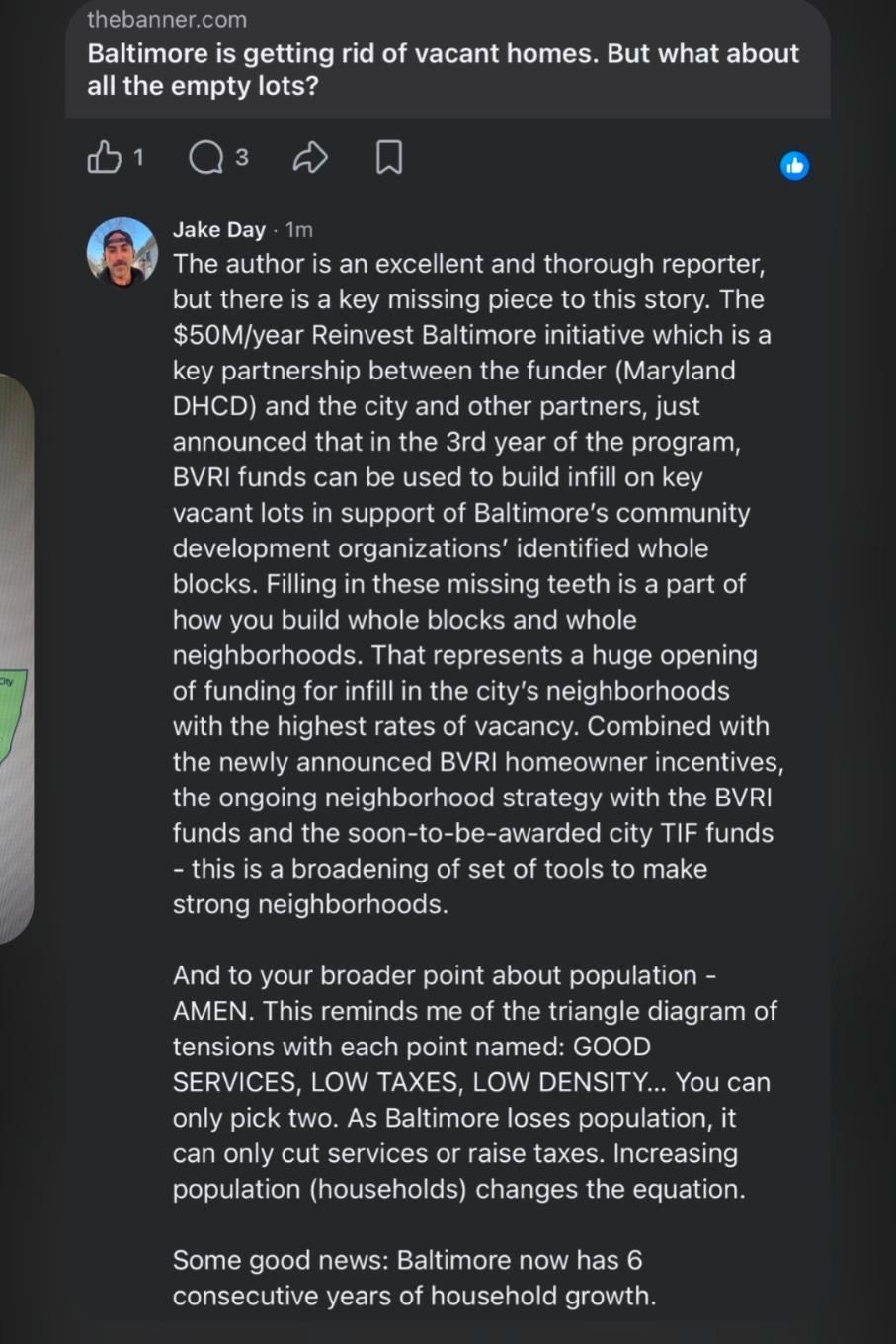
Day’s detailed commentary on the piece went far beyond standard cabinet-level cheerleading. By outlining how the state’s $50M/year Reinvest Baltimore initiative and Baltimore Vacants Reinvestment Initiative (BVRI) funds are being adapted to support infill housing on vacant lots, Day demonstrated an intricate understanding of neighborhood design, municipal finance, and community development.
For political observers watching the long-term landscape in Maryland, Day’s engagement raises an intriguing question: Is the former Salisbury Mayor successfully establishing himself as a key champion for Baltimore—and a candidate with a truly statewide reach?
Urban Expertise Meets Statewide Policy
Day’s background makes him an unconventional figure in Maryland executive politics. Raised on the Eastern Shore, trained as an urban designer, and seasoned by two terms as Mayor of Salisbury, Day brings a practitioner's lens to housing policy.
In his response to The Banner, Day pointed directly to the "missing teeth" of Baltimore neighborhoods—the empty lots left behind after demolitions. His emphasis on combining BVRI infill funds, homeowner incentives, community development organization (CDO) block strategies, and Tax Increment Financing (TIF) shows a firm grasp of the multi-layered tools required to rebuild urban infrastructure.
Rather than viewing rural and urban challenges as opposites, Day’s policy approach highlights shared mechanics: small-town revitalization and big-city infill both depend on density, infrastructure reinvestment, and household growth.
The Math of Sustainable Growth
Day also touched on a fundamental governance dilemma: the trade-off between services, taxes, and density. As he noted, a declining or stagnant population forces cities into a difficult choice between cutting services or raising taxes. The only sustainable way out of that loop is household growth—a metric where Baltimore has recently seen six consecutive years of progress.
By focusing on the arithmetic of growth, Day frames state investment in Baltimore not as charity, but as a strategic economic imperative for all of Maryland. A fiscally strong, growing Baltimore lightens the burden across the entire state economy.
A Bridge-Builder for Maryland’s Future
To win and govern effectively across Maryland, leaders must build trust across geographically and demographically distinct regions—from Western Maryland and the Eastern Shore to Baltimore City and the Washington suburbs.
Day’s active leadership on Baltimore’s toughest structural challenge—vacant housing and neighborhood stabilization—demonstrates that his scope extends far beyond his Eastern Shore roots. By combining technical competence, municipal experience, and a clear vision for urban revitalization, Day is carving out a reputation as a pragmatic policy leader who understands how to deliver results in Maryland's largest urban center.
Whether his future lies in continuing to reshape Maryland's housing landscape or stepping into broader statewide leadership down the road, one thing is clear: Jake Day is showing that a deep commitment to Baltimore’s neighborhoods is essential to building a stronger state for everyone.
Jake is my favorite Secretary and he would be an excellent state or federal legislator.