


📰 The Ponds No One Wants to Talk About
Confidential Testimony, Federal Funds, and the Quiet Pressure Campaign Inside Prince George’s County Government
By Barry O’Connell
Prince George’s County employees say they have been living with a quiet pressure campaign—one that has never appeared on a public agenda, never been debated in a hearing, and never been disclosed to the taxpayers who ultimately foot the bill.
According to multiple county employees who spoke on condition of anonymity, Council Member Wala Blegay has repeatedly convened or attempted to convene meetings with staff in which she pressed them to perform maintenance on stormwater ponds owned by private HOAs and developers. These are ponds the county does not own, is not responsible for, and—critically—is legally prohibited from maintaining.
The allegation is stunning not only because of the legal implications, but because of the irony:
Blegay herself helped write and pass the very law that forbids the county from doing what she is now pressuring staff to do.
And the stakes are far higher than a few clogged culverts or overgrown embankments.
County staff say the work she is demanding would require the use of county funds blended with federal EPA stormwater grant money—funds that come with strict federal restrictions and cannot be used to subsidize private property.
If true, the implications are enormous.
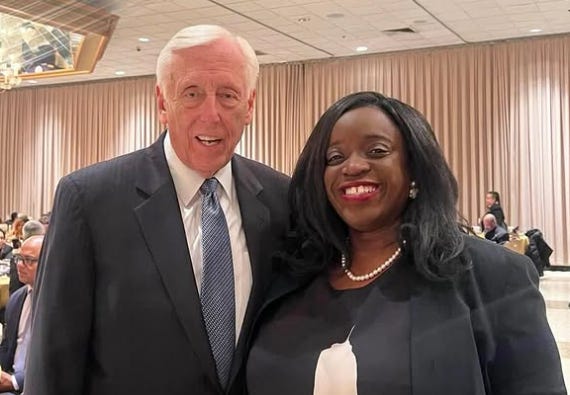
Rumored to Plan on running for Congress
Wala was just sworn in as At-Large Member of Prince George’s County Council and she is considering running to replace Steny Hoyer
The Law Is Clear — And She Wrote It
Prince George’s County’s stormwater code draws a bright, unmistakable line:
- Public ponds → maintained by the county
- Private ponds → maintained by the owner (HOA, developer, or private entity)
The county may inspect private ponds for compliance, but it cannot perform maintenance unless the property has been formally transferred to public ownership or a specific legal agreement exists.
This structure wasn’t accidental. It was the product of years of debate, legal review, and legislative drafting—drafting in which Blegay, an attorney, played a central role.
That is what makes the employees’ testimony so explosive.
If she is pressuring staff to violate the law, she is pressuring them to violate her own law—a law she knows intimately.

The Federal Layer: EPA Grant Money and the Risk of Misuse
EPA stormwater grants are not flexible slush funds. They are governed by:
- the Clean Water Act,
- federal grant conditions,
- and strict prohibitions on using federal dollars for private benefit.
Using EPA stormwater funds to maintain private HOA ponds is not permitted.
Doing so knowingly can trigger:
- EPA Office of Inspector General investigations,
- forced repayment of misused funds,
- suspension of future grants,
- and, in extreme cases, referrals to the Department of Justice.
If a county employee were to follow an elected official’s directive to perform illegal maintenance, the employee—not the official—could be the one exposed to federal liability.
This is why the employees who came forward described the situation as “terrifying.”
Why Would a Council Member Push for This?
That is the question county employees keep asking.
They do not know whether the beneficiaries are:
- political allies,
- donors,
- friendly developers,
- or simply constituents with influence.
They do not know whether envelopes, favors, or promises are involved.
They do not know whether this is a pattern or an isolated push.
What they do know is that the pressure was real, direct, and persistent.
And they know that if they complied, they would be breaking the law.
The Questions That Now Demand Answers
The allegations raise a series of unavoidable questions—questions that can only be answered through an independent investigation:
1. Have any county crews already performed maintenance on private ponds?
If so, which ponds, at whose request, and using what funds?
2. Were EPA grant dollars used, directly or indirectly?
If yes, the county may already be in violation of federal law.
3. Did any county employee feel coerced or threatened?
Pressure from an elected official can constitute an abuse of office.
4. Did the councilmember disclose any conflicts of interest?
If the beneficiaries are donors, political allies, or business partners, ethics rules come into play.
5. Why would an attorney who wrote the law ask staff to break it?
This is the central mystery—and the one that most alarms the employees who came forward.
The Human Element: County Employees Caught in the Middle
The employees who spoke out did so reluctantly.
They fear retaliation.
They fear being blamed for decisions they did not make.
They fear being forced into a position where following orders means breaking the law.
One employee put it bluntly:
> “If we do what she’s asking, we’re the ones who get fired or prosecuted. Not her.”
Their testimony is the reason this story exists at all.
A Call for Transparency and Investigation
Prince George’s County cannot afford to ignore this.
The county must determine:
- whether private pond maintenance has already occurred,
- whether federal funds were misused,
- whether staff were pressured to violate the law,
- and whether an elected official abused her authority.
The public deserves answers.
County employees deserve protection.
And the integrity of the county’s stormwater program—and its federal funding—depends on swift, independent review.
Until those answers come, the county is left with a troubling picture:
A law written to protect taxpayers and ensure accountability may have been undermined by the very person who championed it.
And the people who tried to uphold the law were left to whisper their warnings in confidence.
Further Reading:
The Mathematician in the Basement:

By all accounts, it was just a basement meeting. A handful of insiders, a few folding chairs, and a chalkboard of possibilities. But what happened in that room would alter the trajectory of Prince George’s County—and, eventually, the state of Maryland. At the center of it all sat a quiet man with a mathematician’s mind and a revolutionary’s patience: Er…