

Inspector Generals, Oversight, and the Maryland Dilemma: A Debate Between Two People Who Care Deeply About Good Government
There are few things rarer in Maryland politics than a genuine debate conducted in good faith. Not the cable‑news version, not the Twitter version, but the real thing — two people who know the terrain, who have done the homework, and who care enough about the institutions of government to argue about how to make them better.
That is what happened in a recent conversation between Maryland Wire contributor Jimmy O’Toole and this publication’s editor. And it is worth putting into print, not because either side “won,” but because the disagreement itself reveals something important about the moment Maryland finds itself in.
Jimmy is a progressive — a fact he wears without apology — and he approaches the question of government oversight with the conviction that sunlight is the only disinfectant that ever really works. I come at the issue from a different tradition. I’m a Harry Truman Democrat, which is another way of saying I believe in blunt talk, clean books, and the idea that government works best when it remembers it is spending the public’s money, not its own.
But on the core question — whether Inspector Generals matter — there is no daylight between us. They do. They have. And in many jurisdictions, they are the only thing standing between taxpayers and the slow, grinding corrosion of public trust.
Where Jimmy and I part ways is not on the need for oversight, but on the design of it.
Jimmy’s Case: Maryland Needs More Oversight, Not Less
Jimmy argues that Maryland’s recent history speaks for itself. In Baltimore County, the Inspector General uncovered mismanagement and questionable spending. In Baltimore City, the IG’s push for broader access to records has triggered political resistance. In Prince George’s County, allegations of misconduct — from procurement irregularities to no‑show jobs — have piled up faster than the institutions meant to prevent them can respond.
From Jimmy’s perspective, the pattern is unmistakable:
When oversight is weak, corruption flourishes. When oversight is strong, corruption fights back.
That is why he supports the proposal by Prince George’s County Executive candidate Greg Holmes to create an independent Inspector General through a ballot measure. Holmes’ idea is straightforward: if the County Council won’t create an IG, the people should.
Jimmy sees this as a necessary correction — a way to give residents a watchdog with subpoena power, independence, and the authority to follow the money wherever it leads.
And he is right to say that Prince George’s County, with a population larger than several U.S. states, deserves nothing less.
My Case: Oversight Must Have Guardrails or It Can Become Its Own Problem
Where I diverge from Jimmy is not in the value of oversight, but in the architecture of it.
I have seen what happens when an Inspector General becomes unmoored from accountability. The case of former Baltimore County IG Kelly Madigan is, in my view, a cautionary tale. She was appointed to a five‑year term. At the end of that term, instead of stepping aside, she attempted to pressure the county to keep her. I believe she selectively enforced investigations in ways that benefited a political ally. And when she opened an investigation into the County Executive’s chief of staff, the matter escalated into a lawsuit — one that ended with the county paying out a substantial settlement.
To me, that episode illustrates a structural flaw:
An IG with too much insulation can become as dangerous as an IG with too little independence.
So here is the dilemma:
- If an IG has a fixed term and cannot be removed, a bad IG can do real damage.
- If an IG can be removed too easily, a good IG can be fired the moment they irritate the powerful.
That is the trap. That is the tension. And that is why I am cautious — not about the Holmes proposal, which I think is a step in the right direction, but about the details that come after it.
Oversight without independence is meaningless.
Oversight without accountability is dangerous.
The challenge is to build a system that avoids both failures.
Two Views, One Goal
What makes this debate worth printing is that it is not a clash of ideologies. It is a clash of priorities.
Jimmy prioritizes independence — the ability of an IG to investigate without fear of retaliation.
I prioritize guardrails — the ability of the public to remove an IG who abuses that independence.
Both concerns are legitimate. Both are rooted in experience. And both point toward the same conclusion:
Maryland needs oversight, but it needs to get the structure right.
Holmes’ proposal opens the door. The next step is to design an appointment process, a removal process, and a set of operational rules that protect the public from corruption in both directions — corruption by officials, and corruption by the watchdogs themselves.
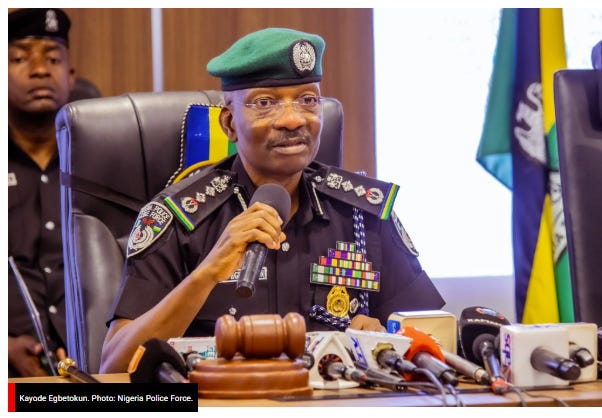
Perhaps my biggest concern about the inspector General proposal is I suspect that if choosing the inspector General is left up to certain members of Prince George’s Countycouncil and Aisha Braveboy that there's a very good chance that they would pick Edward's father and give him a uniform based on the Nigerian IG uniform and tell him he can work from home.
That is not an easy balance to strike. But it is a debate worth having, and Jimmy is exactly the kind of person worth having it with — informed, principled, and unafraid to argue his case.
Maryland would be better off if more of our political disagreements looked like this one.