

Larry Hogan’s Profit‑First Politics Come Home to Roost
By Maryland Wire Staff
Larry Hogan didn’t just govern Maryland. He treated it like a portfolio. The story that began with one wetlands license on Kent Island has now widened into something much larger: a governor who repeatedly used the machinery of state government in ways that aligned with his private real‑estate interests, and a political system that let him get away with it until after he left office.[10][11]
Four Seasons in the Wetlands
The Four Seasons at Kent Island project was never supposed to happen. Twice under Governor Martin O’Malley, the Board of Public Works (BPW) rejected the developer’s bid for a tidal‑wetlands license, with O’Malley and Comptroller Peter Franchot voting no and Treasurer Nancy Kopp voting yes.[12] Each time, environmental concerns dominated: stormwater design that did not meet modern standards, threats to sensitive wetlands, and the risk of building dense retirement housing in a low‑lying, flood‑prone area of the Chesapeake Bay.[12]
The developer, K. Hovnanian Homes, went to court after one of those denials and eventually won a ruling that forced the state to revisit the permit.[12] By then, Larry Hogan was governor—and Hogan’s own real‑estate company had done business with K. Hovnanian and other builders in the same development orbit, even as he sat atop the very board that would decide whether the project lived or died.[10][12]
The Strategic Disappearance
When the Four Seasons wetlands license finally came back to the BPW in November 2015, Hogan suddenly wasn’t there.[12] In his place, Lieutenant Governor Boyd Rutherford took the governor’s chair and cast the key vote to approve the project, breaking with the O’Malley‑era pattern and giving K. Hovnanian the license it needed to build in the Bay’s wetlands.[12]
Opponents, including Kent Island activists like Jay Falstad, saw the choreography as anything but accidental: the governor whose company worked with major developers leaves the state on the day their controversial wetlands license comes up, while his hand‑picked lieutenant casts the deciding vote.[12] Hogan’s camp insisted that his physical absence erased any conflict of interest, but ethics lawyers had already warned him that “participation” includes supervision and direction of others—not just being in the room for the vote.[10]
Ethics Warnings, Ignored
On his first day in office, Hogan received a written advisory from Maryland’s State Ethics Commission that could not have been clearer: as the owner of a large real‑estate brokerage, he had to avoid “personally participat[ing] in any matter” involving his business or its clients—including supervising subordinates handling those matters.[10] He was told to either wall himself off or restructure his holdings.
Instead, Hogan kept meetings with his company’s leadership and watched as his administration steered a disproportionate share of state benefits to developers his firm publicly touted as clients.[10] Nearly 40% of competitive affordable‑housing tax credit awards over his tenure went to companies listed on HOGAN’s own website, and as a BPW member he voted at least five times on loans and grants for four of those same firms.[10][13] The Kent Island wetlands license, granted under his administration to a developer tied into that broader network, fit the same pattern: decisions that advanced the interests of Hogan’s development partners, even when they ran straight through sensitive environmental and ethical red lines.[10][12]
Profit in the Family
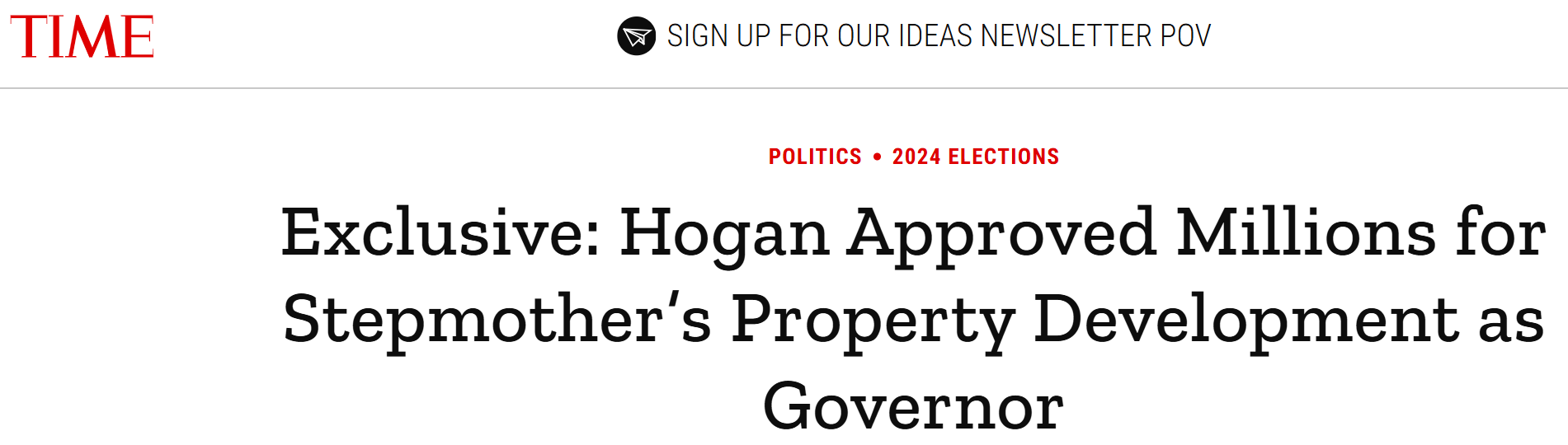
The pattern did not stop with outside clients. Reporting has since documented how Hogan approved major public subsidies that directly enhanced his own family’s bottom line. In one Frederick County case, he green‑lit $15 million in low‑income housing tax credits for a project built partly on land owned by his father and stepmother, a parcel they had bought for around $230,000 and later sold to a Hogan‑firm client‑developer for $3.75 million.[11][14]
Separate investigations into his transportation program showed the same logic playing out on highways and interchanges. Road projects Hogan championed—like a $58 million interchange in Brandywine and other improvements in Prince George’s County and Hyattsville—lined up neatly with areas where his company listed or later sold properties, and where he reported large capital gains after leaving office.[10][14] Critics argue that canceling Baltimore’s Red Line only to plow the state share of that money into suburban road work amounted to a vast transfer of resources from transit‑dependent urban communities to land‑rich suburbs where Hogan’s own business interests stood to benefit.[10]
The Hogan Loophole, Closed—Too Late
For years, defenders fell back on the same line: none of this was technically illegal. Maryland’s ethics rules were vague and built on trust, not enforcement. But the cumulative weight of the wetlands license, the client‑developer subsidies, the family land deal, and the transportation map finally forced Annapolis to admit the obvious—what Hogan did should never be allowed again.[11][15]
In 2025, Delegate Marc Korman pushed House Bill 932, a sweeping ethics reform aimed squarely at the kind of conflicts Hogan normalized.[16][17] The new law requires governors to:
- Divest or place their business holdings into a certified blind trust within a set window after taking office.
- Sign binding non‑participation agreements covering any remaining interests.
- Bar state funds from flowing to companies in which the governor has an undisclosed stake, with new disclosure duties for firms seeking state money.[16][17]
Korman and his allies have said bluntly that investigative reporting—including a series of pieces in Washington Monthly and TIME—was the spark for reform, exposing how Hogan approved millions in public benefits for firms listed as his clients and for property owned by his own family.[10][11][13] Governor Wes Moore, in contrast, had already placed his assets in a blind trust voluntarily—proof that the bar for ethical behavior is not imaginary; it is a choice.[11]
What Four Seasons Really Tells Us
Seen in isolation, the Four Seasons wetlands license might look like a single bad call on a risky project in a fragile ecosystem. Put back into context, it becomes something more disturbing:
- A governor with deep ties to developers, warned explicitly about conflicts, whose administration still cleared a long‑blocked wetlands project pushed by one of those developers.
- A carefully timed absence that allowed a subordinate to cast the decisive vote while preserving the governor’s plausible deniability.
- A broader pattern in which state dollars, permits, and infrastructure kept landing near Hogan’s clients and even on his family’s land, while ordinary Marylanders were told there was no money for transit or other public needs.[10][12][14]
Maryland’s new ethics law is a quiet admission that the old system failed. It allowed a governor to stand astride both the real‑estate market and the state treasury, blurring the line between public service and private gain until watchdogs, activists, and reporters forced the issue into the open.[11][16] Four Seasons at Kent Island is not just a wetlands story. It is Exhibit A in a larger indictment: when the rules are written on the honor system, the public loses every time a politician decides his portfolio matters more than his oath.
Citations:
[1] Creating a Newsletter - GovDelivery https://marylandlibraries.libguides.com/c.php?g=1313931&p=9659731
[2] The Best 2853 Newsletter Email Examples & Designs in 2026 https://reallygoodemails.com/categories/newsletter
[3] How I Turn Email Newsletters Into Blog Posts | Step-by-Step Strategy
https://marylandlibraries.libguides.com/c.php?g=1313931&p=9659731
[4] About - The Maryland Wire - Substack https://themarylandwire.substack.com/about
[5] Archive - The Maryland Wire - Substack https://themarylandwire.substack.com/archive
[6] I launched Maryland Wire on Substack on June 28th, 2025, and ... https://www.facebook.com/groups/1434756060075833/posts/4234379226780155/
[7] Pages - 03.06.01.35.aspx - Maryland Division of State Documents https://dsd.maryland.gov/regulations/Pages/03.06.01.35.aspx
[8] Submitted Breach Notification Sample | State of California https://oag.ca.gov/ecrime/databreach/reports/sb24-556670
[9] Montgomery County, MD Weekly Media Briefing & Public ... - YouTube
[10] Hogan Approved Millions for His Firm’s Listed Clients as Governor https://time.com/7081664/exclusive-as-governor-larry-hogan-approved-millions-in-awards-to-his-firms-clients/
[11] After Hogan Controversy, Maryland Passes New Ethics Law | TIME https://time.com/7283708/after-hogan-controversy-maryland-passes-new-ethics-law/
[12] Board grants controversial wetlands license to Kent Island developer https://cnsmaryland.org/2015/11/18/board-grants-controversial-wetlands-license-to-kent-island-developer/
[13] “Time Magazine Exposé on Larry Hogan May Be More Than ‘Flash ... https://mddems.org/news/time-magazine-expose-on-larry-hogan-may-be-more-than-flash-in-the-pan-expert-says-wtop/
[14] Gov. Hogan Approved Millions for Family Property Development https://time.com/7094238/larry-hogan-stepmother-property-development-exclusive/
[15] Lawmakers “Seek Tighter Ethics Laws for Future Governors ... https://mddems.org/news/lawmakers-seek-tighter-ethics-laws-for-future-governors-following-reports-that-hogan-funneled-millions-to-business-partners-washington-post/
[16] [PDF] HB0932 Public Ethics - Conflicts of Interest and B - Maryland https://mgaleg.maryland.gov/cmte_testimony/2025/ent/26977_02252025_15322-647.pdf
[17] [PDF] Conflicts of Interest and Blind Trust – Governor (HB 932) - Maryland https://mgaleg.maryland.gov/cmte_testimony/2025/ent/1nl9S3dkFY3JH2-k4FkKglFOfqAmsOdDa.pdf


Thank you writing this up as many Marylanders have thougth for years he was so good for Maryland. They didn't look at the things that affected the environment and more. :)
Great article