

HoCo: The Prince of Darkness vs. The Teacher Next Door
By Barry O’Connell
There is an old rule in politics:
When voters stop arguing about policy and start arguing about character, the race has already changed.
That appears to be exactly what is happening in the Howard County District 2 council race between political operative Arinze Ifekauche and public school teacher Jessica Nichols.
What should have been a routine Democratic primary centered on schools, development, traffic, and affordability has instead become something far uglier: a referendum on temperament, ego, and whether cruelty now passes for strategy in local politics.
And increasingly, many Howard County Democrats appear uncomfortable with the answer.
The Old Navy Moment
The turning point may have come over something so absurd that nobody outside politics would believe it mattered.
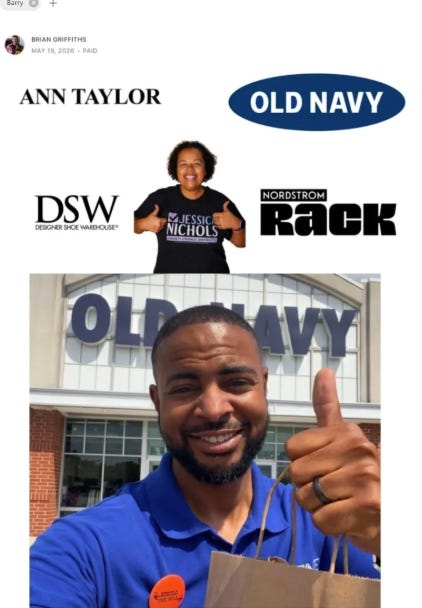
Jessica Nichols purchased clothing for campaign appearances and advertising. A blazer. Professional attire. The sort of ordinary campaign expense candidates make every election cycle without controversy.
But Arinze Ifekauche and his allies attempted to transform the purchase into scandal material.
A story surfaced portraying the expenditures as a “shopping spree.” Then, in a move that stunned even seasoned local observers, Ifekauche posed for a photograph inside an Old Navy store and made it his Facebook profile picture.
That image quickly became symbolic of the race itself.
To supporters of Nichols, it looked less like political messaging and more like a man publicly humiliating a school teacher for trying to look professional while running for office.
And once voters begin seeing a candidate as mean-spirited rather than strong, campaigns can deteriorate quickly.
The Money Game
The financial attacks followed the same pattern.
Ifekauche loaned approximately $36,000 to his own campaign and then publicly declared that he had “won the money game.”
The problem is that subsequent campaign finance reports told a different story.
Nichols ultimately reported substantially more cash on hand than Ifekauche despite lacking the ability to personally inject tens of thousands of dollars into her campaign.
That contrast reinforced the larger narrative already forming around the race.
Jessica Nichols looks like a grassroots candidate.
Arinze Ifekauche looks like an insider candidate.
And in Howard County Democratic politics, those labels matter.
Two Different Worlds
Jessica Nichols comes into the race with the profile of exactly the kind of candidate suburban Democrats traditionally admire.
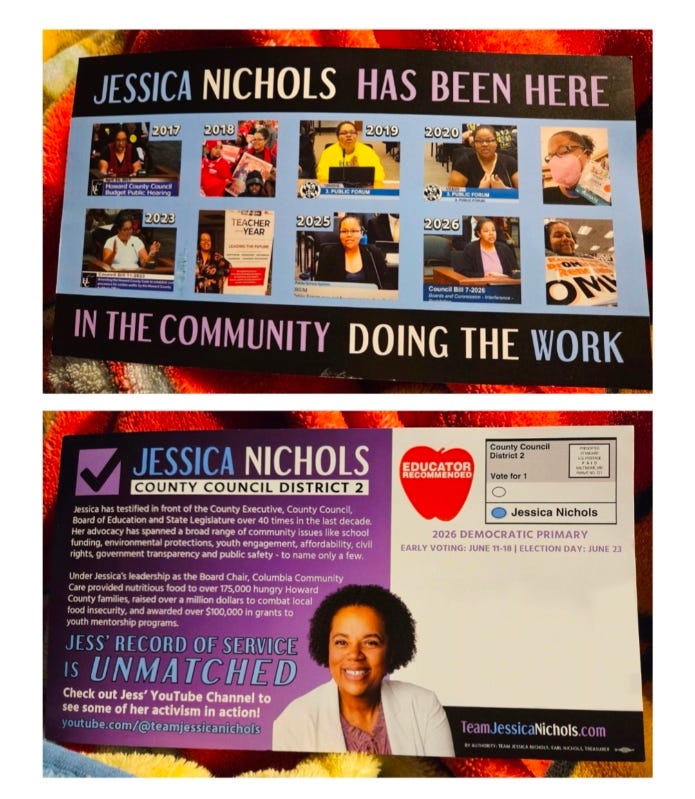
She is a National Board Certified public school teacher. She has spent years testifying before county government. She has been deeply involved in community advocacy and civic life long before becoming a candidate.
Her endorsements reflect that background: educators, labor organizations, Moms Demand Action, environmental groups, and local Democratic clubs.
Supporters describe her as earnest, approachable, and relentless.
Her personal story also resonates with many voters.
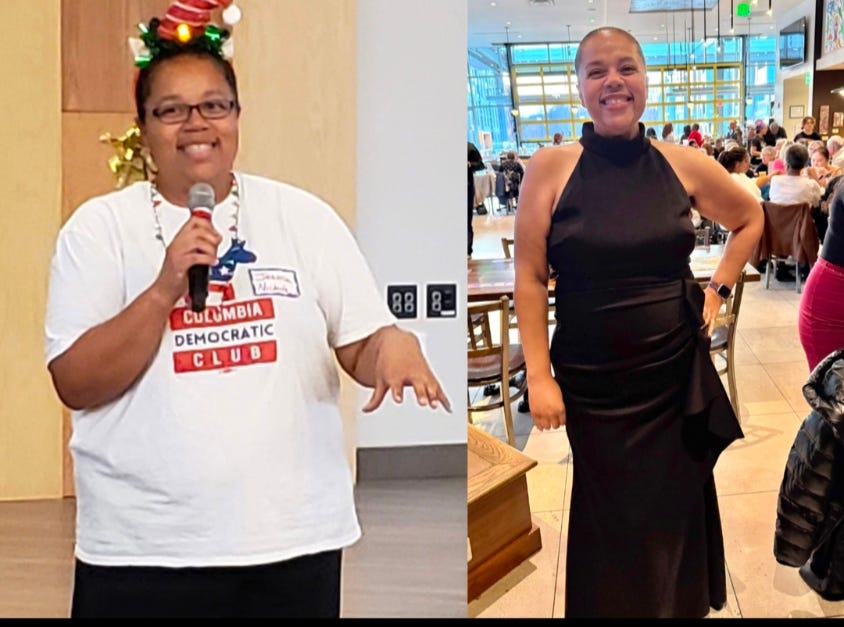
Nichols has spoken openly about growing up food and housing insecure in Texas. During the stress of the campaign, while continuing to teach full-time and coach speech and debate, she reportedly lost nearly 100 pounds.
At the same time, her husband was laid off from work.
Yet friends say she never publicly complained, never sought sympathy, and simply kept teaching and campaigning.
Ifekauche represents a very different political archetype.
He is widely known as a political consultant and strategist. Supporters describe him as polished, media savvy, and highly ambitious. He runs the Kappa League mentorship program and teaches Sunday school, accomplishments his allies point to as evidence of community leadership and mentorship.
But critics increasingly argue that his campaign tactics have overshadowed those accomplishments.
The Special Interests Argument
The contradiction generating the most quiet discussion inside Democratic circles involves Ifekauche’s repeated attacks accusing Nichols of being tied to “special interests.”
Because many voters immediately note something obvious:
Ifekauche’s wife works as a lobbyist at Cornerstone Government Affairs, one of the most influential lobbying and government affairs firms in the country.
That reality has complicated his outsider message.
Critics increasingly ask how a candidate can portray himself as fighting insider influence while simultaneously benefiting from one of the most politically connected professional networks in Maryland politics.
Fair or unfair, the contradiction has become part of the race itself.
The Bigger Problem
Ultimately, this election may have less to do with ideology than personality.
Howard County Democrats are not allergic to aggressive politics. But they generally expect campaigns to maintain a certain level of professionalism and restraint.
Increasingly, this race feels less like a disagreement over policy and more like a clash between two visions of public life.
One candidate comes across as a teacher and community advocate who spent years doing the work before seeking office.
The other increasingly appears to many voters as a political consultant who believes humiliation is an acceptable campaign tactic.
And that distinction may decide the election.
Because in the end, voters may not remember every endorsement or campaign filing.
But they probably will remember this:
Jessica Nichols bought a blazer.
Arinze Ifekauche bought himself a mirror.
And voters are still deciding which image disturbed them more.
So she works full time as a teacher AND she is running for office. That tells me she is a hard working individual. Teaching is a difficult job that requires diplomacy, perseverance, and unending energy. I prefer representation by someone who knows what it's like to work hard for a middle class salary. The fact that she is being attacked for buying professional clothing appropriate for the job for which she aspires tells me more about the attacker than it tells me about her.
Clothing is not an ordinary campaign expense.
Having approval from the state board is an important point to cover. Her campaign manager says the campaign got permission, but the Baltimore Sun didn’t cover this aspect well so I’m not sure what the actual story is there.
I know that’s not the real point of your post, but it does matter.