

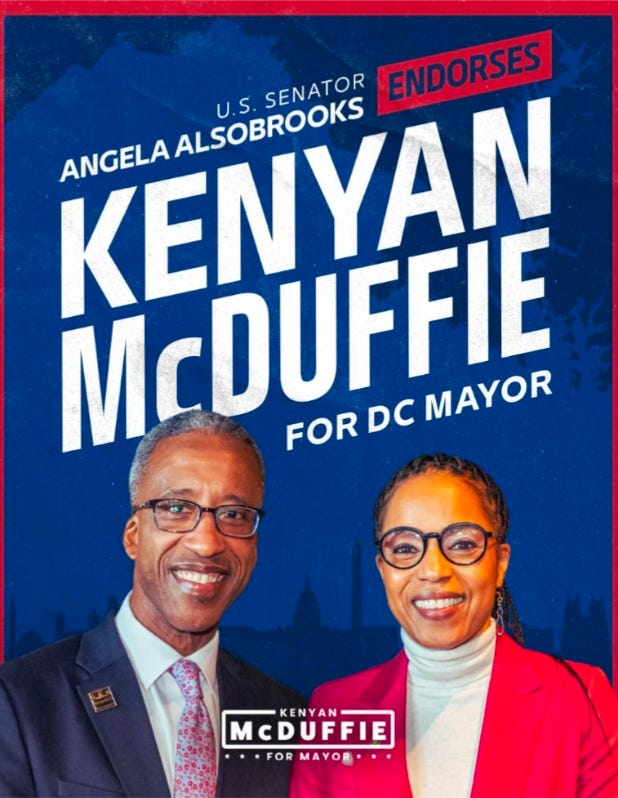
Hate Has No Place in DC — And Voters Deserve Straight Answers
In the middle of a mayoral race that should be about competence, safety, and the future of Washington, an unexpected issue has forced its way into the conversation: whether candidates for the city’s highest office are willing to meet with mainstream Jewish organizations.
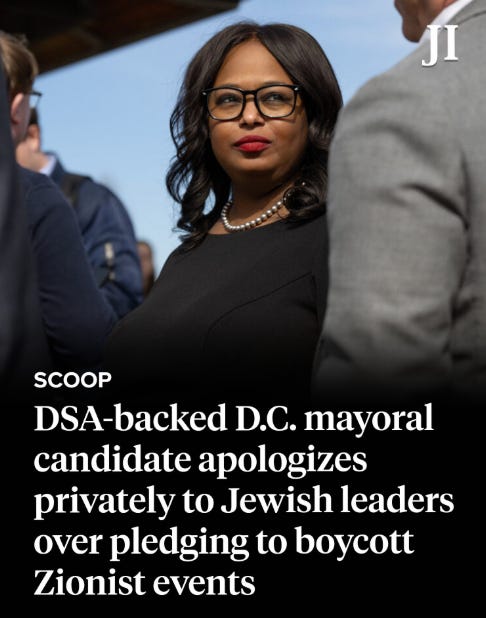
Recent reporting revealed that one major candidate, Janeese Lewis George, signed a pledge committing to avoid events “promoting Zionism” and to refuse engagement with certain “Zionist lobby groups.” In practice, that language sweeps in the majority of Jewish civic institutions in Washington, DC — synagogues, community centers, advocacy groups, and long‑standing neighborhood organizations.
Jewish leaders across the city saw this for what it was: a functional boycott of Jewish communal life, justified under the banner of anti‑Zionism.
She apologized privately, blamed staff, but has not publicly corrected or disavowed the pledge.
That’s the backdrop for Kenyan McDuffie’s letter this week — a letter that didn’t name names but didn’t need to. His message was unmistakable: no candidate for mayor should be cutting deals that shut out entire communities.
And he’s right.
This Isn’t About Foreign Policy — It’s About Who Counts as a Neighbor
There is a growing trend on the far left to treat Jewish civic organizations as politically radioactive unless they pass a purity test on Israel. That is not principled foreign‑policy debate. That is collective punishment of American Jews for the actions of a foreign government.
I say this as someone who has been clear about my own position:
I support the nation‑state of Israel. I do not support Benjamin Netanyahu.
I think his leadership has been damaging to Israel’s long‑term security and moral standing.
But loving a country while objecting to its leadership is not hypocrisy.
It’s the same way I love the United States while rejecting the direction Donald Trump has taken it.
If I can hold that distinction, so can anyone running for mayor of Washington, DC.
What you cannot do — what no serious candidate should do — is declare that because you oppose a foreign leader, you will refuse to meet with American Jews who have nothing to do with that leader’s decisions.
That’s not foreign‑policy critique.
That’s exclusion.
McDuffie Chose the Harder, Better Path
McDuffie’s statement wasn’t just boilerplate “unity” language. It was a deliberate choice to draw a moral line:
- No antisemitism.
- No Islamophobia.
- No racism.
- No sexism.
- No shutting out communities for political convenience.
He framed the mayor’s job the way it should be framed: as a steward of pluralism, someone who shows up for every community even when it’s uncomfortable.
That’s leadership.
The Stakes Are Bigger Than This Race
This controversy is not an isolated DC squabble. It reflects a broader drift in parts of the socialist movement — a willingness to collapse Jewish identity into geopolitical grievance, to treat Jewish institutions as suspect unless they renounce Israel entirely.
That’s not progressivism.
That’s not solidarity.
And it’s not something Washington should normalize.
McDuffie’s letter is a reminder that the city doesn’t have to go down that road.
We can debate policy without boycotting our neighbors.
We can criticize governments without excluding entire communities.
We can build a city where every resident — Jewish, Muslim, Black, white, immigrant, native Washingtonian — is treated as a full participant in civic life.
That’s the standard McDuffie set.
And it’s the standard voters deserve.