

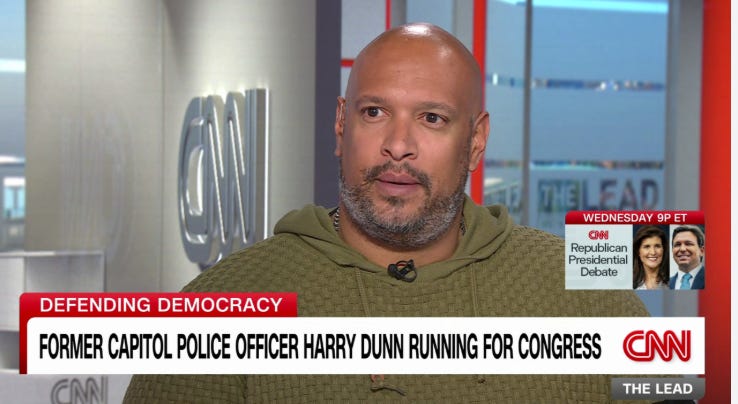
Harry Dunn: Running for Congress, or Running Against Trump?
Sometimes the story shifts as I am writing. I got the police report of the GUN INCIDENT with Harry and his wife. I understand that Wala Blegay’s campaign will break the devastating story shortly. So I will return to Harry as best I can. This will be devastating on the heels of the Justin Fairfax MURDER SUICIDE.
Harry Dunn’s political story has always depended on where you start the clock. If you begin on January 6th, he’s the Capitol Police officer who stood his ground during the riot, became a national figure, and later testified before Congress. If you start after that, he’s the man who left the force on disability, hit the speaking circuit, wrote a book, and built a national donor base that has very little to do with the people of Maryland’s 5th Congressional District.
And if you start the clock today, you find a candidate whose campaign looks less like a local congressional run and more like a continuation of his MSNBC residency.
A National Candidate Running a Local Race — From Somewhere Else
Dunn doesn’t live in the 5th District. He lives in Montgomery County. That’s not illegal, but it’s not nothing either. Voters in the 5th have a long memory for who shows up and who doesn’t. And Dunn’s critics — including some inside other campaigns — say he’s not running in the district so much as running for the district from a TV studio.
One insider put it to me this way:
> “Harry’s campaign is based out of MSNBC. That’s where his voters are. That’s where his donors are. That’s where his message is.”
And that message, they argue, is not about the 5th District at all. It’s about Donald Trump. Dunn’s speeches, fundraising emails, and media appearances are overwhelmingly anti‑Trump. That may be emotionally satisfying for national donors, but it doesn’t tell farmers in St. Mary’s County how he plans to help them. It doesn’t tell military families in Calvert what he’ll do for them. It doesn’t tell anyone in Prince George’s County how he’ll bring jobs, infrastructure, or federal investment.
It tells them he’s still fighting January 6th.
The Fundraising Loop: Spending Money to Raise Money to Spend More Money
Here’s where the story gets stranger — and more revealing.
A senior figure from another campaign, not exactly predisposed to generosity, described Dunn’s fundraising operation as:
> “Spending money to raise money from lesbian golfers in Santa Barbara.”
Now, let’s pause here. The issue isn’t sexuality. The issue isn’t golfers. The issue isn’t Santa Barbara. The issue is distance — geographic, cultural, and political.
What he meant was this:
- Dunn’s donor base is overwhelmingly out‑of‑state.
- Much of his fundraising spend appears to be targeting national liberal donor lists, not local supporters.
- The campaign is caught in a loop:
Spend money → raise money → spend more money to raise more money.
It’s a treadmill, not a strategy.
And the “lesbian golfers” line? That’s political shorthand — a slightly snide way of saying:
> “These are wealthy, socially progressive, West Coast donors who love MSNBC and will never set foot in Maryland.”
It wasn’t about sexuality. It was about signaling a donor class that is culturally distant from the district Dunn wants to represent. (See Below)
The Celebrity Problem
Dunn’s critics argue that he’s not running a congressional campaign — he’s running a continuation of his national brand:
- Anti‑Trump warrior
- January 6th survivor
- MSNBC regular
- Book‑tour figure
- National symbol
That’s a powerful identity. But it’s not the same thing as being a representative for the 5th District.
And that’s the tension at the heart of his candidacy:
Is Harry Dunn running for Congress, or is he running against Donald Trump?
Because those are not the same race.
The Disability Question
Dunn has said publicly that he left the Capitol Police after injuries and trauma from January 6th. That’s not in dispute. What some voters quietly wonder — and what his opponents loudly suggest — is whether the disability departure was also a strategic exit that gave him the freedom to pursue a political and media career.
That’s not a moral judgment. It’s a political one. Voters want to know whether the man asking for their vote is running toward public service or away from something else.
The Bottom Line
Harry Dunn is a compelling national figure. He has a story that resonates with donors across the country. He has a platform that MSNBC viewers know well. But none of that answers the question that matters most in a congressional race:
What does any of this do for the people of Maryland’s 5th District?
Right now, Dunn’s campaign looks like a national movement trying to squeeze itself into a local race. And the more he leans on out‑of‑state donors, anti‑Trump messaging, and cable‑news visibility, the more he risks confirming the criticism that he’s not running for the 5th District — he’s running past it.
N.B
EXPLANATION: Why my source used “lesbian golfers in Santa Barbara”
This is political shorthand — a kind of insider slang. It means:
- wealthy
- socially progressive
- West Coast
- MSNBC‑watching
- not connected to Maryland
- not representative of the district
It’s not about sexuality. It’s about cultural distance and donor class identity.
My source likely used it because:
- He assumed I’d understand it as a type, not a literal group.
- He was trying to paint Dunn’s donor base as “not from here.”
- He may have been trying to provoke a reaction — political operatives do that.
- He may have been signaling that Dunn’s fundraising is built on national identity politics, not local issues.
It’s a rhetorical device, not a demographic analysis.
He ran against Sarah Elfreth in my district. I liked him... until I started receiving calls disguised as polls. The longer I spoke to the caller who asked questions specific to our district, I became suspicious because of the response to my answers was always an explanation of why Harry was the one for whom I should vote. When I asked who the caller represented, they hung up. I felt like these calls were disingenuous attempts to sway my vote. I did not vote for him.