

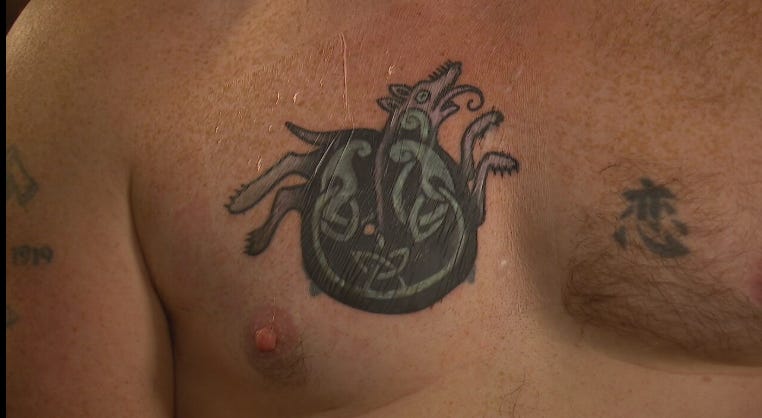
THE CONVENIENT OUTRAGE
What a Skull Tattoo, a GOP Operative, and a Media Panic Reveal About Our 2028 Blind Spots
I. THE REAL STAKES
- This isn’t about Graham Platner.
- This isn’t about one tattoo.
- This isn’t about one ex‑girlfriend.
This is about 2028.
And if we don’t start understanding the cultural divide inside our own country — and inside our own party — we are going to walk straight into another loss while telling ourselves it was impossible.
Too many Democrats in the Acela corridor are already humming the “Blue Wave” lullaby.
It’s soothing.
It’s familiar.
And it’s dangerous.
Because the country is not Potomac.
The country is not Chevy Chase, Woodmore, Mitchelville, Gibson Island, or even Columbia .
The country is not the narrow strips of blue on the coasts.
If we forget that, we lose.
II. THE BREAKUP STORY THAT BECAME A NATIONAL MORAL PANIC
Let’s lay out the facts without the hysteria:
- A Republican messaging operative
- An old relationship
- A Democratic candidate
- A tattoo
- A media ecosystem hungry for a clean villain
That’s the whole story.
And anyone who has lived long enough to survive a few breakups knows how memory works.
I married at 33, divorced at 36, dated again.
Some women remember me fondly.
Some remember me as the villain.
Neither version is the whole truth.
Graham Platner is living the same dynamic.
That’s not scandal — that’s adulthood.
But when a GOP operative with emotional history and political incentives suddenly becomes the moral authority on a tattoo?
We should at least pause.
III. THE TATTOO ITSELF: SYMBOL OR RORSCHACH?
Here’s the part the media refuses to say out loud:
- A smiling skull is not automatically a hate symbol.
- The Totenkopf was a military insignia, not the Nazi Party emblem.
- Tens of thousands of young men have skull tattoos.
- Most of them are not extremists.
But in certain ZIP codes — the ones with Whole Foods density and median incomes north of $200k — the instinct is to treat every skull as a confession.
That instinct does not exist in most of America.
And if we don’t understand that difference, we will keep losing elections we should win.
IV. HOW WOULD SHE EVEN RECOGNIZE IT?
This is not about accusing anyone of extremism.
It’s about understanding context.
The average young woman does not know SS iconography.
Why would she?
But a Republican messaging operative?
She spends her days immersed in:
- political iconography
- extremist‑adjacent imagery
- opposition research
- culture‑war symbolism
Not because she believes in it — but because that’s the job.
So yes, she is far more likely than the average person to recognize a symbol that most people would dismiss as “just a skull.”
And she is far more incentivized than the average person to weaponize it.
That’s not slander.
That’s structural analysis.
V. THE CULTURAL LINE THAT RUNS THROUGH AMERICA
When I was buying media in Pennsylvania, there was a literal cultural border — a line that ran from Red Rock down through Carroll County and into Virginia.
East of that line:
- more liberal
- more educated
- more affluent
- more cosmopolitan
- more likely to see New York as “the city”
West of that line:
- more rural
- more working‑class
- more veteran‑heavy
- more culturally conservative
- more economically constrained
Neither side is wrong.
Neither side is immoral.
They are simply different Americas.
And Democrats forget this at their peril.
What feels rational in Potomoc can feel alien in Hagerstown.
What feels obvious in Chevy Chase can feel insulting on the Eastern Shore.
What feels like moral clarity in Montgomery County can feel like cultural contempt in Western Maryland.
If we don’t understand that, we will not win in 2028.
VI. THE VETERAN QUESTION
We don’t get a lot of young combat veterans coming out of certain neighborhoods.
That’s not a criticism — it’s a demographic fact.
So should the neighborhoods that have never sent a son or daughter into uniform get to decide what symbols are acceptable for the men who did?
Should the people who never served get to police the culture of those who did?
Should the elite moral vocabulary of the coasts dictate the meaning of a tattoo worn by a Marine?
These are not rhetorical questions.
They are the fault lines of 2028.
VII. THE REAL STORY
We don’t know:
- that the tattoo is a Totenkopf
- that he knew what it meant
- that she recognized it on her own
- that her motives are pure
- that her memory is accurate
What we do know:
- She had emotional motive.
- She had political motive.
- She had financial motive.
- She had professional motive.
- She had ideological motive.
And the media had every motive to believe her.
This isn’t about Graham Platner.
This isn’t about one tattoo.
This isn’t even about one ex‑girlfriend.
This is about whether Democrats are willing to understand the country we’re trying to win — or whether we’re going to keep losing it while congratulating ourselves on our moral clarity.
Good points. But what I'm most concerned about is getting another John Fetterman. That is, someone who changes their entire political philosophy and betrays his supporters, possibly because the GOP is blackmailing him about something in his past or background. This lack of total transparency is a critical risk to me about Platner until he comes totally clean.