

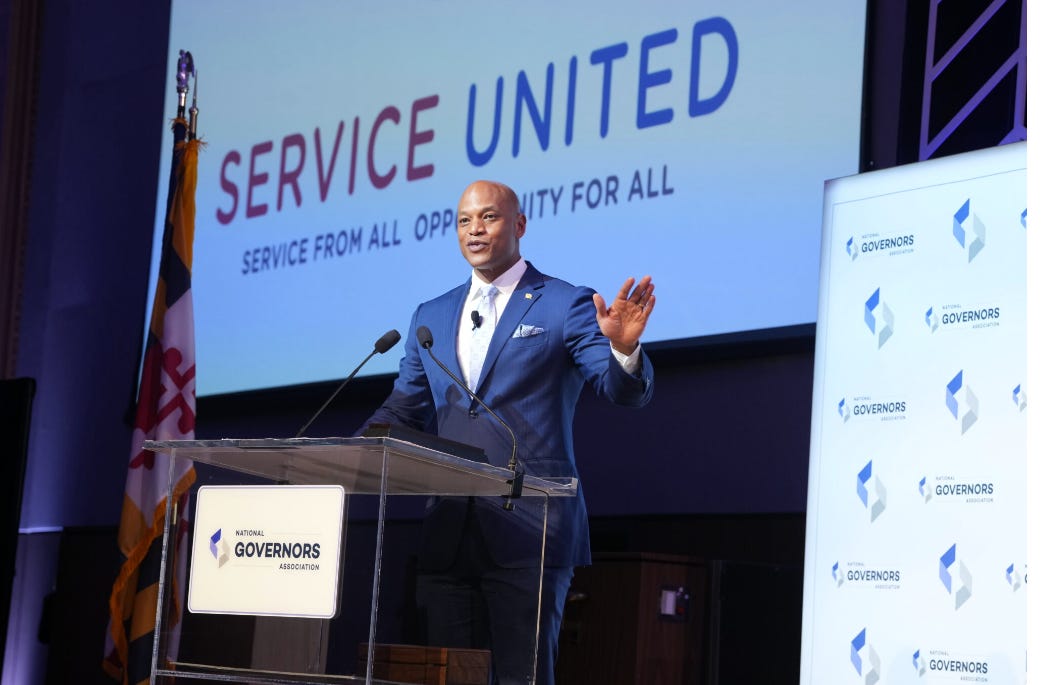
The Gap Year That Pays: What Wes Moore’s New Push Means for Kids We Know
While the political headlines this week were dominated by redistricting fights and horse racing schedules, Governor Wes Moore launched an initiative as the new Chair of the National Governors Association that deserves a closer look from families across Maryland.
It builds on a program Maryland quietly pioneered last year: the Service Year Option. Now, backed by $10 million in philanthropic funding, Moore is trying to export Maryland’s model nationwide under the moniker "Service United."
Strip away the statehouse buzzwords, and the concept is straightforward: a state-supported, paid gap year for young adults ages 18 to 21.
For parents, grandparents, and neighbors watching high school seniors or young adults figure out their next steps, here is what this actually means on the ground.
1. Real Options for Kids Who Aren't Ready for a Four-Year Degree
We all know bright young adults who finish high school unsure of their path. Maybe they aren't ready to take on thousands in college debt, or maybe four more years in a traditional classroom feels like the wrong fit.
Instead of drifting into low-wage, dead-end jobs, the program offers a structured year working directly in local communities—tutoring in schools, supporting local health clinics, working on conservation projects, or helping municipal agencies.
2. Paychecks and a Financial Head Start
This isn't an unpaid internship for kids who can afford to work for free. Participants receive:
A liveable hourly wage: At least $15 an hour for 30–40 hours a week.
A completion stipend: An extra $6,000 cash award at the end of the year, earmarked for tuition or to launch a career.
Mentorship and skills training: Dedicated career coaching throughout the 9-month placement.
For a 19-year-old, walking away after nine months with real work experience, a professional reference, and $6,000 toward community college, trade school, or tools for a trade changes the math entirely.
3. A Practical Alternative to the "College or Bust" Pressure
For decades, the cultural message to young people has been binary: go directly to a four-year college or fall behind. But with rising tuition costs and growing skepticism about degree returns, families are looking for practical off-ramps.
A structured service year gives young adults a low-risk environment to build discipline, test out career fields, and figure out what they actually like doing before spending a dime on higher education.
4. Stronger Local Communities
The work doesn't happen in a vacuum. Participants are placed directly inside Maryland non-profits, school districts, and community groups that are already stretched thin. It puts young energy directly into local neighborhoods—whether that's helping senior centers, clearing parks, or supporting youth programs.
The Takeaway
Politics aside, the question facing every community is simple: How do we help the next generation get on their feet without burying them in debt?
Whether "Service United" succeeds nationally remains to be seen, but for families right here in Maryland, the underlying program is already live. If you have a child, grandchild, or neighbor in that 18-to-21 window who is looking for direction, it’s worth a look.
Thank you for posting Barry. I did an estimate of how many young people could be given that opportunity with that $10M bucket How will the bucket get bigger or continue? The math says that $10M would benefit between 250-275 students in a 40 hr week position at $15/hour, including taxes and the $6K benefit at the end... give or take. Is there a plan for how those students will be chosen? It sound like a truly innovative and fantastic progam... just curious how it will play out and be sustained?...